Blackmagic Micro Converter Review: Compact Yet Picky
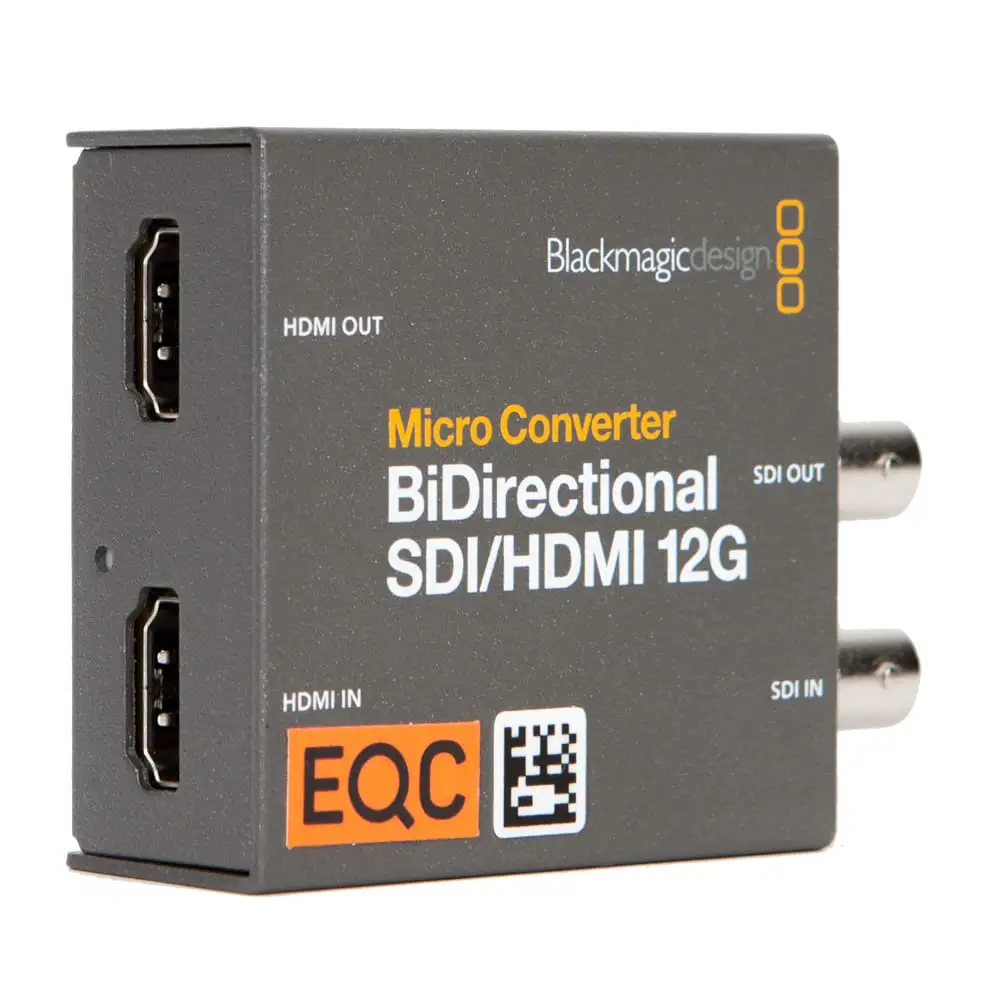
A Reddit user testing the Blackmagic Micro Converter BiDirect SDI/HDMI 3G with a Datavideo SE-1200 mixer summed it up bluntly: “SDI to HDMI works fine, but HDMI to SDI doesn’t.” On paper, this is “the world’s smallest bidirectional broadcast quality converter” with glowing 4.8-star ratings on Amazon, but digging deeper reveals that its real-world versatility hinges on compatibility and signal formats. Verdict: 8.2/10 — an excellent compact converter, but unforgiving with unsupported gear or mismatched resolutions.
Quick Verdict: Conditional Buy
| Pros | Cons |
|---|---|
| Tiny, rugged design ideal for mobile rigs | Limited by HD-SDI-only hardware compatibility |
| True simultaneous SDI↔HDMI conversion | No firmware downgrade option for some legacy workflows |
| Camera control protocol support for BMD Pocket Cinema Cameras | HDMI→SDI path fails with certain mixers at 1080p60 |
| Strong build with broadcast-grade components | Resets camera color settings on reboot during remote control |
| USB-C power with international AC adapter | EDID behavior can force unsupported resolutions |
| Format auto-detection | No workaround for signal output behavior when camera is off |
Claims vs Reality
Marketing promises that the unit “converts SDI to HDMI and HDMI to SDI, even in different formats” with automatic format matching. While that’s true in isolation, multiple Reddit and Trustpilot accounts describe scenarios where HDMI-to-SDI fails on certain mixers. Reddit user xtree mtec explained, “Your mixer does not support 3G. Only up to HD-SDI which is a maximum of 1080i50… 1080p60 won’t work as it is 3G-SDI.”
Another claim is “camera control protocol allowing Blackmagic Pocket Cinema Cameras to work with SDI switchers.” A Trustpilot account confirmed remote color correction with an ATEM Television Studio Pro 4K, but also found “some resolutions on the 6K were greyed out and not selectable… changing back to the old model fixed the issue.” The reason, according to Australian BMD tech support, is that ATEM’s control forces certain codecs and frame rates—restrictions that aren’t obvious from the marketing copy.
Finally, Blackmagic promotes “broadcast-grade signal processing with low SDI jitter for long cable runs.” No user disputes this outright; in fact, those using it in live production setups report rock-solid SDI outputs, especially when powered via USB from the device it’s feeding.
Cross-Platform Consensus
Universally Praised
Compactness and portability are repeatedly hailed. Sweetwater calls it “quite possibly the smallest bidirectional broadcast-grade converter ever made,” and pros like event videographers love that it fits into tight rigs. Its rugged metal housing wins points from those who transport gear often—eBay listings emphasize “new, unused” condition and high resale turnover, suggesting they hold up physically.
USB-C power is a quality-of-life win for mobile crews. A verified buyer on Amazon noted: “I powered it directly from my laptop during a livestream; no AC outlet nearby, flawless.” This flexibility in power sourcing—from televisions, laptops, or power banks—gives professionals and hobbyists alike a wider range of deployment scenarios.
For Blackmagic Pocket Cinema Camera owners, the camera control protocol is the standout: enabling tally lights, remote color tweaks, and recording triggers via SDI mixers. A Trustpilot reviewer said, “It worked… remote colour correction from the switcher to the 6K,” which eliminates the friction of separate control cables.
Common Complaints
HDMI→SDI conversion failures are the most repeated frustration. When firmware versions are above 7.2, some users report incompatible handshake behavior. Reddit accounts point to “different EDID table” between the bidirectional and unidirectional HDMI→SDI models, meaning laptops default to the highest possible resolution—even if the mixer can’t handle it. That forces manual matching of frame rate and resolution at both ends, an extra technical step novices may stumble over.
Another trustpitfall: remote control quirks. The Trustpilot user abandoned 6K remote control entirely because “the ‘feature’ that the ATEM seems to reset the colour settings on the 6K back to default whenever the camera is rebooted… volunteers aren’t good at regrading, so it’s not worth it.” That’s a silent workflow hazard for teams that rely on consistent camera profiles.
Finally, powering down connected devices alters signal flow unexpectedly. Trustpilot flagged “issue of the converter sending the SDI in signal out the SDI out when the 6K is switched off,” an unusual behavior that can disrupt live chain setups.
Divisive Features
Format auto-detection delighted some, but annoyed others. It’s fast and accurate for SDI inputs, but forces less flexible HDMI sources into resolutions that certain downstream gear can’t process. While a live production enthusiast might appreciate EDID-driven negotiation, a fixed studio with legacy mixers finds it unpredictable.
Camera control is also polarizing. For solo operators, it’s a godsend. In multi-operator environments, automatic codec/frame rate enforcement (and inability to choose ProRes) is viewed as an artificial limitation.
Trust & Reliability
Scam concerns are minimal—most Trustpilot reports focus on technical quirks, not transaction issues. Blackmagic’s tech support through New Magic Australia gets repeated praise: “Absolutely great… explained exactly why resolutions were greyed out.” This suggests strong post-sale service, especially for complex multi-device setups.
Longevity is promising. Users report older Micro Converter models still functioning smoothly, which is why changes in newer models’ behavior stand out. One Trustpilot post compared old vs new and found that the older unit allowed more display resolution flexibility, implying stable hardware design over time with changing firmware constraints.
Alternatives
While no competing brands dominate the gathered data, Decimator MD-LX and MD-HX converters pop up in eBay cross-listings, often marketed for similar bidirectional HDMI↔SDI roles. These alternatives offer scaling and frame rate conversion, possibly sidestepping EDID conflicts, but generally cost more and are bulkier.
Price & Value
Pricing is consistent: $79 new via Amazon, Sweetwater, and eBay with power supply. Pre-owned units sell in the $55–$70 range, and demand is steady—popular listings show “55 sold” on eBay for the 3G variant. Given the broadcast-grade build, they hold resale value well.
Buying tips from the community stress knowing your resolution and format needs before purchase. As Reddit user xtree mtec explained, “If you put the mixer in 720p60 you must set your laptop to the same resolution and frame rate otherwise it won’t work.”
FAQ
Q: Will it work with any SDI mixer?
A: No. It supports SD, HD, and 3G-SDI formats, but mixers limited to HD-SDI will fail with 3G signals like 1080p60. Ensure all connected devices share compatible formats.
Q: Can I downgrade firmware to restore compatibility?
A: Not on newer models. Users report no method to revert below certain firmware versions, which can affect workflows that relied on older EDID behavior.
Q: Does camera control lock my format settings?
A: Yes. When controlled via ATEM, the camera defaults to Blackmagic RAW and locks out certain frame rates/codecs, particularly at resolutions like 6K.
Q: Is simultaneous conversion really possible in live setups?
A: Yes—users have run SDI→HDMI and HDMI→SDI concurrently, even in different formats, but only when both ends’ gear fully supports those formats.
Q: Can it be powered without AC outlets?
A: Absolutely. USB-C power from laptops, televisions, or battery banks is a tested configuration in field use.
Final Verdict: Buy if you’re a mobile or live production operator using modern SDI gear or Blackmagic Pocket Cinema Cameras. Avoid if your chain includes older HD-SDI-only mixers or you need persistent camera color settings via remote control. Pro tip from community: Match all source and mixer formats before connecting—this tiny converter won’t correct your resolution mismatches for you.