Behringer ADA8200 Review: Budget ADAT Expansion Verdict
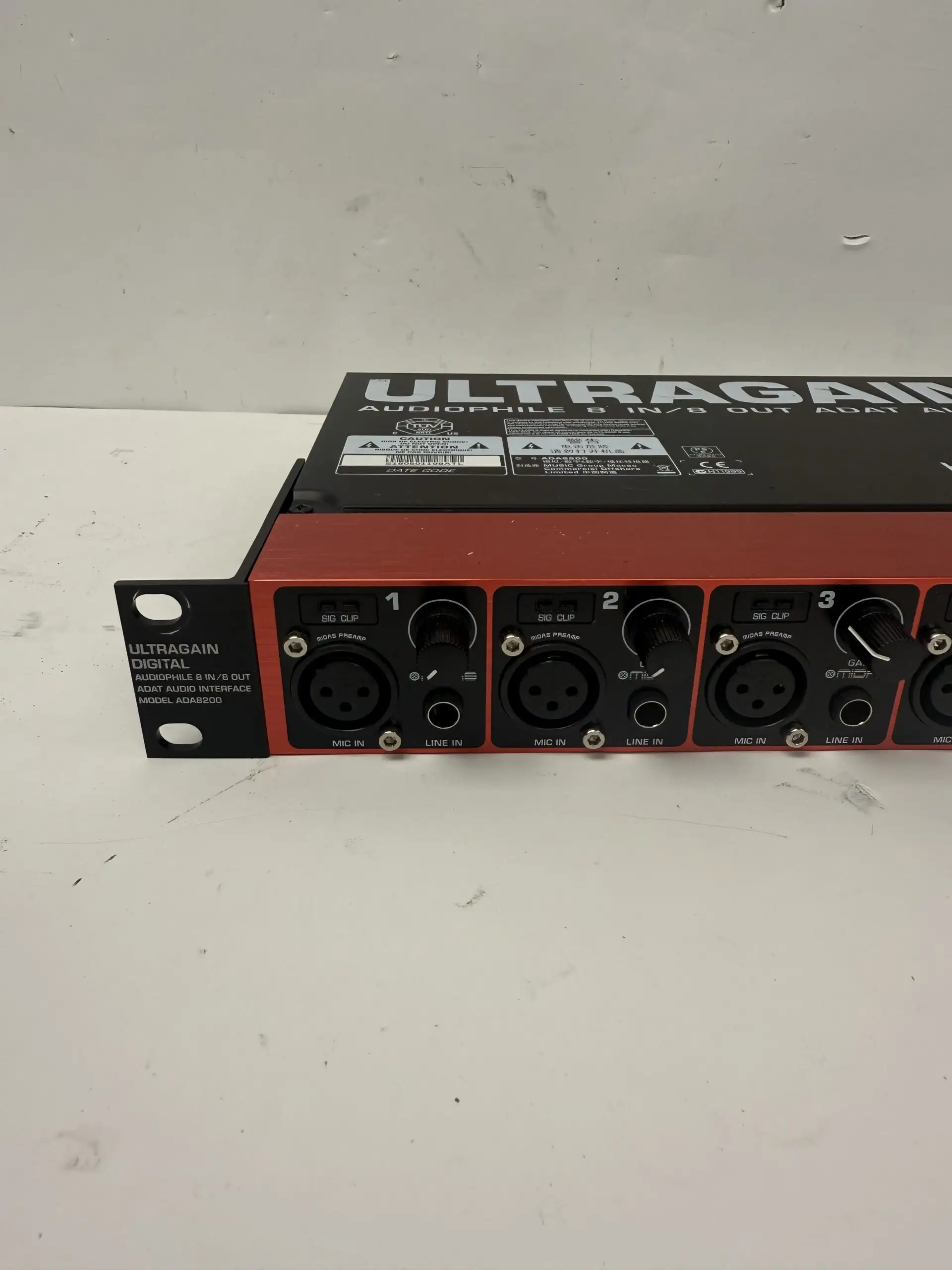
What shocked many engineers is how far a $229 rack unit could go — the Behringer ADA8200 Microphone Preamp regularly earns 8.5/10 from budget-focused studio owners, not because it rivals $3,000 converters, but because it solves the “I just need eight more inputs” problem without falling apart sonically. One Reddit user summed it up: “No‑brainer if you’re short on money and need more I/O.” Universal praise surrounds its Midas‑designed preamps and Cirrus Logic conversion for the price, but nuanced reports reveal quirks in gain range, occasional hum, and crosstalk depending on use case.
Quick Verdict: Conditional
| Pros | Cons |
|---|---|
| Very affordable 8‑channel ADAT expansion | Gain range feels less than claimed +60 dB |
| Clean, quiet Midas‑designed preamps | Fairly bad crosstalk when mixing dissimilar sources |
| Reliable syncing with most interfaces | Build feels light; front‑panel connections can clutter |
| Dual A/D and D/A functionality | No bypass for converters to use direct outs |
| Runs cooler than older ADA8000 | Phantom power LED colors counterintuitive |
| Widely available used at low price | Occasional hum and power supply issues over time |
Claims vs Reality
Marketing leans hard on the Midas mic preamps and reference‑class Cirrus Logic 24‑bit converters. Behringer claims “clean, clear sound through the entire signal path” with up to +60 dB gain. Digging into user reports, the gain claim is contested. On Gearspace, one owner noted, “There’s just no way the ADA8200 preamps are the claimed +60 dB… same mic into a decent pre will sound much hotter.” For typical instruments, the range is fine, but quiet dialogue or ribbon mics may disappoint.
The ADA8200 is also promoted as a faithful successor to the ADA8000 with cooler running switch‑mode power and better sync stability. Multiple long‑time owners do back this up — “Runs way cooler than the older 8000… seems to clock and stay in sync better,” posted one Redditor. However, “better” doesn’t mean faultless; some still encounter sync quirks requiring flipping the rear switch between master/slave modes to lock properly.
Lastly, Behringer markets “virtually pristine performance at 44.1 or 48 kHz,” implying studio‑grade transparency. While no one accuses it of sounding bad for the price, ReverbZone reviewers note it doesn’t match truly high‑end converters in depth. One buyer explained, “There are arguably cleaner pres around, but not at this price point and channel count.” The ADA8200 rarely offends ears but also doesn’t magically lift mixes into boutique territory.
Cross‑Platform Consensus
Universally Praised
Budget‑minded engineers appreciate how it expands ADAT connectivity without straining finances. A verified buyer on Amazon noted: “Hardest part was routing the cable — DAW now had 16 channels and awesome sound reproduction quality.” Midas preamps receive consistent compliments for being quiet and neutral, which benefits home studios recording full drum kits or ensembles. Sweetwater customers highlight the dual‑function A/D and D/A: it can feed extra mic channels into an interface or act as an 8‑channel D/A for outboard gear — rare even at higher price brackets.
Multi‑interface setups also benefit. Reddit user diogo_c shared, “I use my first 8200 only for the D‑A section, more than acceptable; second unit for additional drum mics expanding from 10 to 18 tracks.” This versatility makes it a “Swiss Army knife” in setups with limited I/O.
Common Complaints
Where users sour is in edge cases. Crosstalk emerges if very different sources occupy different channels. One ReverbZone reviewer found, “Signal from mics on 1 & 2 was clearly audible on inputs 3 & 4, and vice versa” — negligible for miking a drum kit but intrusive when combining, say, a synth and spoken word. Gain knobs attract regional criticism: some feel more like 50 dB max gain, and there’s a pronounced jump toward the top end.
Build quality is functional but light. zZounds reviewers note that with so many front‑panel connections, racks can appear cluttered and make live gain tweaks awkward. A few encounter hum or PSU issues after a year, echoing older ADA8000 weaknesses — “That’s the power supply starting to go… might be able to power cycle until it comes good” wrote a Gearspace user.
Divisive Features
Preamps’ sonic character splits opinions. Some call them transparent and comparable to far costlier Focusrite units; others describe them as slightly harsh at high frequencies. One zZounds review contrasted a Focusrite OctoPre MKII as having more “depth and body,” but conceded the ADA8200 is “good on a budget.” The inability to bypass converters also frustrates engineers wanting direct analog outs, relegating them to routing ADAT out into ADAT in — passing through conversion again.
Modding culture adds another divide. Black Lion Audio offers ADA8200 upgrades, and while some owners swear it “lifted a blanket off the speakers,” others dismiss mods as snake oil. Buyer motivation here often comes from wanting extra assurance against hum or further sonic refinement.
Trust & Reliability
Few outright scam concerns surface, but warranty limitations matter — one ReverbZone customer simply stated: “Out of warranty… and it just died.” Extended life stories exist too; a drummer on ReverbZone reported using one for three years before buying a second for 16 total inputs, with “no complaints” throughout.
Longevity hinges on environment and use; units run cooler than the ADA8000, which helps lifespan, but heavy gain usage could reveal PSU weaknesses over time. Maintaining clean power and proper clocking sources appears to prevent many sync and hum issues.
Alternatives
The Focusrite OctoPre appears repeatedly as a higher‑end alternative, delivering “more depth and body” but at nearly twice the cost. Presonus DP88 earns high marks from those who upgraded: “Best ADAT line I/O device I’ve found to date… excellent sound and features.” However, community consensus holds that if you’re simply chasing extra channels for drums or synths, the ADA8200’s cost‑to‑channel ratio is unmatched.
Price & Value
New pricing hovers around $229, but used units surface at €100–$160 in good condition — staggering value if only half the channels work in expansion scenarios. Resale holds surprisingly well due to constant demand for affordable ADAT expansion. Community buying tips emphasize grabbing mint units via Reverb or eBay, where they often bundle cables, and avoiding overpaying for “new old stock” since supply is steady.
FAQ
Q: Can the ADA8200 run at 96 kHz?
A: Officially no; it supports 44.1 or 48 kHz. However, some users discovered limited operation at 96 kHz via channel pairing, reducing available channels.
Q: Does it really have +60 dB gain?
A: Real‑world reports suggest closer to 50–55 dB usable gain; fine for most sources but marginal for very quiet mics.
Q: Can I bypass the converters for a pure analog signal?
A: No direct bypass exists. Routing ADAT out into ADAT in approximates this, but the signal still passes conversion stages.
Q: Is crosstalk a common problem?
A: Only when mixing very different sources across channels. For single‑environment miking (like a drum kit), it’s negligible.
Q: How reliable is the PSU?
A: Improved over ADA8000, but occasional failures occur after heavy use; cooler running helps lifespan.
Final Verdict: Buy if you’re a home studio owner, live engineer, or budget‑minded producer needing 8 more ADAT channels with acceptable quality. Avoid if your work relies on ultra‑quiet preamps for low‑output mics or if you need absolute source isolation. Pro tip from Gearspace: calibrate gain knobs with a test tone once, then leave adjustments to source gear — it sidesteps the “meh” knob feel and keeps levels consistent.





