BAGSMART Travel Backpack 28L Review: Smart Value, Cheap Feel
“‘The materials, hardware, and bag, in general, feel cheap in use’” is the line that keeps echoing across sources—and it frames the biggest takeaway about the BAGSMART Travel Backpack 28L with USB Charging Port, Black: smart layout for the money, but you’re betting on budget-grade build. Verdict: conditional buy for organized, light travel. Score: 7.3/10.
Quick Verdict
For travelers chasing an underseat personal item and lots of compartments, BAGSMART Travel Backpack 28L with USB Charging Port, Black looks like a strong value—if you’re okay with some “cheap” feel and comfort quirks. Pack Hacker summed up the positioning bluntly: “budget-friendly and has smart travel features; however, you get the quality you pay for.”
| What matters | What people said | Who it suits |
|---|---|---|
| Organization | Pack Hacker: “multiple compartments for quick and easy access to gear” | Overpackers, commuters, gadget-carriers |
| Water resistance | Pack Hacker: “water-resistant external materials keep your gear dry” | City commuters, light rain travel |
| Comfort | Pack Hacker: “wish the harness system were more comfortable without a laptop stowed inside” | Better if you always carry a laptop |
| Structure | Pack Hacker: “lack of structure… feel saggy” | Users who pack cubes/compress |
| Durability confidence | TakeTravelInfo: “some users report durability issues, including ripping after a few months of use” | Risk-averse buyers may hesitate |
| Customer experience | US-Reviews complaints: “lack of clear communication and transparency… felt… tricked” | Buy via trusted retailers if worried |
Claims vs Reality
One recurring marketing promise is “carry-on/personal item” travel convenience, often tied to the 180-degree opening and airport-friendly access. Digging deeper into user-facing commentary, Pack Hacker leaned into the upside—“The main compartment opens like a duffle bag, offering spectacular access”—but also flagged a practical tradeoff: “accessing this pocket with the pack upright is challenging,” meaning it’s easiest when you can put the bag down. For airport dashers, that’s a small but real friction point.
Another implied claim is premium protection for laptops (especially because listings emphasize “fits up to 17.3 inches” on some variants and “USB charging port” tech friendliness). Pack Hacker’s experience complicates that narrative: “there isn’t a ton of padding… and it doesn’t have a false bottom,” followed by advice that “using a case… isn’t a bad idea.” For a work traveler carrying a 15–16 inch laptop daily, the bag may “fit,” but protection is not universally described as heavy-duty.
The third claim is durability/value. While official copy and retail positioning suggest a dependable daily bag, multiple sources hedge. Pack Hacker said they’ve “had no issues with the materials or hardware,” yet still warned the “materials… feel cheap” and raised “long-term durability concerns.” Meanwhile, the TakeTravelInfo review explicitly notes “mixed durability experiences” and even cites reports of “ripping after a few months of use.” While the bag is marketed as water-resistant and travel-ready, the lived reality described across sources is: good utility now, uncertain longevity later.
Cross-Platform Consensus
Universally Praised
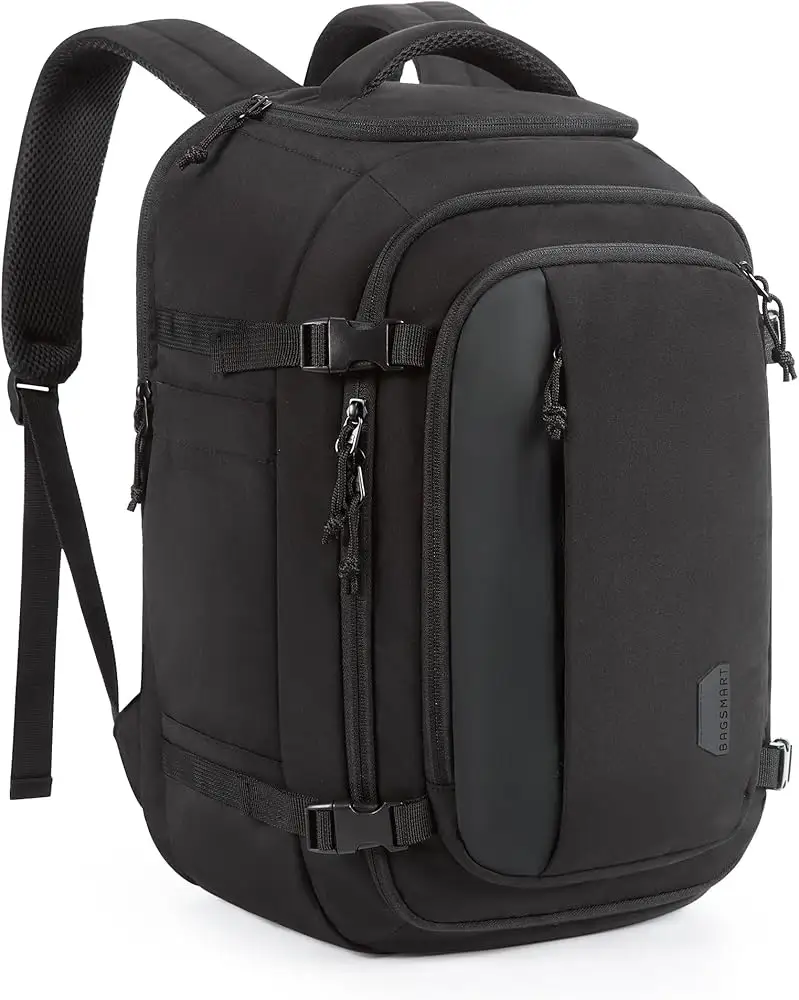
The strongest agreement is that BAGSMART Travel Backpack 28L with USB Charging Port, Black is built around access and organization. Pack Hacker emphasized that “there are multiple compartments for quick and easy access to gear,” then walked through a layout that favors travelers who hate digging: a “large dump pocket” up top, quick front pockets for grab-and-go items, and hidden storage for valuables. For a frequent flyer juggling snacks, chargers, passport, and phone at security, that structure is the point of the product—and it’s where the feedback is most consistently upbeat.
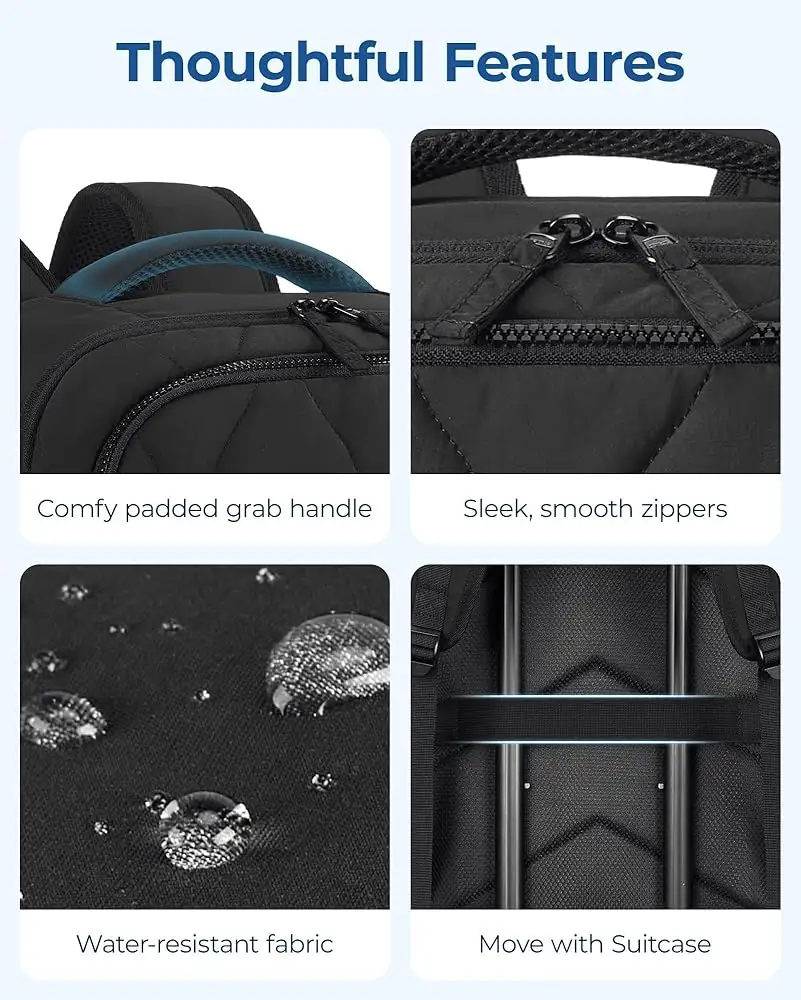
A second recurring pattern is weather practicality. Pack Hacker praised “water-resistant external materials” and said the bag appears to have “some sort of coating or laminate.” That matters most for commuters and weekend travelers who get caught in light rain or set bags down on damp surfaces. The framing isn’t “stormproof expedition,” but rather an everyday layer of protection that aligns with typical urban travel.
Comfort gets qualified praise, especially when the bag is packed with a laptop. Pack Hacker described the back panel as “padded” and “comfortable and more structured if you have a laptop inside the bag.” That detail is meaningful for hybrid workers or students who always carry a device: the bag reportedly carries better when it has that rigid rectangle inside. For minimalists who travel without a laptop, the same harness can feel less supportive.
After those core themes, a smaller but notable praise cluster is travel handling. Pack Hacker highlighted the “handles on the top and side” for overhead bins and car trunks, and a “luggage pass-through” that keeps it upright on rolling luggage—an efficiency detail that matters to business travelers moving between terminals quickly.
- Strongest praise theme: “multiple compartments” and easy access (Pack Hacker)
- Practical weather layer: “water-resistant external materials” (Pack Hacker)
- Best comfort scenario: carries better “if you have a laptop inside” (Pack Hacker)
Common Complaints
The most repeated criticism is the feel of materials and structure. Pack Hacker didn’t mince words: “the materials, hardware, and bag, in general, feel cheap in use,” and “a lack of structure makes the pack look and feel saggy.” For travelers who want a backpack to hold a crisp shape—especially in professional settings—this “saggy” presentation can be a dealbreaker. It also affects how the bag rides when partially packed, which is exactly how many underseat travelers carry (light on the way out, heavier on the way home).
Comfort complaints show up in a specific scenario: carrying without a laptop. Pack Hacker wrote: “we wish the harness system were more comfortable without a laptop stowed inside.” If you’re buying a travel backpack for weekend trips where you leave the laptop behind, this is the wrong kind of conditional comfort—it suggests the pack needs the laptop’s stiffness to feel better.
Then there’s the durability question mark. TakeTravelInfo flags “mixed durability experiences,” including mentions of “ripping after a few months of use.” Pack Hacker’s own timeline is short but revealing: after “2 weeks of use,” they saw “a few loose threads,” though they called them “non-structural.” For someone using this as a daily commuter bag, loose threads early can feel like a warning sign even if the bag remains functional.
- Biggest downside: “feel cheap” + “saggy” structure (Pack Hacker)
- Comfort caveat: less comfy “without a laptop” (Pack Hacker)
- Durability uncertainty: “ripping after a few months” reported by some users (TakeTravelInfo)
Divisive Features
Pocketing is both the hero and the headache. TakeTravelInfo notes that the “complexity of numerous pockets may overwhelm users seeking simplicity.” Pack Hacker, on the other hand, frames the many pockets as a positive—“multiple compartments for quick and easy access”—and then points out where it still falls short: some pockets “lack organization” and part of the interior feels like “wasted space.” In other words, people who love pockets may still want a different kind of pocket.
The bag’s budget positioning also splits opinion. Pack Hacker essentially argues it’s worth it given the price—“for the price, it’s hard to go wrong”—while simultaneously cautioning that if you travel constantly “it likely won’t last as long as one with better elements and materials.” For occasional travelers, that trade looks attractive; for weekly travelers, it can read as a hidden long-term cost.
Trust & Reliability
Concerns about trust show up less in product performance and more in buying experience. On US-Reviews, shopper frustration centers on order tracking and communication rather than the backpack itself. Reviewer E. McLaughlin wrote: “the order number they gave me wasn't valid,” and said the “lack of clear communication and transparency left me feeling frustrated and like i'd been tricked.” Judy Berge echoed a similar anxiety about silence after purchase: “i didn't get any confirmation… they haven't answered… worrying that i might have been scammed.” These stories don’t prove a systemic issue with every purchase, but they establish a pattern of buyers feeling unsupported when something goes wrong.
On long-term durability, the available Reddit snippet is more a pre-purchase concern than a “6 months later” report. A Reddit thread asking about a comparable 28L class bag raises a measurement skepticism: “the stated volume… 28l does not match with the dimensions… (… is 23 liters).” That’s not a durability story, but it is a reliability signal—some travelers are scrutinizing whether capacity claims line up with geometry. Meanwhile, TakeTravelInfo’s summary explicitly states some users report “ripping after a few months of use,” reinforcing that longevity is the risk side of the ledger.
Alternatives
The only clearly named alternative in the provided data is a Reddit discussion about “Cabin Zero 28L Classic.” The shopper’s context in that thread is underseat travel and skepticism about volume math—precisely the scenario where a simpler, more traditionally structured 28L bag might appeal. The BagSmart pitch leans heavily into pocketing, clamshell access, and travel niceties; the implied alternative appeal is simpler design and potentially more straightforward “what you see is what you get” capacity.
Within BagSmart’s own ecosystem, multiple listings reference an expandable version (28L to 38L) described by Pack Hacker: “one that extends from 28 liters to 38 for an extra 10 liters.” That “more space” option comes with a warning: “when extended, the bag loses some structure, and it can feel a bit saggier.” So the alternative isn’t automatically “better,” but it is a path for shoppers who prioritize flexibility over shape.
Price & Value
From the e-commerce signals in the data, pricing varies dramatically by channel and region. The BagSmart collection page shows the Blast line around “$74.99” (with other colors and models nearby). Irv’s Luggage lists “$89.99” for the Blast Quick Access carry-on travel backpack. Meanwhile, the Amazon specs shown for a different BagSmart laptop backpack (not the 28L Blast travel model) show “$31.99,” highlighting how BagSmart’s lineup spans budget tiers—and why shoppers can get confused comparing prices across models.
Value, therefore, hinges on whether you’re buying this as a “smart features for under $80” bag or expecting premium build. Pack Hacker’s verdict captures that tension: “budget-friendly… however, you get the quality you pay for,” while still concluding “for the price, it’s hard to go wrong.” If you treat it as a weekend/occasional travel bag and pack with cubes to manage structure, the value proposition aligns with the reviews; if you want a decade-long daily driver, the same sources advise caution.
- Observed price band across sellers: roughly
$70–$90(BagSmart site listings, Irv’s Luggage) - Value framing: strong features-per-dollar, but “feel cheap” and “saggy” risk (Pack Hacker)
- Buying tip suggested by complaints: purchase via retailers with reliable support/returns (US-Reviews patterns)
FAQ
Q: Does it really work as an underseat personal item travel bag?
A: Conditionally. Pack Hacker scores it well for “carry-on compliance” and notes it’s marketed to meet personal item sizing, but also says accessing the main compartment upright is “challenging.” It fits the underseat mission best if you’re okay setting it down to pack/unpack.
Q: Is the laptop compartment protective enough for daily work travel?
A: It fits, but protection may be average. Pack Hacker wrote there “isn’t a ton of padding” and “it doesn’t have a false bottom,” recommending a case if you’re “rough on your gear.” For commuters with a 15–16 inch laptop, extra protection may be wise.
Q: Are the materials and zippers durable?
A: Expect budget feel with mixed signals on longevity. Pack Hacker said the zippers “feel a bit cheap” but reported “no issues” so far, while also noticing “a few loose threads” after two weeks. Another summary source mentions reports of “ripping after a few months.”
Q: Is the pocket layout easy or overwhelming?
A: It depends on your organization style. Pack Hacker praised “multiple compartments,” but another source warns the “complexity of numerous pockets may overwhelm users seeking simplicity.” If you like a minimalist single-cavity bag, this may feel like too much.
Q: Is buying directly from the brand reliable?
A: Some shoppers report frustrating service experiences. On US-Reviews, E. McLaughlin cited an “order number… wasn’t valid” and “lack of clear communication,” while Judy Berge described paying but receiving “no confirmation.” Buying through a retailer with strong support may reduce stress.
Final Verdict
Buy if you’re an organization-first traveler who wants a 28L-class personal item backpack with clamshell access and lots of quick pockets—and you’re comfortable with Pack Hacker’s warning that it “feel[s] cheap in use.” Avoid if you need a structured, premium-feeling pack or you frequently carry it without a laptop, since the harness was described as less comfortable “without a laptop stowed inside.” Pro tip from the community-style feedback: treat it like a packing-cube bag, because when the structure is light, the way you pack becomes the “frame.”