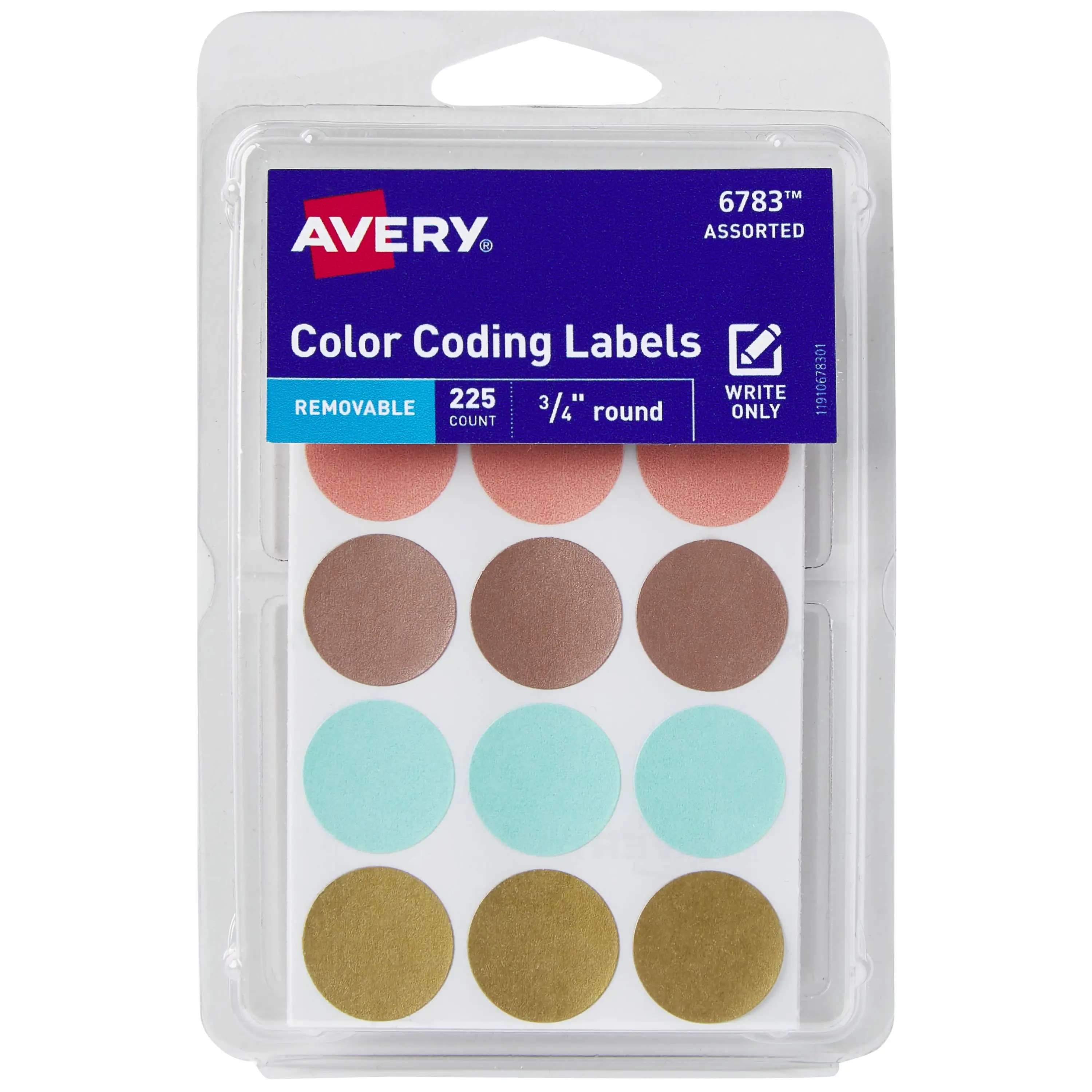
Avery Removable Round Labels Review: Clean Peel, 8.7/10
“Truly a removable label” is the line that keeps popping up—and it’s the clearest signal of what buyers actually care about with Avery Color-Coding Removable Round Labels, Assorted Colors. Verdict: a practical organizer’s staple with a few real-world caveats. Score: 8.7/10
Quick Verdict
For most people: Conditional Yes. If you need small, removable dots that “stick well” on smooth surfaces and come off clean, the feedback is strongly positive—but expect weaker performance on textured materials and occasional “not very sticky” complaints depending on surface and product variant.
| What users agree on | Evidence from feedback | Who it helps | Where it can disappoint |
|---|---|---|---|
| Clean removal is a standout | “They leave no residue.” (FindThisBest quote); “labels easily peeled off of every single surface” (blog review) | Resellers, teachers, planners | Textured fibers/fabric |
| Easy to write on | “Easy to write on” (FindThisBest); “use a black extra-fine sharpie marker” (blog review) | Homeschoolers, inventory tracking | Tiny size limits writing space |
| Visibility/bright colors | “attention grabbing neon-orange” (blog review) | Garage sales, priority tagging | Some colors described differently than expected |
| Printer compatibility varies by product | Amazon 5795 says “not for use with printers or copiers” while 5474 says “handwrite or print” | People who need printable dots | Confusion if you buy the wrong SKU |
Claims vs Reality
Avery’s listings repeatedly frame these as removable labels that “stick firmly” and “remove cleanly.” Digging deeper into user stories, that claim largely holds on typical smooth surfaces—paper, cardboard, plastic, laminate—where removability is the point. A reviewer describing a yard-sale pricing marathon wrote that the labels “easily pulled up so that i could place another label on the item,” and later emphasized, “the labels easily peeled off of every single surface… [and] did not rip paper or damage items.” That kind of experience lines up with the brand’s promise of temporary labeling without residue.
But the same on-the-ground account shows where the marketing line stops: texture changes everything. The same reviewer said, “the only surface they reluctantly stuck to were textured fibers.” That’s a recurring pattern across the broader ecosystem of dot stickers and color-coding labels: adhesion tends to be strongest on smooth surfaces, and less reliable on fabric-like or textured materials, even when a product is marketed as broadly usable.
Printer compatibility is also a spot where reality can diverge from assumptions. For the 1/4" removable dots (5795), the Amazon spec copy is blunt: “convenient 4 x 6 sheets, not for use with printers or copiers,” and also lists “machine compatibility: handwrite only.” Meanwhile, other Avery dot labels in the dataset (like 5474) are described as “handwrite or print… for use with laser printers,” and one Amazon reviewer explicitly praised printing performance: “they printed well & didn't jam my cranky printer.” The gap isn’t “users vs specs” so much as SKU confusion—buyers expecting printable dots need to match the exact model.
Cross-Platform Consensus
Universally Praised
A recurring pattern emerged: people don’t gush about dot labels unless they solve a tedious, repetitive problem—and clean removal is the hero feature. For yard-sale sellers who change prices midstream, removability is the difference between chaos and control. One long-form reviewer explained how pricing shifts played out in real time: “sometimes i changed my mind about a price. the labels easily pulled up so that i could place another label on the item,” and later reported that after the sale, “the labels easily peeled off of every single surface.”
Planners and schedule-jugglers echo the same benefit, but with a different emotional payoff: flexibility. A FindThisBest-quoted user described using the dots to track changing work shifts: “since my schedule changes frequently, i love that i can peel off a sticker and place it on a different day without hassle.” For anyone managing rotating schedules—nurses, gig workers, part-time staff—that “move it without hassle” story explains why removable adhesive matters more than “strong stickiness.”
Visibility and legibility show up as the second big win. In a garage-sale context, the reviewer called the neon shade “attention grabbing,” adding, “no matter what i stuck a label to, the color stood out.” In more meticulous uses like mapping and education, another FindThisBest-quoted homeschool user said the dots are “a good color, easy to write on,” and emphasized that the approach gave kids “a visual scope of their learning.” That’s the organizational promise translated into a real classroom or kitchen-table scenario: quick recognition at a glance.
Finally, writing experience is consistently praised—especially for people who just want to grab a pen and label. The yard-sale reviewer reported using “a black extra-fine sharpie marker,” while FindThisBest feedback called the labels “easy to write on” and “nice and see-through.” For detail-oriented organizers—inventory trackers, homeschoolers cataloging lessons, or anyone labeling maps—the ability to write cleanly without smearing is part of the product’s perceived quality.
- Clean removal stories dominate: “leave no residue,” “peeled off… every single surface.”
- Visibility is a repeat theme: “color stood out,” “brighten my day.”
- Handwriting works in real use: Sharpie/pen notes, easy labeling.
Common Complaints
The biggest complaint isn’t that the labels fail universally—it’s that performance depends heavily on surface type. While marketing language often implies broad adhesion, real use stories show limits. The most specific and vivid complaint comes from the yard-sale reviewer: “the only surface they reluctantly stuck to were textured fibers.” For users trying to label cloth bins, textured craft materials, or fabric-like surfaces, that “reluctantly stuck” phrasing is a warning sign.
Size can also become a constraint depending on the task. When labels are tiny (like 1/4" dots), the tradeoff is obvious: great for quick color coding, not great for writing much. While the dataset’s praise focuses on organization and quick notes, some feedback around similar Avery labels mentions being “a bit small,” even when the buyer still considered it a net positive because it means “i got a lot in the pack.” That’s a practical complaint: small labels work best when color alone carries meaning, or when you’re writing a number rather than a full word.
There’s also a subtle but important frustration around “stickiness” expectations. Some users love that the labels are removable; others want them to stay put like permanent dots. In the FindThisBest compilation for a related Avery removable dot product, one quoted user said they are “easy to remove yet sticky enough to stay put,” while another product entry (Avery 5472) flags “not very sticky sometimes.” For busy environments—classrooms, warehouse bins, or anything handled often—“removable” can feel like “not sticky enough” if the surface is imperfect.
- Weakest use case: textured fibers/fabric.
- Small dots limit writing space for detailed labeling.
- “Removable” can read as “not sticky” for some users.
Divisive Features
Transparency and “see-through” design is one of those traits that some people love for precision tasks, while others may not even notice. A FindThisBest-quoted user praised that the dots are “nice and see-through,” explaining they could “still see the paper underneath,” and that on maps they “don’t interfere with the map at all.” That’s a clear win for educators, travelers marking routes, or anyone annotating printed materials where underlying text matters.
But color perception can split opinions—especially with neon variants. The yard-sale reviewer noted a mismatch between how a color is described and how it looks: “this particular label color is a neon-orange, though i have seen it described as red… there is no way i would call this label any shade of red.” For buyers who need strict color standards (office systems, compliance labeling, or consistent inventory coding), that kind of disagreement can cause friction even if the labels function perfectly.
Trust & Reliability
On trust, the strongest “reliability” signals come from people who repeatedly buy Avery labels and treat them as a default. An Amazon reviewer wrote: “i’ve never had a problem with any of avery’s labels and these are no exception,” adding that the dots “printed well & didn’t jam my cranky printer” and “peel easy and stick where you put ’em.” That’s not a lab test—it’s a reliability narrative from someone who’s purchased “in many places and in many colors.”
Long-term durability is less directly documented in the provided Reddit/Trustpilot fields (most of that content is product-page summary rather than posts), but the repeated theme across platforms is consistency: labels that stick for the task, then remove when you want them gone. The yard-sale reviewer’s end-of-day cleanup story—“applying and removing the labels was the easiest part of the sale!”—frames reliability as “predictable behavior under stress,” which is exactly what organizers want.
Alternatives
Only a few competitors are explicitly present in the data, and they’re mostly generic bulk dot sticker brands surfaced by FindThisBest. For buyers who care about massive quantity and don’t need removability, Utron’s 3/4" dots are framed as “great quantity for the price,” with a buyer saying, “they stick well, with lots of colors,” but also warning: “removal isn’t super easy.” That’s the trade: more permanent feel can mean harder cleanup.
At the more aggressive-adhesive end, LR Ogoe dots are described as “ultra sticky,” with one user cautioning: “be careful, as they are ultra sticky — if you leave them out, they’ll stick to everything!” For classrooms and toddler activities, that can be either perfect or a nightmare—especially if “removable” is the main requirement.
If you want Avery but in different formats, Office Depot’s Avery 5407 (1-1/4") and other larger dot/shape variants show the same removable-color-coding pitch, but with more writing room. That matters for users labeling moving boxes or storage where a number isn’t enough.
Price & Value
At a glance, the value argument is simple: lots of dots, low per-label cost, and the time saved by quick visual coding. The Amazon listing for the 1/4" assorted removable dots (5795) shows $6.27 for 768 labels (about a cent each), and the entire ecosystem around these products reinforces the “bulk utility” idea—yard sales, calendars, inventory, homeschooling.
Resale pricing on eBay for Avery removable color-coding labels (example listing for 3/4" orange 1008 labels) is higher than typical Amazon pricing in the dataset—$12.74 plus shipping—suggesting that shipping costs and region availability can dominate total cost more than the label price itself. For buyers outside the US (the Amazon page even surfaces “$12.38 shipping to new zealand”), the “cheap labels” story can flip into “expensive delivered.”
Community buying tips embedded in user stories are practical: pick the right size for the job, and decide upfront whether you need true removability or something closer to permanent. The yard-sale reviewer’s approach—using removable dots because prices change—captures the “why” behind paying for a known removable adhesive.
FAQ
Q: Are Avery removable color-coding round labels actually removable without residue?
A: Feedback strongly supports clean removal on smooth surfaces. A FindThisBest-quoted user said they “leave no residue,” and a yard-sale reviewer reported the labels “easily peeled off of every single surface” used, without ripping paper or damaging items. Results may vary on textured fibers.
Q: Do these labels stick well on everything (plastic, metal, fabric)?
A: On smooth materials, many users describe reliable adhesion. But on fabric-like textures, performance can drop. One reviewer specifically noted, “the only surface they reluctantly stuck to were textured fibers,” even though they worked well on cardboard, metal, plastic, laminate, and wood.
Q: Can you print on Avery color-coding dots, or are they handwrite-only?
A: It depends on the exact product number. Amazon’s 1/4" dots (5795) are listed as “handwrite only” and “not for use with printers or copiers,” while other Avery dot labels (like 5474) are described as printable and an Amazon reviewer said they “printed well & didn’t jam my cranky printer.”
Q: Are the colors easy to see and useful for organization systems?
A: Visibility is a consistent strength in stories. A reviewer called a neon shade “attention grabbing,” saying “the color stood out,” while a planner-style user described moving dots around a calendar “without hassle.” Some buyers argue about exact color naming (e.g., neon orange described as red).
Q: What size should I buy—1/4" or 3/4"?
A: User stories suggest 1/4" works best for quick marking (maps, documents, tiny indicators), while larger dots are better when you need to write more than a number. One buyer loved quarter-inch dots for maps because they were “about a quarter inch wide” and “don’t interfere with the map at all.”
Final Verdict
Buy if you’re a planner, teacher, homeschool parent, or garage-sale seller who needs Avery Color-Coding Removable Round Labels, Assorted Colors to “stick where you put ’em” and then come off clean when plans change. Avoid if your main use case is labeling textured fabric or you need permanent-level adhesion.
Pro tip from the community: if your system changes often, lean into removability—one user summed up the appeal by saying they could “peel off a sticker and place it on a different day without hassle.”