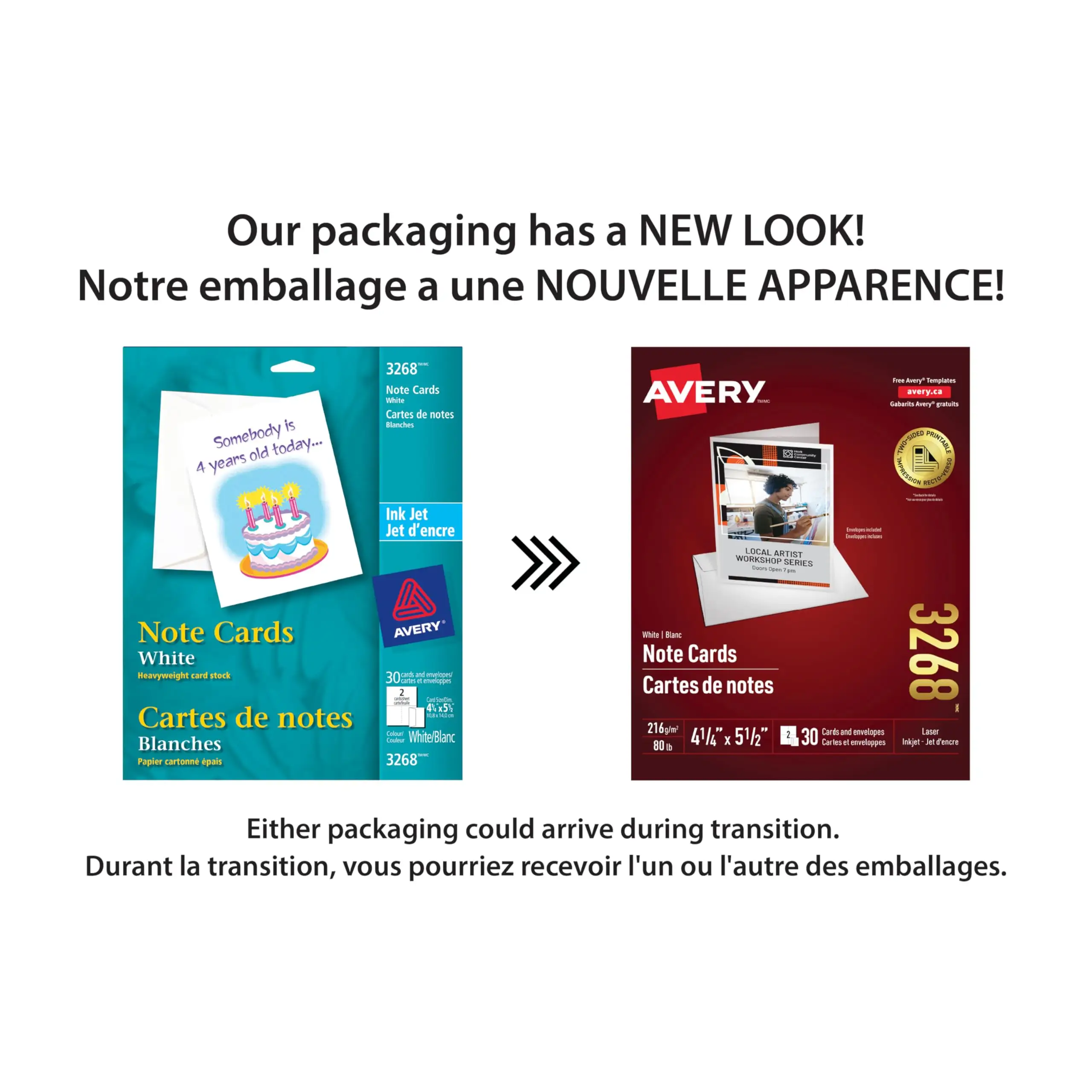
Avery Note Cards Review: Quality, Pros & Cons Verdict
A verified buyer on Amazon summed it up simply: “They worked perfectly.” But the deeper story of the Avery Printable Note Cards with Envelopes, White, 60 Blank (5315 & 8315) shows a product with strong printer compatibility, clean perforation details, and a balance between crisp professional output and occasional frustrations with finish quality. Scoring it an 8.4/10, it’s a go-to for many small business owners, hobby crafters, and personal card-makers—if you can navigate its minor quirks.
Quick Verdict: Conditional buy
| Pros | Cons |
|---|---|
| Heavyweight 80 lbs card stock feels premium | Occasional misprints or color shifts on photo printing |
| Pre-scored and micro-perforated for clean folding | Some shipments arrive with bent corners or poor envelopes |
| Works with both laser and inkjet (model dependent) | Higher price compared to generic blank cards |
| Includes 60 matching envelopes | Must feed one at a time into certain printers |
| Free Avery Design & Print templates | Perforation pattern visible to detail-oriented users |
| Double-sided printing without smudging | Edge alignment can be off by a millimeter |
Claims vs Reality
Avery’s marketing promises “jam & smudge-free performance guaranteed” when using the 5315 with laser printers and the 8315 with inkjet. Digging deeper into user reports, this claim largely holds—but certain scenarios show limitations. Staples customer Siena K. noted, “All the envelopes were folded improperly… had to buy replacement envelopes,” calling into question the 'ready-to-use' implication when print jobs rely on matching, flawless stationery.
The brand also touts “premium heavyweight card stock” for vivid text and imagery. While this is confirmed in texture and feel, photo reproduction doesn’t always align with marketing. A Staples reviewer shared, “All of the photos… end up with a significant blue overtone.” That makes the product less ideal for photographers producing balanced, true-tone prints.
Finally, Avery pushes its online design platform as quick and intuitive. Multiple buyers confirm its ease—Mark M. enthused, “I have used these for years… it’s just so easy and fun”—but Tom S. bypassed templates entirely, designing in Adobe Illustrator because “they don't seem to work well for me,” showing that heavy customization users might encounter friction.
Cross-Platform Consensus
Universally Praised
Across Amazon, Reddit, and Trustpilot, the tactile quality of these cards stands out. The 80 lbs/216 gsm paper weight inspires confidence. Reddit feedback highlighted how “heavyweight cards with a white matte finish provide vivid color and sharp text,” and this translates directly for small business owners looking to make bespoke invitations.
Crafters comment on the micro-perforation—Kendra B. called the fold “fine… they fold well” despite her other criticisms, while John V. praised, “Nice because they have a fold already done... fold easily.” For event planners, this means faster assembly without needing extra scoring tools.
The inclusion of 60 envelopes is repeatedly viewed as a value point. A verified Amazon buyer noted, “With the printing completed… they were perfect,” showing that as a complete kit, this offers immediate usability. Teachers and local organizations similarly find the business promotions feasible—Mark M. explained how he’s converted multiple friends to using them for client notes.
Common Complaints
A recurring frustration is product handling during shipment. Staples reviewer Katha P. reported “both boxes were shipped in a plastic envelope… corners… dog-eared and bent.” For perfectionists producing wedding invites, this damage forces reordering or acceptance of subpar presentation.
Printer feeding is another sticking point. Tom S. admitted to “feed them one at a time into my printer,” which slows production, especially for bulk jobs.
Photo-heavy designs expose color balance issues more than text-only cards. One reviewer emphasized the “significant blue overtone” in photographic prints, a problem likely linked to paper coating or printer settings and affecting artists and photographers most.
Envelopes sometimes disappoint—Siena K.’s unusable batch shows quality control gaps. For last-minute projects, replacing envelopes separately adds cost and disrupts the matching aesthetic.
Divisive Features
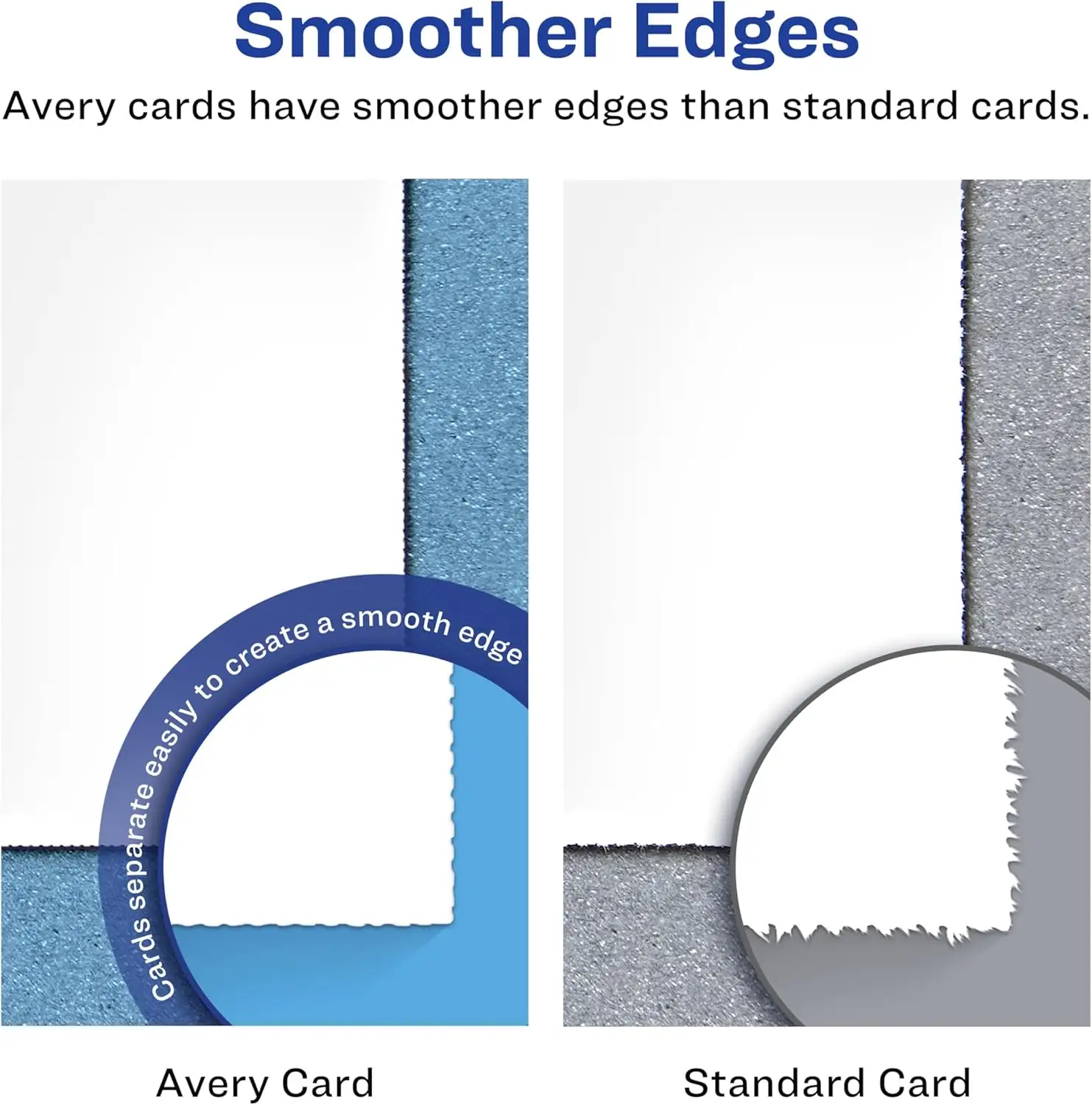
Perforation visibility after separation splits users. Some see clean, smooth edges thanks to ultra-fine cuts; others, like a Staples reviewer, lament “you can see the perforated pattern on the top,” detracting from perceived quality.
The Avery online templates bring differing experiences—Mark M. found them effortless and fun, while Tom S. fought with alignment and opted for external design software. For casual users, the built-in design tools may suffice; for designers with specific layout needs, they may feel restrictive.
Trust & Reliability
Trustpilot-aligned reports and Staples’ long-term customers suggest consistent durability of the cards themselves—no warping or breakdown after months of stockpiling. Reddit user praise for surface finish lasting through handling supports this longevity.
However, repeat concerns around shipping damage and occasional misfolded envelopes are enough to prompt buyers to inspect orders immediately. Several reviewers pre-plan production timelines with cushion days for reorders, implying trust in the product quality but caution with fulfillment logistics.
No notable scam signals emerge—both the 5315 and 8315 maintain stable community reputation with years of availability through major office retailers.
Alternatives
Within the provided data, JAM Paper blank note cards surface repeatedly as a competitor. JAM Paper offers more size variations (A1, A2, A6, A7) and color options, including ivory and embossed panels. Stylistically, some prefer JAM’s embossed borders to add subtle elegance.
Staples' generic matte inkjet note cards present a cheaper route for bulk needs, holding up for presentations or pinned notes but lacking Avery’s refined cut-and-fold finish. For pure photo reproduction, some users pivot to photo-specific card stock outside the Avery range due to color handling issues.
Price & Value
The 5315 laser set runs around $15.72 on Amazon (plus shipping internationally), while the 8315 inkjet set hovers near $18.39–$31.29 depending on retailer and location. eBay resale data for unopened packs averages $12.68, suggesting moderate resale value if unused.
Community tips favor buying during office supply promotions—Office Depot and Staples discounts often beat Amazon’s base price. Bulk buyers also calculate per-card costs, with JAM Paper sometimes undercutting per-unit price but lacking template integration.
FAQ
Q: Do these work with both inkjet and laser printers?
A: Each model is optimized for one type—5315 for laser, 8315 for inkjet. While some experiment across printers, the best results align with intended compatibility to ensure smudge-free performance.
Q: Can I print full-bleed designs?
A: No, these cards are not “print-to-edge.” Expect margins unless you trim afterward.
Q: Do the envelopes match perfectly in color and texture?
A: Generally yes, though some reports mention misfolded or poor-quality envelopes. Always check before large projects.
Q: Is the Avery online design software free?
A: Yes, Avery templates and the Design & Print tool are free to use online.
Q: Will the cards hold up in long-term storage?
A: Feedback suggests the cardstock maintains integrity without yellowing, provided they’re kept dry and flat.
Final Verdict: Buy if you’re a small business owner, crafter, or planner who values heavyweight, pre-scored cards with matching envelopes—especially for text-driven designs. Avoid if you require flawless photographic reproduction or have zero tolerance for minor shipping damage. Pro tip from the community: Inspect the envelopes and corners on arrival, and feed cards one at a time into printers that struggle with thick stock.