Avery Customizable Name Badges Review: Worth It? 8.6/10
“Inserts load into the badge at the top so they do not fall out”—that single line captures why people keep buying Avery Customizable Name Badges, Pin Style, Clear Name Tag Holders with Printable Inserts. Verdict: a practical, event-ready badge system with strong ratings across retailers, best for offices and organizers who want clean, printable results. Score: 8.6/10.
Quick Verdict
Conditional Yes — a strong pick if you want reusable holders and crisp printable inserts; less ideal if you need clip or lanyard attachment instead of pins.
| What the data suggests | Evidence (platform) |
|---|---|
| Strong overall satisfaction | “4.8 out of 5 stars” on Amazon for the 3" x 4" pin-style kit bundle (Amazon) |
| Reusable holder concept resonates | “Reusable and feature a pocket-style design” (Amazon product description) |
| Printing experience is a key selling point | “Crisp, smudge-free printing… optimized for both laser and inkjet printers” (Amazon; Staples listing echoes this) |
| Attachment is central: “no-snag pin” | “No-snag pin to securely hold badges in place” (Amazon; Avery.com product copy) |
| Some buyers compare sizes/series | Multiple sizes and SKUs shown (e.g., 74540 3" x 4", 74549 2-1/4" x 3-1/2", 74652 24-pack) across Amazon/Avery/Staples |
Claims vs Reality
Avery’s marketing leans hard on convenience and polish: “create professional name tags quickly and easily” and “get crisp, smudge-free printing” (Amazon listing language; similar phrasing appears on Staples and Avery.com pages). Digging deeper into user feedback, the clearest “reality check” is that people don’t just want the template promise—they care whether the holder and insert system behaves in real workflows: stays flat, holds shape, and doesn’t eject the paper.
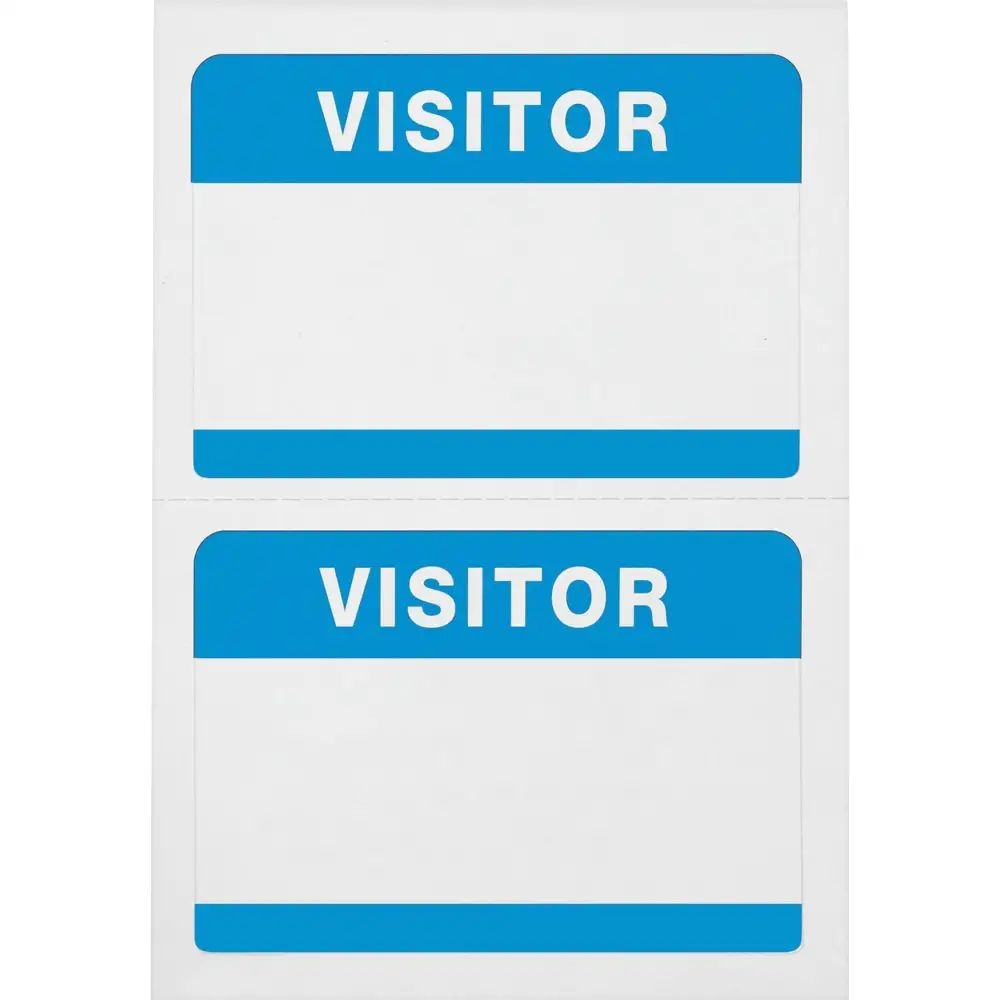
One verified Amazon reviewer (for a related Avery top-loading badge system) framed the real-world upgrade logic in practical terms: “I had a smaller box… and decided to purchase the larger 100 badges box… since it was only a few dollars more for over twice the number of badges.” That same reviewer emphasized durability and flatness over buzzwords: “the plastic cover seems slightly thicker, more durable and so far seems to hold its shape and stay flat better.” For event coordinators or front-desk teams producing visitor badges repeatedly, that “stays flat better” detail is the sort of performance marker marketing copy can’t fully prove—but users do.
Marketing also highlights insert security via top-load/pocket design. In user terms, the success metric is simple: do the inserts slip? The same verified buyer wrote: “Inserts load into the badge at the top so they do not fall out.” While this quote is from a clip-style Avery product page review, it maps directly to the broader Avery badge-holder ecosystem described across product listings: pocket-style holders, quick loading/unloading, and “top-load design” language on Avery.com and Staples.
Finally, “no-snag pin” is positioned as garment-friendly. The data provided doesn’t include a large set of pin-specific complaint quotes about fabric damage—so there’s no documented backlash here—but it does show that Avery offers clip style, magnetic style, lanyard hang style alongside “no-snag pin style” (Amazon manufacturer section). That variety itself implies the “right reality” depends on user type: pins for secure hold, clips for garment sensitivity, lanyards for conferences requiring visible ID all day.
Cross-Platform Consensus
Universally Praised
A recurring pattern emerged across retailer descriptions and the single detailed verified review: buyers value badge systems that behave like a repeatable process—print, tear, insert, wear—without fiddly steps. The story that surfaces most clearly is the organizer’s mindset: building visitor badges, employee name badges, or conference name tags quickly, then reusing holders for future events. The verified buyer on Amazon explicitly described that use case: “Works great for designing visitor badges, employee name badges, etc.”
“Reusable holders” is also not just a marketing phrase here; it’s a core buying logic. Across listings, the holders are described as “reusable” with a “pocket-style design” and “top-load design” (Amazon; Avery.com). For HR teams onboarding new hires, school staff running multiple events, or volunteers managing check-in tables, that means fewer one-and-done purchases and faster turnaround between events.
Printing quality and clean edges form the other major “everyone nods” theme in the data. Multiple product pages emphasize inserts optimized for “laser and inkjet,” and perforations designed for smooth separation (Amazon; Avery.com; Staples). The implication for corporate admins is straightforward: if the inserts tear cleanly and print sharply, the badges look intentional instead of improvised. Even without many direct user quotes about print sharpness in the provided data, the repetition of “ultra-fine perforations” and “crisp, smudge-free printing” across platforms signals that this is a major expectation customers are buying into.
Summary bullets (after the narratives):
- Reuse and repeatability: pocket/top-load holder systems.
- Event readiness: visitor badges, employee IDs, meetings.
- Print ecosystem: templates + laser/inkjet compatibility + clean perforations.
Common Complaints
The provided dataset is unusually light on direct negative user quotes—there aren’t Reddit threads, X posts, or multi-review excerpts showing frustrations. What does show up, instead, is a “complaint by implication”: buyers must choose the correct attachment style and size, and the ecosystem is fragmented by SKUs (74540 vs 74549 vs 74652, plus clips and other mounting methods). For time-pressed purchasers, the confusion risk is not about quality but about ordering the wrong configuration.
This becomes more apparent when you compare listings: a 2-1/4" x 3-1/2" 24-pack kit (Amazon 74652; Staples 74652) sits alongside 100-count pin-style options (Avery.com 74549; Office Depot 74549; Office Depot 74540 in 3" x 4"). For conference planners ordering at scale, buying the wrong size could create last-minute print/template mismatches—even if the product itself works.
There’s also a subtle tension between “no-snag pin” and “wear badges securely without damaging your clothing” positioning (Amazon manufacturer section). The data provided doesn’t contain user reports of fabric damage or pin failure, so no claim can be made either way—but it does suggest why some buyers choose clip-style alternatives (Avery 74536 clip style listing in the dataset). If your environment includes delicate fabrics (certain uniforms, knitwear, or formal wear), shoppers may gravitate toward the garment-friendly clip system rather than a pin, even if the pin is “no-snag.”
Summary bullets (after the narratives):
- Choice overload: many SKUs/sizes/styles increase ordering mistakes.
- Attachment preference: pin vs clip vs lanyard depends on clothing policies.
- Planning friction: templates and sizes must match before printing.
Divisive Features
The biggest “split” isn’t documented as love/hate in user quotes here; it’s structural: the pin style is either perfect or not appropriate based on workplace norms. Digging deeper into the manufacturer framing, Avery positions “no-snag pin style” as one of several “name your style” options (Amazon manufacturer section). For staff IDs that need to stay put—retail floors, trade shows, school events—a pin can feel more secure than a clip that might shift. But for organizations with strict dress codes or concerns about piercing garments, pin attachment can be a nonstarter.
Pack size is another quiet divider. The dataset shows 24-count kits and 100-count boxes. The verified buyer story leans toward value and scale: “only a few dollars more for over twice the number of badges.” That logic is compelling for recurring events, but less so for someone hosting a one-time meetup who doesn’t want leftover supplies.
Trust & Reliability
There’s no meaningful Trustpilot-style scam pattern in the provided material—what’s present is largely product-page copy and star ratings rather than fraud narratives. So the “trust” signal here comes from consistency: the same core claims repeat across Amazon, Avery.com, Staples, and Office Depot listings—reusable clear holders, printable inserts, laser/inkjet compatibility, and secure pin attachment.
For durability, the most concrete long-term reliability cue comes from the verified buyer who compared older and newer boxes and focused on materials: “plastic cover seems slightly thicker, more durable… hold its shape and stay flat better.” They also reported no hardware failures in their use: “I have not had any of the clips come out”—again, clip-style rather than pin-style, but still relevant to the badge-holder construction quality Avery is selling across lines.
Alternatives
Only a few real alternatives appear in the data, and they’re mostly other Avery attachment styles rather than competitor brands. If you like Avery’s print/template workflow but want different wear mechanics, the dataset points to these options:
For fabric-sensitive users, Avery clip style name badges (e.g., 74536 3" x 4") are positioned as “garment-friendly clips that won't damage fabric” (Avery listing text included in the dataset). That makes sense for staff in uniforms, knitwear, or formal attire where pinholes are unacceptable.
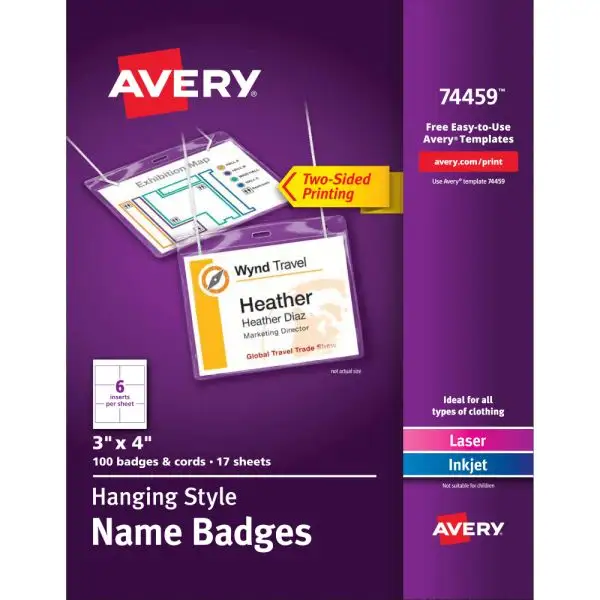
If you need larger visibility or a different event format, the data also references hanging badge systems (via the provided image title and Avery “badge holders & inserts” ecosystem mentions). The dataset’s listings repeatedly emphasize pocket-style holders and printable inserts, so the real “alternative” is often orientation/attachment rather than abandoning the platform.
Price & Value
Pricing in the dataset varies widely by pack size and retailer. On Amazon, the 3" x 4" bundle shown lists a “bundle price” around $31.63 for a set including holders and a large insert refill pack (Amazon specs block). Smaller kits like the 24-pack (Amazon 74652) appear around $9.36, while Staples shows the 24-pack at a higher listed price ($16.19) in the provided excerpt—suggesting retailer pricing swings are meaningful.
Value narratives in user feedback tilt toward buying larger counts when the incremental cost is small. A verified Amazon buyer described upgrading from a smaller box because it was “only a few dollars more for over twice the number of badges.” For offices that run recurring trainings, visitor check-ins, or volunteer events, that kind of scaling logic matters more than the per-unit price.
The dataset does not contain true resale-market dynamics (the eBay section here repeats product-page style content rather than listing-level sold prices). So “resale value trends” can’t be credibly summarized from the provided data.
FAQ
Q: Do the printable inserts stay in place during events?
A: The most direct user feedback says yes: a verified Amazon buyer noted, “Inserts load into the badge at the top so they do not fall out.” Product descriptions across Amazon, Avery.com, and Staples also emphasize a “top-load” or “pocket-style” holder designed to make inserts secure and easy to swap.
Q: Are these compatible with both inkjet and laser printers?
A: Yes—multiple listings state the inserts are “optimized for both laser and inkjet printers” (Amazon product text) and Staples similarly describes “insert sheets… optimized for both laser and inkjet printers.” This matters most for offices printing name tags in-house using standard 8.5" x 11" sheets.
Q: Are the badge holders reusable or disposable?
A: Listings consistently describe the clear holders as reusable: Amazon notes “reusable” holders with a “pocket-style design,” and Avery.com repeats “durable, reusable name badge holders.” For event coordinators, this supports reprinting only the cardstock inserts while keeping the holders.
Q: Should I buy pin style or clip style?
A: It depends on clothing policies and comfort. Pin style is marketed as a “no-snag pin” that “securely” affixes (Amazon; Avery.com). Clip style is described as “garment-friendly clips that won't damage fabric” (Avery clip-style listing in the dataset), which may be better for delicate garments.
Final Verdict
Buy if you’re an office admin, event organizer, or volunteer coordinator who needs repeatable, professional-looking name tags with printable inserts—and you like the idea of reusing clear holders over and over. Avoid if your group can’t wear pins or needs lanyard/hanging formats instead. Pro tip from the community: a verified Amazon buyer recommended scaling up because the larger box was “only a few dollars more for over twice the number of badges,” and praised that the “plastic cover seems slightly thicker, more durable” and “stays flat better.”