Avery Customizable Name Badges Review: Solid Pick (8.6/10)
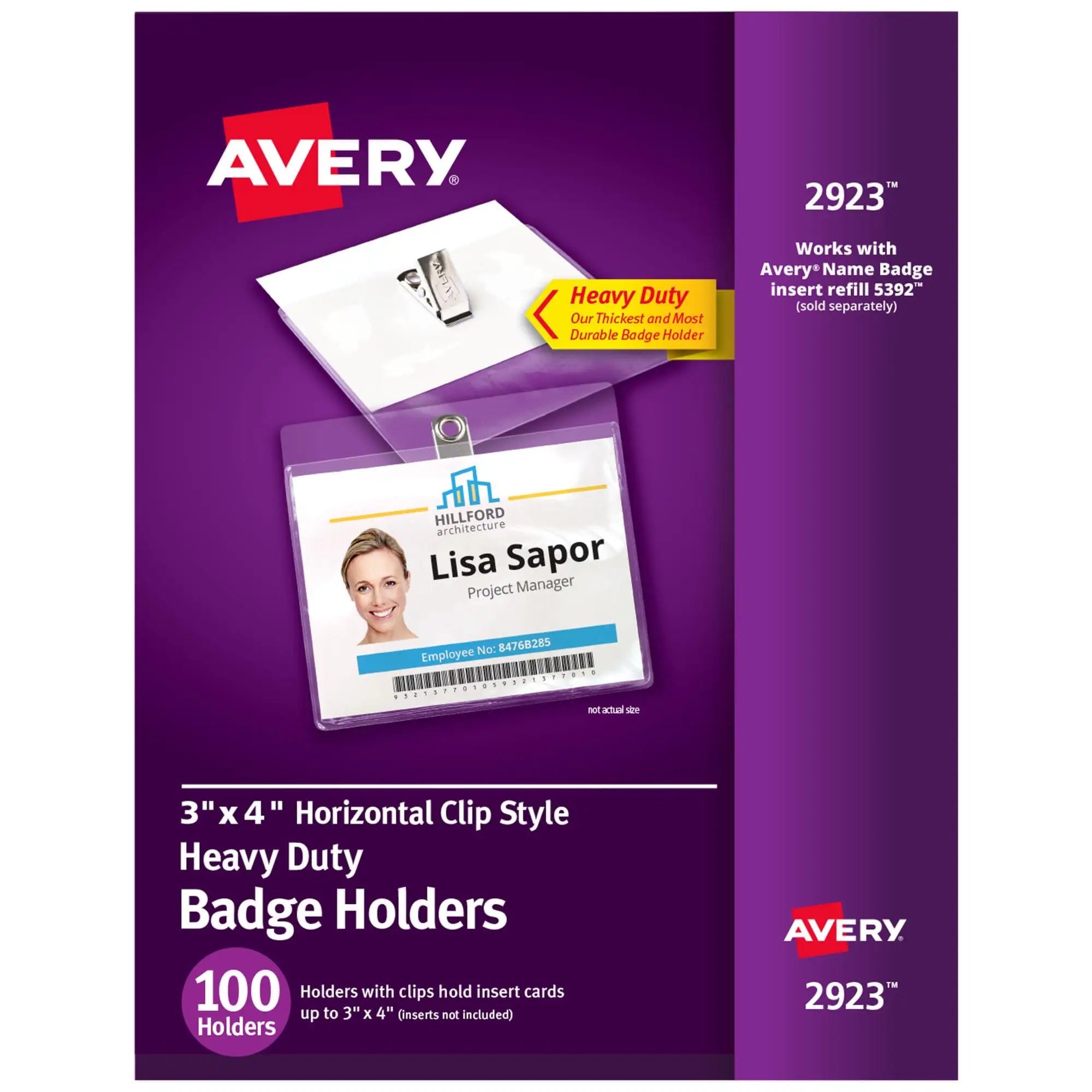
“Works great… inserts load into the badge at the top so they do not fall out.” That single Amazon review captures the core appeal of Avery Customizable Name Badges, Clip Style, Clear Name Tag Holders with Printable Inserts: simple, professional-looking identification without the usual badge drama. Verdict: solid choice for events and workplaces that need reusable clip-on badges. Score: 8.6/10
Quick Verdict
Yes (Conditional) — Yes if you want reusable, top-loading badge holders you can print or handwrite; conditional if you require PVC-free materials or need guaranteed stock availability.
| What the feedback supports | Evidence from sources | Who it’s best for |
|---|---|---|
| High satisfaction overall | Amazon listing shows 4.7/5 from 468 reviews (74536) | Event organizers, offices |
| Secure top-loading inserts | Amazon reviewer: “inserts load into the badge at the top so they do not fall out.” | Conferences, visitor badges |
| Durability improved vs older Avery packs | Amazon reviewer: “plastic cover seems slightly thicker, more durable… stay flat better” | Reuse across multiple events |
| Garment-friendly clip positioning | Product pages emphasize clips that “won’t damage fabric” (Amazon + Avery) | Staff wearing badges daily |
| Potential material confusion (PVC vs PVC-free) | Amazon 74536 description says “PVC-free,” while Avery 74536 describes “durable pvc plastic” | Sustainability-sensitive buyers |
Claims vs Reality
Avery’s marketing repeatedly frames these as quick, professional, fabric-safe badges you can print at home, then reuse. Digging deeper into the available user feedback, most real-world commentary aligns with the “quick and easy” and “reusable” pitch—but there’s a notable contradiction around materials that could matter to compliance-driven workplaces.
Claim 1: “Top-load design keeps inserts secure and makes loading easy.” The strongest piece of user feedback here comes from an Amazon review for a closely related 3" x 4" kit (74541). A verified Amazon reviewer noted: “inserts load into the badge at the top so they do not fall out.” For reception desks, volunteer check-in, or visitor management, that’s not a cosmetic detail—it means fewer mid-event fixes and less time reprinting names.
Claim 2: “Durable, reusable holders.” That same reviewer framed the durability as an upgrade over older Avery boxes: “plastic cover seems slightly thicker, more durable and so far seems to hold its shape and stay flat better than the ones i had in the past.” For recurring meetings or multi-day conferences, “stay flat” is the difference between a badge that looks crisp on day two and one that curls and feels disposable.
Claim 3: “Garment-friendly clip won’t damage fabric.” Across Amazon and Avery product pages, the clip is consistently described as “garment-friendly” and designed to “hold firmly without damaging fabric.” But user-level evidence about fabric impact isn’t present in the provided reviews; what exists is primarily the manufacturer claim repeated across platforms. While the overall ratings are high (Amazon 74536 shows 4.7/5), the dataset doesn’t include a specific user story confirming “no fabric damage,” so that promise remains more marketing than verified experience here.
Cross-Platform Consensus
Universally Praised
A recurring pattern emerged around “professional results without outsourcing.” The official Amazon listing for 74536 emphasizes that buyers can “quickly and easily create durable, professional clip style name tags” and design them using Avery templates. The one concrete user story available supports that real-world workflow: a verified Amazon reviewer described choosing a larger pack to produce “visitor badges, employee name badges, etc.” and concluded: “overall this is a great product i would recommend for designing name badges.” For office administrators and event staff, that endorsement is fundamentally about reducing friction—print, insert, clip, done.
Another consistent theme is insert security. In environments where badges are constantly handled—front desk sign-ins, conferences, kid programs—insert slippage is one of the most common failure points. The Amazon reviewer’s detail is specific and operational: “inserts load into the badge at the top so they do not fall out.” For trade shows and mixers, where people fidget with badges and move between sessions, “do not fall out” is the kind of small win that prevents dozens of interruptions.
Durability also shows up as a practical benefit rather than a vague claim. The same reviewer compared older Avery badge kits to newer ones: “plastic cover seems slightly thicker, more durable… hold its shape and stay flat better.” For teams that reuse holders and just swap cardstock inserts each event, “hold its shape” directly impacts perceived professionalism; a warped badge holder makes even a well-designed insert look cheap.
After those themes, the ratings themselves form a kind of cross-platform signal. Amazon’s 74536 listing shows 4.7/5 from 468 reviews, and Avery’s 74536 page shows 4.8/5 (31 reviews). While star ratings aren’t a story on their own, they align with the limited but positive narrative evidence: buyers generally see these as dependable, repeatable event supplies rather than one-off disposable tags.
Key strengths buyers keep circling back to:
- Printing + top-loading inserts suit recurring events and visitor programs
- “Stays flat” and “more durable” matters for reuse across multiple days
- High ratings across Amazon and Avery product pages reinforce overall satisfaction
Common Complaints
The biggest “complaint” visible in this dataset isn’t about performance—it’s about availability. On the Amazon listing for the 3" x 4" 50-count kit (74536), the page states it is “currently unavailable.” For last-minute event planners, “unavailable” is not an inconvenience; it can force a switch in badge format (lanyards, adhesive badges, or another size) and may require redesigning inserts under time pressure.
Another issue is confusion around product identity and specs across sizes. The dataset includes multiple Avery badge products—74536 (3" x 4", 50 count), 74461 (2-1/4" x 3-1/2", 100 count), and 74651 (24 total)—with overlapping descriptions. That matters because a buyer might expect a certain sheet layout (“6 per sheet” vs “8 per sheet”) or a specific badge size for compatibility with existing inserts. The sources describe those differences, but user feedback here doesn’t clarify how often buyers order the wrong one; it’s simply a realistic risk given the similar naming.
The most concrete “reality check” is a material contradiction. Amazon’s 74536 description calls the holders “PVC-free clear plastic,” while Avery’s 74536 page calls them “durable pvc plastic,” and the Office Depot listing for 74461 identifies the material as “polyvinyl chloride (PVC, #3).” While officially described as PVC-free in at least one place, multiple official retail/manufacturer pages elsewhere describe PVC. For workplaces with strict materials requirements (healthcare systems, schools, certain procurement policies), that mismatch can become a purchasing blocker even if the badge works well.
Common friction points implied by the data:
- Stock issues can derail event prep (Amazon 74536 “currently unavailable”)
- Similar product names and sizes create ordering risk
- While officially described as PVC-free in one listing, multiple sources describe PVC
Divisive Features
The biggest divisive element isn’t a feature—it’s the “PVC vs PVC-free” labeling conflict. Sustainability-minded organizers may be drawn to the Amazon claim of “PVC-free,” but procurement teams cross-checking Avery or Office Depot may see “PVC plastic” and reject it. While marketing claims one material story in some places, the dataset suggests buyers should verify the specific SKU and retailer description before assuming a PVC-free holder.
Size and pack count can also split opinions depending on the use case. A small team running occasional workshops might prefer compact 2-1/4" x 3-1/2" badges (74461) for less bulk, while conferences may gravitate toward 3" x 4" (74536) for readability. The Amazon reviewer who upsized to a 100-badge box did so for value: “only a few dollars more for over twice the number of badges.” That mindset won’t match buyers who only need a handful and don’t want leftover inventory.
Trust & Reliability
Across the provided sources, there isn’t meaningful Trustpilot-style “scam concern” content—what’s included under Trustpilot is essentially product-page material and retail listings, not consumer complaint narratives. That absence limits any investigation into fraud patterns, misleading listings, or customer service disputes based on verified Trustpilot reporting.
On reliability in actual use, the single detailed long-form user story points toward stable performance over time, at least relative to older versions. A verified Amazon reviewer compared their earlier Avery badges to a newer kit and reported: “more durable… hold its shape and stay flat better,” plus “i have not had any of the clips come out.” For teams reusing holders—swapping inserts for each event—that “clips come out” detail is the kind of failure prevention that matters most in day-to-day operations.
Alternatives
Only a few alternatives are explicitly mentioned in the data, and they mostly live within the same ecosystem. The most direct “alternative” is choosing a different Avery size/count rather than a different brand.
If you’re deciding between Avery 74536 (3" x 4", 50 count) and Avery 74461 (2-1/4" x 3-1/2", 100 count), the trade is readability vs compactness and sheet layout. Avery’s 74536 page describes “6 per sheet,” while 74461 lists “8 per sheet,” which can matter for batch printing speed. For staff ID badges worn daily, the smaller format might feel less bulky; for conferences where legibility across a room matters, 3" x 4" is often the safer bet.
Avery also sells other attachment styles (magnetic, pin, lanyard) described on the Amazon manufacturer content, but there’s no user feedback in the dataset comparing these directly. So the strongest alternative guidance supported here is simply: pick the right size and pack count for your event cadence, and confirm the material claim at the retailer you’re buying from.
Price & Value
The data suggests price/value is strongly tied to pack size. An Amazon listing for a smaller top-loading kit (74651, 24 total) shows $17.77, which implies a higher per-badge cost for small quantities. On the other end, Avery’s site lists 74461 (100 count) at $113.76 (with shipping details), positioning it as more of a bulk procurement item.
A verified Amazon reviewer framed the value decision plainly: they moved from a 40-badge box (Avery #5384) to a 100-badge box (Avery #74541) because it was “only a few dollars more for over twice the number of badges.” For offices that continuously need visitor badges or rotating staff badges, that logic often wins—especially if holders are reused and only inserts are reprinted.
For resale or market pricing, the provided “eBay” section is effectively a duplication of product-page pricing info rather than real secondary-market transactions. The clearest buying tip supported by the dataset is procurement-oriented: confirm the exact SKU (74536 vs 74461 vs 74651), confirm the sheet format (6 per sheet vs 8 per sheet), and double-check the material labeling (PVC vs PVC-free) before placing a bulk order.
FAQ
Q: Do the inserts fall out of these top-loading Avery badges?
A: The available user feedback suggests the top-loading design holds inserts securely. A verified Amazon reviewer wrote: “inserts load into the badge at the top so they do not fall out.” That’s especially relevant for conferences and visitor badges where badges get bumped and handled frequently.
Q: Are the badge holders PVC-free or PVC?
A: The sources conflict. Amazon’s 74536 listing describes “PVC-free clear plastic,” while Avery’s 74536 page describes “durable pvc plastic,” and Office Depot lists 74461 as “polyvinyl chloride (PVC, #3).” Buyers with strict material requirements should verify the specific SKU and retailer listing.
Q: Are these durable enough to reuse for multiple events?
A: One verified Amazon reviewer compared older Avery badges to a newer kit and said the “plastic cover seems slightly thicker, more durable” and “seems to hold its shape and stay flat better.” They also reported: “i have not had any of the clips come out,” supporting reuse for repeated events.
Q: Which size should I pick: 3" x 4" or 2-1/4" x 3-1/2"?
A: The data shows both sizes are common. Avery 74536 is 3" x 4" (50 count) and Avery 74461 is 2-1/4" x 3-1/2" (100 count). Larger badges can improve readability at conferences; smaller badges can feel less bulky for daily staff use.
Final Verdict
Buy if you’re an office admin, event coordinator, or volunteer organizer who needs reusable, top-loading clip-on name badges that print cleanly and stay together; the available user story backs “do not fall out” inserts and improved durability. Avoid if your organization requires confirmed PVC-free materials, because the official descriptions conflict across retailers. Pro tip from the community: a verified Amazon reviewer upgraded to a larger box because it was “only a few dollars more for over twice the number of badges,” making bulk packs the better value when you run recurring events.