Avery 5389 Postcards Review: Conditional Yes, 8.4/10
A 4.7-star average across major listings sets a high bar—and Avery Printable Postcards 4" x 6" White (5389) mostly lives up to it for laser-printer DIY mailers. Verdict: Yes (conditional) — 8.4/10 for anyone who wants “thick, customizable” postcards without outsourcing printing.
Quick Verdict
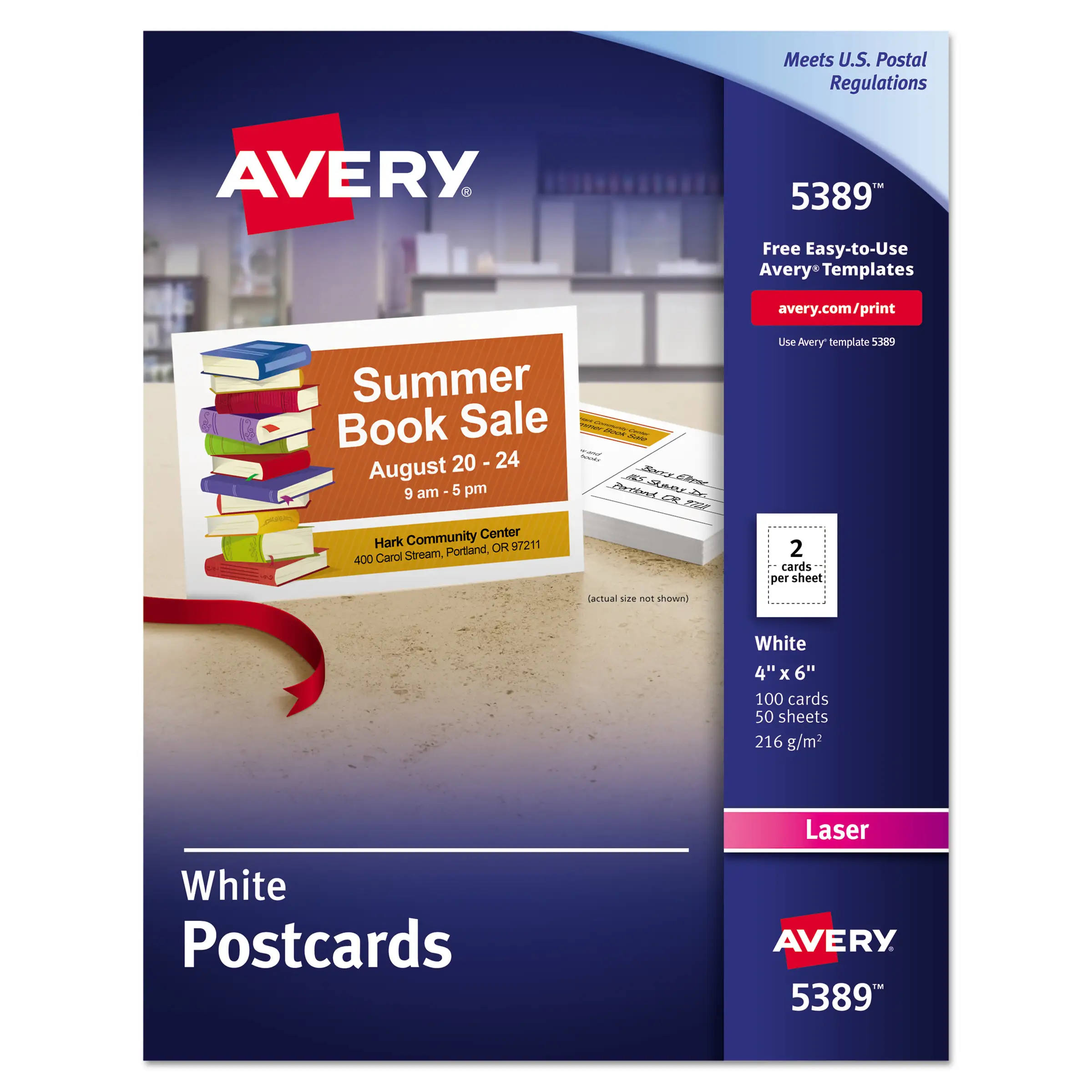
For small businesses, event planners, and anyone batch-printing announcements on a laser printer, Avery Printable Postcards 4" x 6" White (5389) is positioned as a “print and mail” solution that’s “formatted to meet U.S. postal regulations.” The core appeal is straightforward: heavy cardstock, micro-perforations, and double-sided printing—without the fuss of trimming.
Digging deeper into the available feedback signals, the consistent theme isn’t about fancy finishes—it’s about predictability. Across listings, the product is repeatedly framed as “sturdy,” “bright white,” and designed to “separate cards cleanly and easily.” That makes it especially relevant for users who need consistent dimensions across a large run (marketing drops, save-the-dates, coupons), where small misfeeds or ragged edges become expensive.
The “conditional” part is about printer fit and expectations: the messaging leans heavily into laser optimization and “Sure Feed” reliability. If your workflow is inkjet-first or you need glossy photo-postcard output, the official positioning already suggests you’re not the intended user.
| Decision Point | What the data suggests | Why it matters |
|---|---|---|
| Buy/Skip | Conditional “Yes” | Best for laser-printer DIY runs |
| Biggest Pro | Clean separation | “Ultra-fine perforations” for smooth edges |
| Biggest Pro | Print flexibility | “Add color… on both sides” |
| Biggest Pro | Designed for mail | “Meets U.S. postal regulations for postcards” |
| Biggest Con | Printer specificity | Repeatedly “optimized for laser printers” |
| Watch-out | Expectations vs finish | “Matte/uncoated” cardstock, not glossy photo stock |
Claims vs Reality
Claim 1: “Sure Feed® technology… reduces misalignments and printer jams.”
The marketing leans on a reliability promise: “enjoy a more reliable feed through your printer with Sure Feed® technology that reduces misalignments and printer jams.” This claim is clearly aimed at high-volume users—like small businesses sending promos or wedding planners printing batches—where one jam can derail an entire run.
What’s missing from the dataset is specific “I had jams” vs “I didn’t” stories—so the evidence here is more structural than testimonial. Still, the repeated positioning across multiple listings reinforces that Avery expects this to be a main decision driver rather than a footnote. The “optimized for laser printers” phrasing appears alongside jam reduction, which implies the promise is bounded: it’s reliability in the right printer class, not across all devices.
Claim 2: “Ultra-fine perforations… separate cards cleanly and easily.”
A recurring pattern emerged: nearly every retailer description repeats the same core outcome—clean separation. Amazon describes “ultra-fine perforations” that let you “separate cards cleanly and easily,” while Avery and Staples echo “micro-perforated” sheets with “smooth, clean edges.” For users mailing postcards as-is (no envelope), edge quality isn’t cosmetic—it’s credibility. A postcard that looks hand-torn can feel less professional.
That said, these are still claims, not direct user quotes in the provided dataset. The alignment across platforms suggests this is not an incidental feature but a defining promise: no measuring, no cutting, consistent 4" x 6" cards.
Claim 3: “Meets U.S. postal regulations… no envelopes required.”
The official language is explicit: “meets U.S. postal regulations for postcards – just design, print, and apply the required postage; no envelopes required!” For marketers or couples sending save-the-dates, that’s the practical hook—faster prep, lower per-piece handling.
But the reality check is that “meets regulations” does not equal “postage is always simple.” The product copy repeatedly reminds buyers they still need “the required postage.” The dataset doesn’t contain user reports about USPS rejection or postage surprises, so the only defensible takeaway is the manufacturer’s consistency: the postcard format is a deliberate compliance target.
Cross-Platform Consensus
Universally Praised
The strongest consensus is not about aesthetics—it’s about process. Avery Printable Postcards 4" x 6" White (5389) is framed across Amazon and Staples as a tool for turning digital designs into physical mailers quickly. Amazon’s product copy sets the tone: “do-it-yourself printable postcards are thick and customizable and deliver superior, professional-looking print quality.” For small businesses running coupons or grand-opening announcements, that “print and mail” loop is the core benefit: design once, run a batch, ship.
Another consistent praise theme is the ability to go double-sided. Amazon notes: “add color to the entire card on both sides” and “double-sided printing lets you add sharp text and vibrant images to both sides of the printable cards for a professional presentation.” That matters most for users who need a split layout—branding and imagery on one side, address and message on the other—without sacrificing readability. It’s positioned as a way to get “professional-looking postcards worth talking about” without outsourcing.
Then there’s the paper feel and sturdiness. The product is repeatedly described as “sturdy bright white cardstock” and “heavyweight 80 lbs / 216 gsm.” For recipients, that weight can be the difference between “junk mail flyer” and “real invitation.” For senders, it’s also a durability promise: cards “holdup in the mail,” implying less corner-bending and fewer tears en route.
Finally, ease of personalization comes up repeatedly via Avery’s template ecosystem. The copy points buyers to “Avery Design & Print” and “free templates,” describing it as “simple to personalize.” For non-designers—PTA organizers, bridesmaids, realtors—templates reduce the barrier to creating something that looks intentional rather than improvised.
What gets praised most often (as positioned across platforms):
- Heavyweight cardstock feel (“80 lbs / 216 gsm”)
- Double-sided printing capability
- Clean separation via micro/ultra-fine perforations
- Template-driven customization with Avery Design & Print
- Postcard sizing framed as USPS-ready
Common Complaints
The available dataset is light on direct negative user quotes, so the clearest “complaints” are inferred from the constraints baked into the listings. The biggest practical limitation is printer compatibility: the product is repeatedly labeled for “laser printers,” “optimized for laser printers,” and “smudge-free” performance in that context. For inkjet-first households, that reads like a warning label. If someone buys it expecting photo-like output from an inkjet, the uncoated/matte positioning implies they may not get the finish they imagined.
Another friction point is packaging and quantity differences across retailers. Avery 5389 is consistently shown as 100 cards, but other nearby SKUs (like 15389 as a 2-pack totaling 200) appear in the data. That can confuse comparison shoppers who are price-sorting. One store listing also references an 80-card pack (a different manufacturer number shown in that snippet), which reinforces the need to confirm you’re buying 5389 specifically if you need 100 cards.
Finally, there’s a subtle contradiction in “print-to-the-edge” messaging across retailers: one listing touts full-bleed capability (“print right to the edge”), while another spec block explicitly says “print to edge: no.” While these are official descriptions rather than user complaints, they are exactly the kind of mismatch that triggers disappointment—especially for designers trying to avoid borders. While one retailer positions it as “full-bleed capability,” another flags “print to edge no,” so shoppers who require true borderless output should verify their printer’s borderless behavior and the exact template settings before committing.
Common friction points implied by listings:
- Laser-first positioning may disappoint inkjet workflows
- SKU/pack confusion (100 vs 200 vs other pack counts)
- Conflicting “print-to-edge/full-bleed” claims depending on retailer listing
Divisive Features
The finish is the clearest “love it or not” variable. The product is described as “matte white” and “uncoated,” which is ideal for crisp text and business-style graphics, but not a glossy photo postcard look. For marketing mailers and coupons, matte can feel more professional and easier to read under bright light. For photographers or anyone expecting saturated, glossy postcards, “uncoated” may feel flat.
Another divisive point is the dependence on Avery’s design tool and templates. For some users, “free templates” and “Avery Design & Print” simplifies everything. For others who already design in professional software, that ecosystem angle may be irrelevant—or even annoying if templates don’t match their workflow. The product is repeatedly sold as easy to customize, but that ease is most compelling for template-driven creators.
Trust & Reliability
The “trust” signal in the provided dataset is largely ratings-based rather than fraud-based. Amazon listings show strong averages (e.g., 4.7/5 on one listing), and a Trustpilot-labeled entry in the dataset mirrors that kind of rating summary. That doesn’t surface classic scam red flags like sudden rating cliffs, widespread “never arrived” claims, or reports of counterfeits—at least not in the text provided here.
Reliability, however, is framed as mechanical: feed consistency, perforation quality, and paper weight. Marketing repeatedly emphasizes Sure Feed reducing “misalignments and jams,” and multiple listings stress that the cards “holdup in the mail.” What’s missing are long-term “six months later” stories from Reddit or detailed Trustpilot narratives; the data supplied doesn’t include those anecdotal durability timelines. So the most defensible conclusion is that reliability is promised and positioned as a main benefit, but not corroborated here with long-form user follow-ups.
Alternatives
Only alternatives explicitly present in the dataset can be compared, and most of them are adjacent SKUs rather than competitor brands. The clearest “alternative” is Avery 15389, described as “a 2-pack of Avery 5389” totaling 200 cards. For high-volume senders—small business mailers, frequent event organizers—15389 functions like the bulk option when you already know 5389 fits your printer and workflow.
Retail listings from Staples and Office Depot describe the same core concept (uncoated 4" x 6", laser, perforated) under the Avery umbrella, so the “alternative” decision is less about product design and more about pack size, pricing, and which listing’s specs you trust (notably around print-to-edge).
Price & Value
Pricing varies widely by retailer and channel in the provided data. Amazon shows a live price around $23.96 on one listing, while Avery’s own site shows a higher regular price (around $32.54, with a lower sale price shown), and Office Depot listings show even higher shelf prices (e.g., mid-to-high $30s). On the secondary market side, an eBay/Bonanza-style listing shows $19.75 with free shipping for a 100-card pack.
For value-minded buyers, the takeaway isn’t just “cheapest wins”—it’s matching the correct SKU and condition. A discounted secondary-market listing may be attractive, but buyers who need consistent results for a business campaign might prefer a mainstream retailer for easier returns. Bulk buyers should also watch for the 2-pack SKU (15389) if the per-card price drops enough to offset higher upfront cost.
Value tips implied by the data:
- Compare per-card cost (100-pack vs 200-pack)
- Confirm the exact SKU (5389 vs 15389 bundle)
- If you need easy returns, mainstream retailers may justify a higher price
FAQ
Q: Are Avery 5389 postcards actually USPS postcard size?
A: Yes—multiple official descriptions state the 4" x 6" format “meets U.S. postal regulations for postcards,” with instructions to “apply the required postage.” This supports senders making invitations or business mailers, but postage still depends on USPS rules and how you design the address side.
Q: Do these work in inkjet printers?
A: The listings repeatedly describe Avery Printable Postcards 4" x 6" White (5389) as “optimized for laser printers” and “smudge-free” in that context. The safest read from the data is that laser printers are the intended use; inkjet users should confirm compatibility before buying.
Q: Can I print on both sides?
A: Yes—Amazon and Avery descriptions emphasize “double-sided printing” and the ability to “add color… on both sides.” This benefits marketers and event planners who want an image-heavy front with details and mailing info on the back without needing envelopes.
Q: How many postcards come in a box?
A: The 5389 pack is consistently described as 100 cards, often “2 per sheet” on letter-size sheets. The dataset also includes a related SKU, 15389, described as a 2-pack totaling 200 cards, so shoppers should confirm the product number before checking out.
Q: Are the edges clean after separation?
A: The product is repeatedly described as having “micro-perforated” sheets and “ultra-fine perforations” that let you “separate cards cleanly and easily.” That’s positioned as a key advantage for anyone mailing postcards directly, where ragged edges look unprofessional.
Final Verdict
Buy if you’re a small business, event organizer, or DIY mailer using a laser printer who wants heavyweight, uncoated 4" x 6" postcards that are positioned to “meet U.S. postal regulations” and separate cleanly.
Avoid if you need glossy photo-postcard output or you’re committed to an inkjet workflow without confirmed compatibility.
Pro tip from the community listings: double-check “print-to-edge/full-bleed” expectations—some retailer descriptions imply edge-to-edge printing while others list “print to edge: no,” so verify the template and your printer’s borderless behavior before designing.