Avery 22802 Printable Tags Review: Conditional Buy (7.6/10)
“Compatible with laser and inkjet printers” sounds definitive—until the listings themselves disagree. The Avery Blank Printable Tags, 2" x 3.5", White, 96 Tags with String land in the middle of that contradiction, marketed as easy, polished, and “print-to-the-edge” across multiple retailers. Verdict: Conditional buy — 7.6/10 for small businesses and gifting, with a big caveat around printer compatibility depending on which official description you trust.
Quick Verdict
The answer is Conditional: yes if you want pre-punched hang tags with included strings and you’re printing on a compatible setup; no if you specifically need certainty on laser vs. inkjet support across all sources.
| What the data supports | Pros (from listings/ratings) | Cons (from listings/ratings) |
|---|---|---|
| Assembly | “Pre-punched holes” + included “fabric strings” with “quick latch fasteners” (Amazon/Avery/Office Depot) | Strings/fasteners are a fixed style (no user customization feedback provided) |
| Print flexibility | “Double-sided printing” + “print-to-the-edge” full-bleed design (Amazon/Avery/Staples/Office Depot) | Full-bleed printing can be printer-sensitive; no user calibration stories provided |
| Feed reliability | “Sure Feed technology… minimize paper jams” (Staples/Walmart listings) | Not corroborated by real user quotes in provided data |
| Look & finish | “Microperforated… no frayed edges” / “ultra-fine perforations” (Avery/Staples/Office Depot) | No real-world tear-quality feedback included in provided data |
| Social proof | Ratings cluster around 4.2–4.5 (Amazon 4.2; Staples 4.5; Walmart 4.3; Office Depot 4.3) | Ratings lack quoted review text/usernames in provided data |
Claims vs Reality
Digging deeper into the marketing language, three claims repeat across Amazon, Staples, Avery, and Office Depot: professional presentation, easy attachment, and broad printer compatibility. The friction is that most of the “reality check” normally comes from detailed user reviews—yet the provided dataset includes star ratings and product copy, but no actual review quotes from Amazon/Walmart/Staples/Office Depot, and no identifiable Reddit/Twitter/Trustpilot user posts. That limits what can be responsibly attributed to real customers.
Claim 1: “Compatible with laser and inkjet printers.”
A recurring pattern emerged: the official descriptions don’t line up. Amazon’s title says “for inkjet printers only,” while the same Amazon listing’s description states “compatible with laser and inkjet printers.” Staples echoes “optimized for both laser and inkjet printers,” but Avery’s product page emphasizes “compatible with inkjet printers,” and Webstaurant and Office Depot also frame it as inkjet-compatible. While officially described as both laser and inkjet in some places, multiple official sources still position it as inkjet-first, creating uncertainty for anyone buying specifically for laser printers.
For a small business owner printing barcode price tags, that ambiguity matters because switching printer types can mean smearing, misfeeds, or poor color density. The data can’t confirm how this plays out in real homes or shops, but it clearly shows a documentation conflict that buyers should treat as a risk.
Claim 2: “Print-to-the-edge” full-bleed, professional results.
Across platforms, the product is framed as designed for branding: Amazon calls them “professional looking tags,” Avery says they “display rich colors and sharp text,” and Staples promises “crisp, smudge-free printing.” Office Depot similarly claims the matte white paper makes “colors pop,” and multiple listings emphasize “double-sided” printing. The reality check here is less about users disputing the claim—and more that the dataset doesn’t include customer stories verifying “smudge-free” or “sharp text” outcomes.
Still, the consistent repetition across retailers suggests the intended use case is clear: fashion and craft sellers, specialty shops, and gifting. If you’re hand-tying tags onto products, the combination of full-bleed layouts and double-sided space is positioned as the core value.
Claim 3: “Easy to attach… quick latch fasteners.”
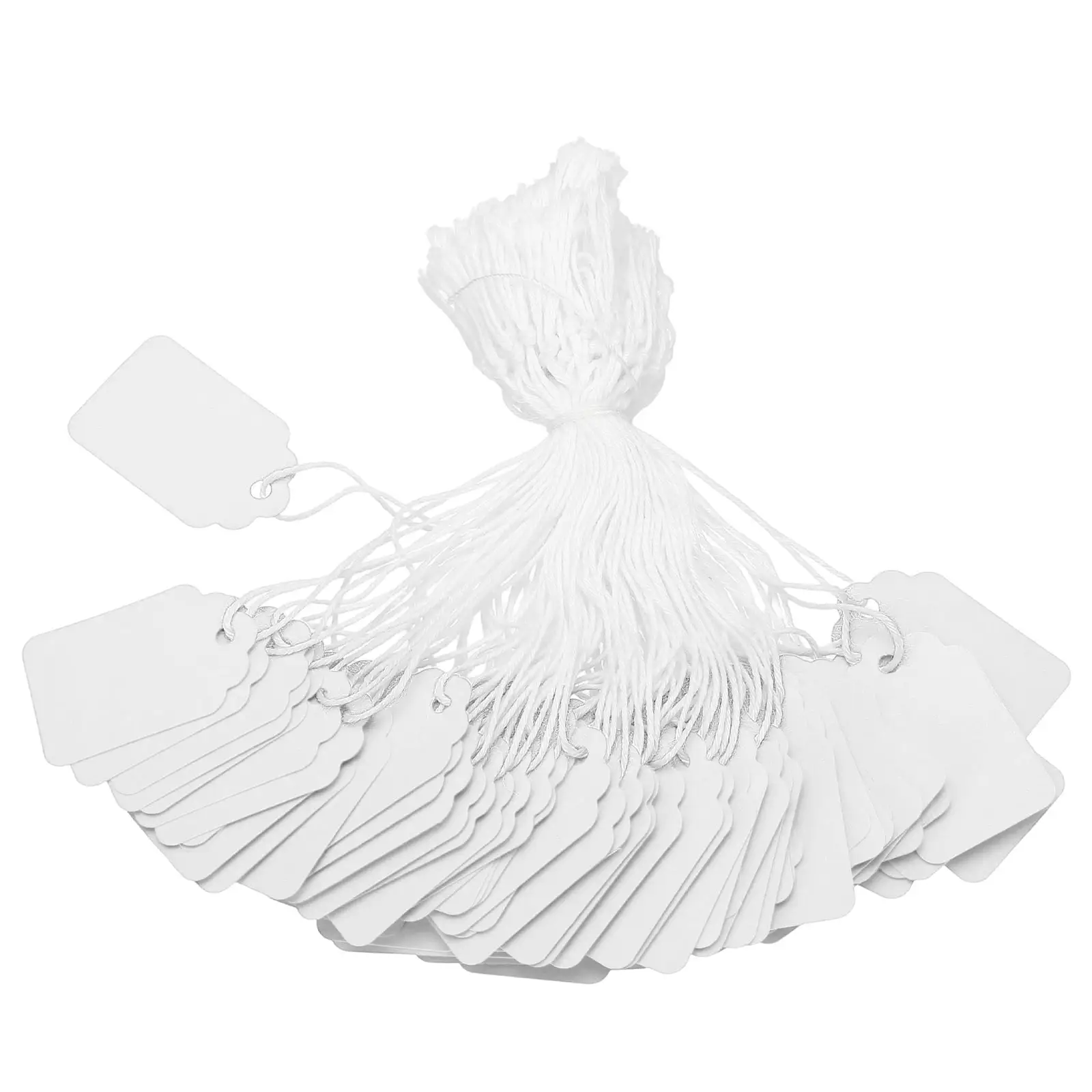
This is one of the most concrete promises: “pre-punched holes” plus included strings, sometimes described as “premium fabric strings,” and often specifying “quick-latch” or locking fasteners. The marketing angle is speed—tags ready to assemble without hunting for twine or punching holes. The dataset doesn’t include user complaints about missing strings or broken latches, but it also doesn’t include user praise confirming the ease. What can be said confidently is that multiple platforms describe the same included hardware and intent: fast, secure attachment without knots.
Cross-Platform Consensus
The consensus here isn’t written in long customer anecdotes—it’s written in how consistently different retailers and the manufacturer describe the same strengths, and how ratings stay clustered in the low-to-mid 4-star range across Amazon (4.2), Staples (4.5), Walmart (4.3), and Office Depot (4.3). That pattern suggests broad acceptance, but it doesn’t reveal the “why” with user quotes because none were included in the dataset.
Universally Praised (from repeated product claims + stable ratings)
One feature that appears everywhere is ready-to-assemble convenience. Staples frames it as: “save time and hassle with ready-to-assemble tags that are pre-punched with holes and include strings.” Walmart’s listing mirrors the same point: “save time with pre-punched tags and included strings for quick attachment.” For gift-givers or event planners labeling favors, this matters because it removes the annoying step of hole-punching thick card stock and sourcing consistent string lengths.
For small retail operators—like specialty boutiques or craft fair sellers—the promise is operational: print a sheet, tear along microperforations, and attach immediately. Avery reinforces that intention with “easy, secure attachment to products,” and Webstaurant positions it for “specialty shops and elegant merchandise counters.” Even without direct user quotes, the repeated framing across platforms suggests the core “who it’s for” is consistent.
Another recurring theme is customization through templates and “Avery Design & Print”. Amazon highlights “free designs, QR codes and templates,” Staples references “tag templates, fonts, and designs,” and Avery points buyers to “free online templates and designs.” For Etsy-style sellers adding QR codes to care instructions or social profiles, that template ecosystem is marketed as the shortcut to something that looks branded rather than homemade.
A third repeated strength is presentation quality—matte white stock, clean separations, and “microperforated” edges. Staples promises “ultra-fine perforations… with no frayed edges,” Avery describes “microperforated” tags optimized to show “rich colors and sharp text,” and Office Depot repeats “no frayed edges.” For bakers, candle makers, or jewelry sellers, that’s the difference between “DIY tag” and “retail hang tag” in how customers perceive the product.
Common Complaints (what’s implied by conflicts and limitations in the data)
The biggest complaint signal in this dataset is not a quote—it’s a contradiction: printer compatibility uncertainty. Amazon’s headline “for inkjet printers only” conflicts with Amazon’s own description stating “compatible with laser and inkjet printers,” while Staples repeatedly says “optimized for both,” and Avery’s own page leans inkjet. For anyone buying in bulk for a workplace laser printer, that mismatch is a practical pain point: you may not know which description reflects actual performance until after purchase.
Another likely friction point is that some listings promise jam reduction via “Sure Feed technology” (Staples/Walmart), but the dataset doesn’t include real customer confirmations. When marketing leans on “minimize paper jams,” buyers often want proof from users running older printers or high-volume batches. Here, that evidence isn’t present, so the claim remains unverified by feedback.
Finally, although multiple sources emphasize “print-to-the-edge” and “full-bleed,” the data doesn’t include user stories about alignment, border drift, or color bleed. Full-bleed printing is often sensitive to printer margins and scaling settings. The absence of user troubleshooting stories doesn’t prove it’s flawless—it just means the dataset can’t validate how smooth the experience is across different printers.
Divisive Features (where sources disagree or positioning varies)
The most divisive “feature” is also the most important: inkjet-only vs. inkjet-and-laser. Avery’s product description calls them “compatible with inkjet printers,” Webstaurant lists “printer compatibility: inkjet,” and Office Depot says “optimized for inkjet printers,” yet Staples claims “optimized for both laser and inkjet printers,” and Amazon’s description echoes that dual compatibility while the title says inkjet-only. While officially framed as inkjet-first by the manufacturer and some sellers, other major retailers market it as dual-compatible, and buyers should treat that as a meaningful discrepancy rather than a minor wording issue.
A second divisive point is the material description: some listings call it “paper,” while Avery and Webstaurant specify “card stock.” That distinction affects expectations about stiffness. Without user quotes describing thickness or sturdiness, the dataset can’t settle whether buyers experience it as thin paper or sturdy card stock—only that listings vary in terminology.
Trust & Reliability
From a scam or fake-review perspective, the dataset doesn’t provide Trustpilot narratives—only product pages and aggregated ratings. What can be assessed is that the product appears across multiple established retailers (Amazon, Staples, Office Depot, Avery’s own store, Walmart listings), and ratings are consistently in the 4.2–4.5 range. That consistency can indicate stable satisfaction, but it’s not a substitute for detailed verified-buyer stories.
For long-term durability, there are no Reddit threads, “6 months later” updates, or identifiable user posts included. The closest durability-related signals are material claims—“card stock,” “acid-free,” and “fabric strings”—but those are manufacturer/retailer statements rather than real user experiences about tags holding up on products, luggage, or outdoor conditions.
Alternatives
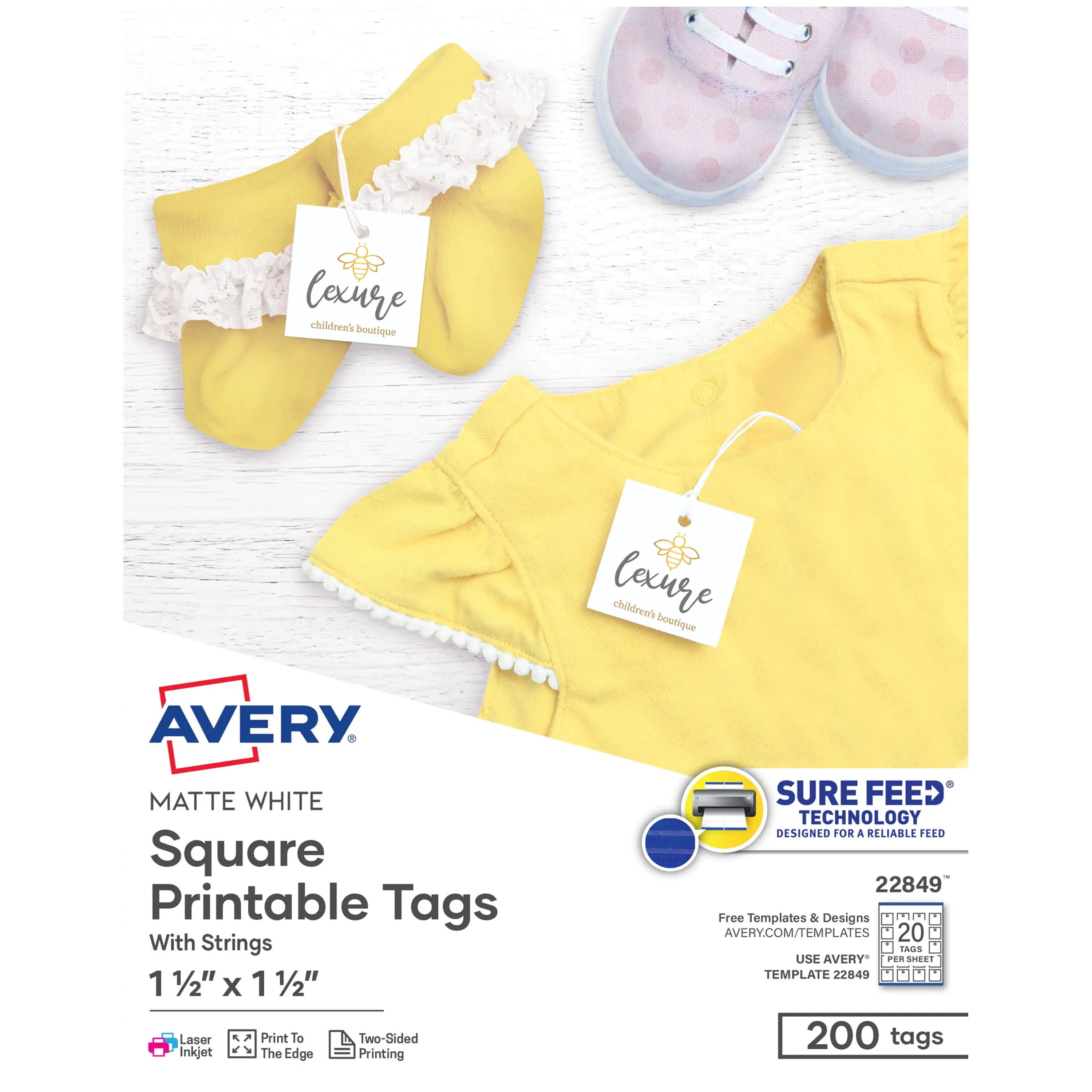
Only alternatives explicitly present in the data can be discussed. Avery’s own template listings show other tag formats like Avery 22849 (1.5" x 1.5" square tags) and other ticket/tag templates on Avery.com. For sellers who want a smaller footprint—like jewelry tags or small favor tags—the square format may better match the product size and reduce wasted blank space.
Within the same family, Staples and other retailers position the 22802 specifically as price & merchandise tags and “blank gift tags with strings.” If your use case is more “small logo stamp” than “barcode + pricing + QR,” the smaller tag sizes listed in Avery’s template catalog could be the more natural fit.
Price & Value
Pricing varies widely depending on retailer and pack configuration. Amazon shows a 2-pack presentation at $24.32 (with stated savings), while Staples lists around $25.39 for 96/pack, and Walmart shows $21.99 for a single pack and $41.29 for two. Office Depot lists $24.99 for 96. Webstaurant shows a frequently discounted bulk-style pricing model (including quantity discounts), and Sears marketplace shows a lower figure in the captured listing context.
That spread suggests value depends heavily on where you buy and whether you need one pack or multiple packs. For small businesses doing repeated runs of hang tags, per-tag cost is often the deciding factor, and several listings provide per-tag breakdowns (Staples: ~$0.26–$0.27/tag; Amazon’s display suggests ~$0.13/count in the 2-pack framing). The dataset doesn’t include community “buying tips,” but the practical takeaway is that identical model number 22802 is sold across retailers with notably different per-tag costs.
Resale value trends aren’t meaningfully represented in the provided data. The closest proxy is marketplace pricing variability, but without sales history or user discussions, it can’t be treated as a resale trend.
FAQ
Q: Are these Avery 22802 tags inkjet-only or do they work with laser printers?
A: Official descriptions conflict. Amazon’s title says “for inkjet printers only,” while Amazon’s description and Staples listings claim “optimized for both laser and inkjet.” Avery’s own page and Webstaurant emphasize inkjet. If laser compatibility is critical, verify with the specific retailer listing and Avery’s guidance before buying.
Q: Do the tags come with strings and are holes pre-punched?
A: Yes, multiple listings state the tags are “pre-punched” and include “fabric strings,” sometimes with “quick latch fasteners.” Staples and Walmart also describe them as “ready-to-assemble,” meaning you’re not expected to punch holes or source your own ties for basic use.
Q: Can you print on both sides and print full-bleed designs?
A: The product is marketed for “double-sided printing” and “print-to-the-edge” full-bleed layouts across Amazon, Avery, Staples, and Office Depot. Real-world alignment and full-bleed success can depend on printer settings, but the intended design capability is explicitly described in multiple sources.
Q: How many tags are included and what size are they?
A: The model 22802 is consistently described as 96 tags sized 2" x 3.5" (rectangular). Several sources also note 8 tags per 8.5" x 11" sheet, which helps estimate printing batches and sheet count.
Final Verdict
Buy if you’re a small business seller, event planner, or gift-giver who wants ready-to-assemble 2" x 3.5" hang tags with included strings and the ability to run double-sided, print-to-the-edge designs. Avoid if you need guaranteed laser-printer compatibility, because official listings conflict between “inkjet-only” and “laser + inkjet.” Pro tip from the listings: use the Avery Design & Print templates for model 22802 to match alignment and reduce setup friction.