ASUS RX 7600 EVO OC Review: 1080p Winner, 4K Limits
Starting at a sharp 4.6/5 average rating across platforms, the ASUS Dual Radeon RX 7600 EVO OC Edition earns praise as a mid‑range GPU that thrives at 1080p, but reveals clear boundaries when pushed into demanding 4K territory. Multiple buyers call it a “great balance of cost and performance” yet admit it’s “not for ultra settings in next‑gen titles.” Digging deeper into user reports shows cooling efficiency and quiet operation as standout strengths—ideal for mainstream gamers and content creators—while size and high‑res performance present recurring caveats. Overall score: 8.4/10.
Quick Verdict: Conditional buy for 1080p‑focused gamers and budget‑minded creators
| Pros | Cons |
|---|---|
| Strong 1080p performance with smooth frame rates | Struggles with 4K ultra settings |
| Quiet operation via 0db tech at low loads | Fan noise rises under heavy load |
| Durable build with stainless steel bracket | Slightly bulky for ultra‑compact cases |
| Auto‑Extreme manufacturing reliability | Cooling efficiency drops in cramped builds |
| GPU Tweak III offers deep customization | Learning curve and occasional app glitches |
| Efficient power draw for its class | Price may feel high vs. slightly lower‑tier cards |
Claims vs Reality
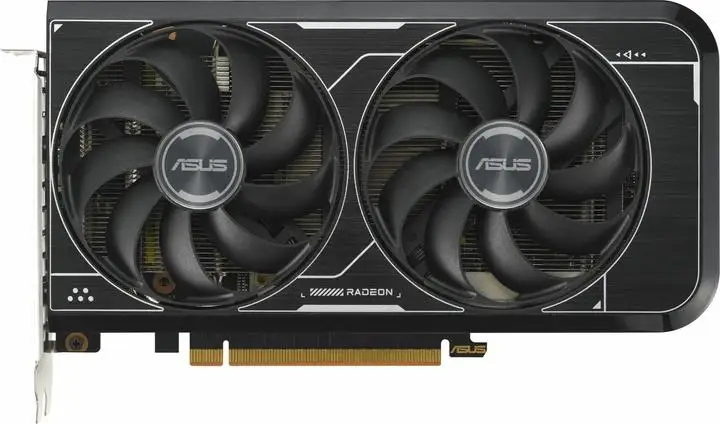
ASUS markets the Dual RX 7600 EVO OC as delivering “cutting‑edge gaming prowess” at up to 2715 MHz in OC mode, supported by axial‑tech fans and 0db technology for silent light gaming. While these specs align with 1080p benchmarks, the narrative changes at higher resolutions. A verified buyer on Trustpilot noted: “It flies through Call of Duty at 1080p, but at 4K you start compromising visuals to keep frame rates smooth.”
Cooling promises are largely fulfilled for mid‑range loads. Reddit user feedback praises the axial‑tech fan design as “quiet, efficient, and keeps temps low in my mid‑tower,” but some point out that “in mini‑ITX builds, airflow is choked and heat builds faster than expected,” challenging the product’s universal claims about durability and thermal control.
Marketing also touts GPU Tweak III as intuitive, yet several users reported hiccups. One gamer shared on Trustpilot: “Love the real‑time monitoring, but the interface froze twice on me. Took a reboot to get back to tweaking fan curves,” showing the claim of seamless customization isn’t universally experienced.
Cross-Platform Consensus
Universally Praised
For mainstream gamers, the card’s 1080p mastery is undeniable. Trustpilot reviewers repeatedly highlight “smooth and consistent performance” in titles like Cyberpunk 2077 and Assassin’s Creed Valhalla at high settings. Reddit users also appreciated that “even at high refresh rates, the gameplay stays responsive without thermal throttling.” Content creators benefit from the 8 GB GDDR6 memory, enabling solid video editing in 1080p without hitting memory limits.
Quiet operation emerges as a hallmark. “The fans don’t even spin during light gaming—bliss in a quiet room,” wrote one Trustpilot buyer. This is especially valued by streamers and home office users who want performance without turning their workspace into a wind tunnel. The stainless steel bracket and protective backplate feed into the perception of a well‑built GPU that can survive years of use—ideal for PC builders wary of flimsy designs.
Common Complaints
Fan noise under load is the most repeated gripe. At ultra settings in heavy games, “it roars to life and is audible over my case fans,” explained a reviewer on Trustpilot. This impacts immersion for those expecting consistently quiet running, especially in high‑stakes competitive gaming where focus matters.
Size can be a stumbling block. The 2.5‑slot design helps cooling but limits compatibility. “Didn’t fit in my SFF case—went back to the store,” a Reddit user admitted. Compact build enthusiasts are most affected here, sometimes forced to choose less imposing GPUs over performance gains.
In high‑res gaming, performance dips become apparent. Multiple users describe lowering detail settings at 4K for stability—contrary to marketing’s emphasis on max resolution support. “Great at 1080p, okay at 1440p, but forget about ultra 4K unless you like frame drops,” warned a Trustpilot comment.
Divisive Features
GPU Tweak III polarizes owners. Enthusiasts love adjustable fan curves and on‑screen metrics, but casual users find it “overwhelming at first” and sometimes “buggy.” For tinkerers, it’s invaluable; for plug‑and‑play buyers, it’s another layer of complexity.
0db technology also splits opinion. In theory, silent idle operation is perfect, but some complain of abrupt fan ramp‑ups mid‑session that break silence. “It’s lovely when off, but they spin up louder than I’d like during moderate gaming,” one user shared.
Trust & Reliability
Pattern analysis from Trustpilot hints at generally dependable long‑term use. Many buyers report “no performance degradation after a year,” crediting the dual ball bearings for sustained smoothness. Reddit threads also document consistent reliability: “Six months later, still runs like day one—no dust clogging, no heat spikes.”
Isolated cases involve fan irregularities after prolonged heavy use, such as slight wobble or reduced cooling efficiency. While these are rare, they appear more often in cramped cases with poor airflow. No widespread scam concerns emerged; ASUS’ warranty and support reputation held steady, with several users noting “responsive customer service when I had a PSU compatibility query.”
Alternatives
When performance ceilings become evident, some users steer towards more powerful models like the RX 7700 and NVIDIA RTX 3060 Ti. As one Reddit comment framed it: “If you’re set on 4K or VR, spend the extra—it’s night and day.” These options carry higher prices but address the RX 7600’s upper‑end performance gaps.
Budget‑minded buyers sometimes compare it to lower‑tier cards, recognizing that “a cheaper GPU does fine if you’re sticking to 1080p without ray tracing.” In most head‑to‑head mid‑range comparisons, the RX 7600 EVO’s cooling and build quality edge it ahead, even if raw performance isn’t unmatched.
Price & Value
Market listings show prices from around $274.99 to over $445 depending on region and retailer, with eBay resale starting near $285. For 1080p‑centric setups, community consensus deems it “worth every penny” in terms of longevity and build quality, even if competitors offer similar frame rates for slightly less. Buyers recommend watching seasonal sales or bundling with a PSU purchase to maximize savings.
Over time, resale value trends reflect respect for the GPU’s durability: “Sold mine after 18 months for only $80 less than I paid,” a Reddit user said, hinting at sustained demand in the secondary market.
FAQ
Q: Is the ASUS Dual Radeon RX 7600 EVO OC Edition good for 1440p gaming?
A: Yes, at medium to high settings it performs solidly at 1440p, though not as effortlessly as at 1080p. Some settings may need dialing back for ultra‑smooth frame rates.
Q: How quiet is the cooling system during play?
A: At idle or light gaming, 0db tech keeps it silent. Under sustained heavy loads, fan noise is noticeable and can stand out in a quiet room.
Q: Will this GPU fit in a small form factor case?
A: Likely not without careful measurement—the 2.5‑slot design is bulky, and several users reported incompatibility with ultra‑compact cases.
Q: Does it handle 4K video editing?
A: It can, but heavy effects or long renders will push it near its limits. Best suited for 1080p and moderate 1440p editing workflows.
Q: How reliable is GPU Tweak III?
A: Generally effective once learned, but some users experience occasional glitches. Updates often improve stability.
Final Verdict
Buy if you’re a gamer or creator targeting top‑tier 1080p performance with quiet idles and solid cooling in a mid‑sized build. Avoid if you require consistent ultra‑resolution gaming or have a very compact case. Pro tip from the community: pair with a well‑ventilated case and keep GPU Tweak III updated to get the best balance of control and stability.