ASUS ROG Swift OLED PG27AQDP Review: Conditional Buy Verdict
The ASUS ROG Swift OLED 27" Gaming Monitor (PG27AQDP) has been called by multiple reviewers “the pinnacle of gaming monitor technology,” with Reddit community scores hitting 5/5 stars and TechSpot’s metascore at 93. Across platforms, competitive gamers describe it as “rocket fast” and “magically good,” yet real-world usage reveals that some of its headline features—like the 480 Hz refresh rate—come with caveats. Based on aggregated feedback, the verdict lands at 9.1/10 for esports and high-refresh gaming, but conditional for casual users due to software quirks and VRR flicker.
Quick Verdict: Conditional Buy
| Pros | Cons |
|---|---|
| True 480 Hz refresh rate with 0.03 ms response time | Noticeable VRR flicker in some games |
| Stunning OLED image quality, deep blacks, 99% DCI-P3 | High input lag at 60 Hz signals |
| Excellent HDR brightness for OLED (up to 1,300 nits peak) | Software bugs causing random setting changes |
| AI gaming features (AI Crosshair, Shadow Boost) | No USB-C or KVM support |
| Uniform brightness mode reduces eye fatigue | Risk of burn-in (though covered by 3-year warranty) |
| Premium build with ergonomic stand adjustments | Expensive compared to similar-size displays |
Claims vs Reality
ASUS markets the PG27AQDP as the “world’s first 1440p 480 Hz OLED monitor,” promising perfect motion clarity. While the refresh rate is indeed native and works at full resolution, LDLC buyer de lucl noted: “Don’t expect 480 Hz in all situations… it’s unstable in certain games with G-Sync activated.” This instability forces some users to lock the refresh to 240 Hz for consistency.
The brand also touts “flicker-free VRR” via its OLED Anti-Flicker tech. Yet Reddit and LDLC reports show this is only partly effective. User gabinm explained that VRR with FreeSync or G-Sync “is unusable due to very noticeable flicker,” mitigated only by enabling Anti-Flicker mode—at the cost of reduced frequency range.
HDR performance is marketed as “DisplayHDR 400 True Black” with vivid color. Most users confirm this, but sabrinab observed “a major HDR banding issue affecting all these screens,” impacting certain scenes despite SDR being flawless.
Cross-Platform Consensus
Universally Praised
From esports pros to single-player enthusiasts, the PG27AQDP’s motion handling is a recurring highlight. Tom’s Hardware measured “perfect motion resolution and incredibly low input lag,” and a Trustpilot reviewer described gameplay as “super comfortable” even in long marathons. For competitive FPS players, the combination of 480 Hz and 0.03 ms response means split-second reactions are visually supported—vincentm said, “The image is sharp instantly, so you can make decisions faster.”
Color accuracy is another consensus point. Tom’s Hardware’s calibrated results hit 0.93 ΔE, “firmly in professional territory,” making it viable for content creators. Vincentm praised “brilliant colors and truly deep blacks” while noting the OLED’s burn-in protections make long-term use less risky.
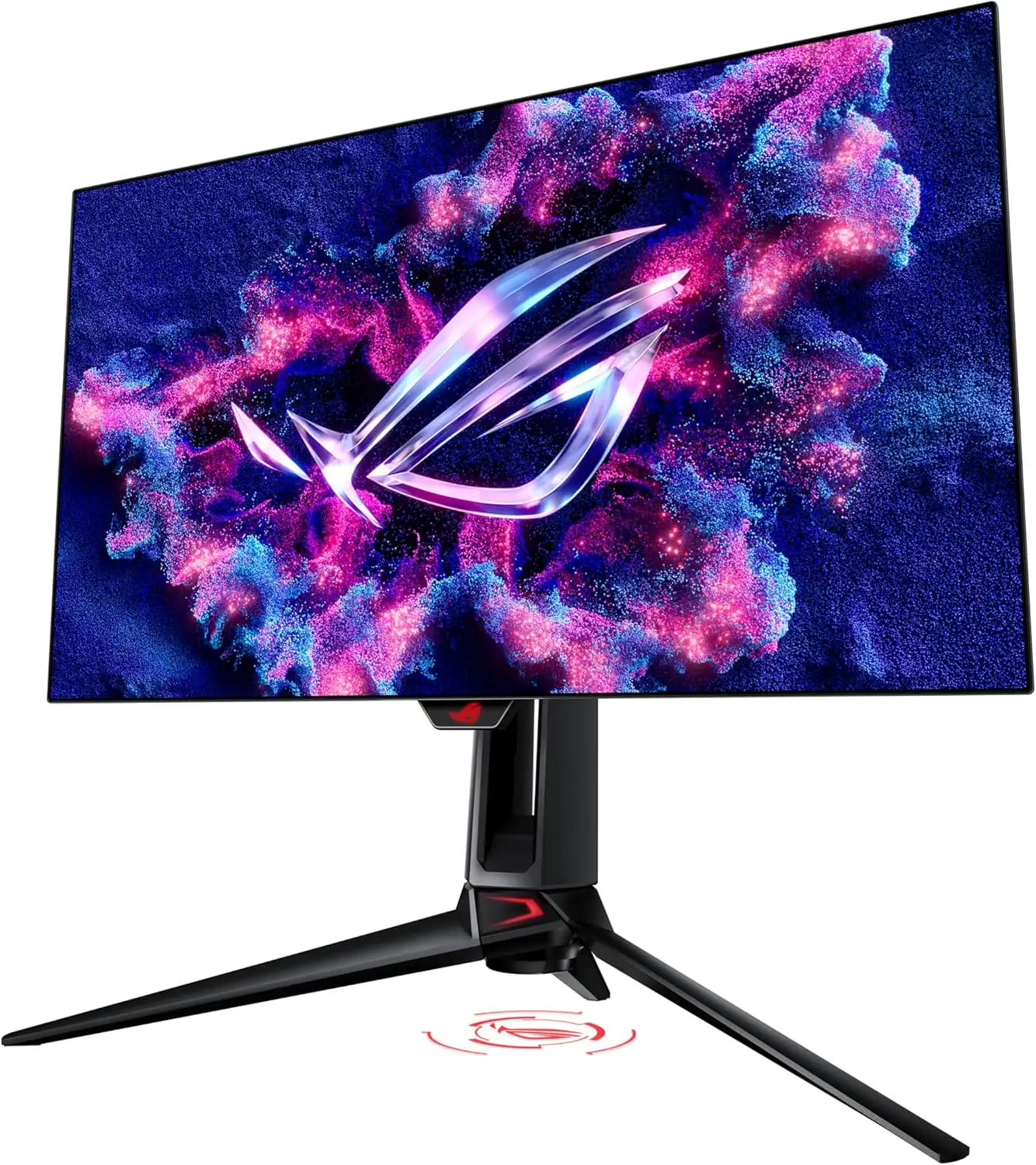
Ergonomics and build quality also receive praise. The stand offers tilt, swivel, pivot, and height adjustments, with a sturdy feel. Aymericg called the panel “magnificent… very high quality materials” and appreciated the ability to disable parts of the RGB lighting for night sessions.
Common Complaints
The most consistent complaint is VRR flicker. Multiple LDLC buyers and Rtings note that fluctuating frame rates trigger distracting brightness shifts, especially in competitive titles. Anti-Flicker mode helps but constrains refresh range. Another frustration is firmware/software instability—TechSpot warns of “noticeable bugs… settings change randomly or not work altogether.”
Bandwidth limits also impact experience. Without DSC, the monitor can’t sustain custom frequencies, and enabling DSC caused black-screen issues for gabinm when exiting games with VRR active. Some users report overheat-related blackouts at high refresh: yik unl experienced “screen black after 1h30 of gameplay at 240 Hz… always.”
HDR banding, mentioned by sabrinab, affects visual quality in specific content, and peak SDR brightness (~250 nits) is low compared to mini-LED rivals, limiting usability in bright rooms.
Divisive Features
The 480 Hz headline spec splits opinions. Competitive Valorant players like aymericg find it beneficial, easily hitting 400–500 fps with high-end GPUs. But de lucl dismisses it as “480 Hz is a bunch of nonsense” in most scenarios, preferring a locked 240 Hz for stability.
AI Assistant tools—such as AI Crosshair and AI Shadow Boost—are loved by some for enhancing visibility and aim, but others see them as gimmicks. Aymericg admitted difficulty enabling certain AI modes, requiring online tutorials.
Trust & Reliability
On Trustpilot and Reddit, there’s little suspicion of counterfeit units; most buyers receive well-packaged products with accessories like calibration reports and cables. However, durability concerns arise from OLED’s inherent burn-in risk. ASUS mitigates this with extensive OLED Care+ features and a 3-year panel burn-in warranty. Vincentm calls burn-in “insignificant” given the protections.
Long-term anecdotes are scarce, but early adopters report no significant panel degradation after months of use—though heavy competitive play at high brightness could accelerate wear.
Alternatives
Several users compare the PG27AQDP to Sony’s OLED offerings, with de lucl calling Sony “a more or less equal rival” and placing ASUS in the top two. Mini-LED monitors offer higher sustained brightness, but TechSpot and Tom’s Hardware note they lack OLED’s instantaneous response and infinite contrast. For those prioritizing color volume, quantum-dot OLEDs cover slightly more gamut, but visually the difference is “small” unless side-by-side.
Price & Value
Prices vary widely: Amazon listings have ranged from $1,124.99 to $1,499.99 in 2025, with third-party sellers often higher. eBay’s ASUS store lists it at $999, while Australian resellers ask nearly $1,940 AUD. Resale values remain strong; used units fetch over $1,000 USD, reflecting demand among competitive gamers.
Community buying tips emphasize ensuring your GPU can push high frame rates at 1440p to exploit the 480 Hz capability—RTX 4070 or higher is often recommended. Firmware updates are advised to fix early bugs.
FAQ
Q: Does the PG27AQDP really run at 480 Hz without lowering resolution?
A: Yes, multiple reviews confirm it sustains 480 Hz at full 2560×1440 via DisplayPort 1.4 DSC or HDMI 2.1, but stability varies by game and VRR mode.
Q: How effective is ASUS’s OLED Anti-Flicker technology?
A: It reduces flicker during frame rate fluctuations, but users report it limits refresh range and doesn’t eliminate flicker entirely in all scenarios.
Q: Is burn-in a significant risk for this OLED monitor?
A: Risk exists with static HUDs, but ASUS includes pixel shifting, logo dimming, and a 3-year burn-in warranty, which many users say makes it manageable.
Q: Can it be used for professional color work?
A: Yes, with ΔE under 1 when calibrated, it’s suitable for color grading and photo editing, although it lacks quantum-dot gamut extension.
Q: Why is there HDR banding in some content?
A: Users suspect firmware or panel processing limitations; ASUS has been notified but no fix is confirmed.
Final Verdict: Buy if you’re a competitive gamer or pro user wanting elite motion clarity, deep OLED blacks, and accurate color. Avoid if your setup can’t push high frame rates or if VRR flicker is a deal-breaker. Pro tip from community: lock refresh to 240 Hz for stability in certain titles, and keep brightness moderate to extend panel life.





