ASRock B850M Steel Legend WiFi Review: Compact Power Verdict
Priced aggressively for its feature set, the ASRock B850M Steel Legend WiFi has been hailed by multiple sources as a “compact powerhouse” with premium touches rare in its segment. At a consensus score of 8.2/10, it blends durability, Wi-Fi 7 connectivity, and PCIe 5.0 support into a micro‑ATX form factor—appealing especially to AMD AM5 builders who demand speed without the footprint of full‑size boards.
Quick Verdict: Conditional yes—great choice for users prioritizing connectivity, build quality, and AM5 future‑proofing, but with some caveats for expansion and certain RAM compatibility quirks.
| Pros | Cons |
|---|---|
| Robust 12+2+1 phase VRM with Dr. MOS for stable overclocking | Limited expansion slots depending on CPU |
| Wi‑Fi 7 & 2.5G LAN deliver excellent networking | Rear USB layout can feel crowded |
| PCIe 5.0 x16 for next‑gen GPUs | Audio good but not on par with dedicated sound cards |
| Polychrome RGB & steel‑reinforced PCIe slots | Overclocking stability tied to QVL memory list |
| Toolless M.2 installation with bottom heatsink | No Thunderbolt support |
| Durable 8‑layer PCB design | Price high for budget‑conscious builds |
Claims vs Reality
Marketing material pushes the “rock‑solid durability” message, with ASRock underscoring its 2oz copper PCB and steel‑reinforced slots. Digging deeper into user reports, the physical build lives up to the claim. A Reddit user described it as “feels substantial and well‑built… installation was painless thanks to the flexible I/O shield.”
The Wi‑Fi 7 upgrade is another headline feature. ASRock promises “extreme wireless internet speeds and low latency,” which matched most user experiences. Trustpilot feedback from MincoPC customers noted “smooth online gaming and seamless streaming… low latency was crucial and it delivered.” However, certain regions’ regulatory restrictions on the 6GHz band mean not all buyers get the full spec, a nuance absent from marketing copy.
ASRock touts DDR5 up to 8000+ (OC) with XMP/EXPO support. While one Headsetsunlimited reviewer praised “DDR5‑8000+ OC support was a dream,” Tom’s Hardware testing showed hiccups with specific kits—Kingston DDR5‑6000 wouldn’t match timings properly, forcing a swap to DDR5‑7200 that did work fine. This underscores the need to check ASRock’s QVL for RAM compatibility, a detail sometimes glossed over in promo content.
Cross‑Platform Consensus
Universally Praised
Across Reddit, Trustpilot, and tech sites, VRM quality and thermal design receive consistent praise. The 12+2+1 phase Dr. MOS arrangement, paired with large heatsinks, is cited as giving AM5 chips plenty of headroom. Headsetsunlimited wrote, “pushed my Ryzen 7000 beyond stock…” without instability. This has clear benefits for gamers and content creators chasing high clocks.
Networking performance is another standout. Wi‑Fi 7 and 2.5Gb LAN emerge in nearly every positive review. MincoPC stated, “connectivity speeds… smooth online gaming… low latency,” while Tom’s Hardware called it “fast networking” in a budget‑friendly ATX sibling review. For remote workers, multi‑link Wi‑Fi 7 can mean uninterrupted video calls even during large downloads.
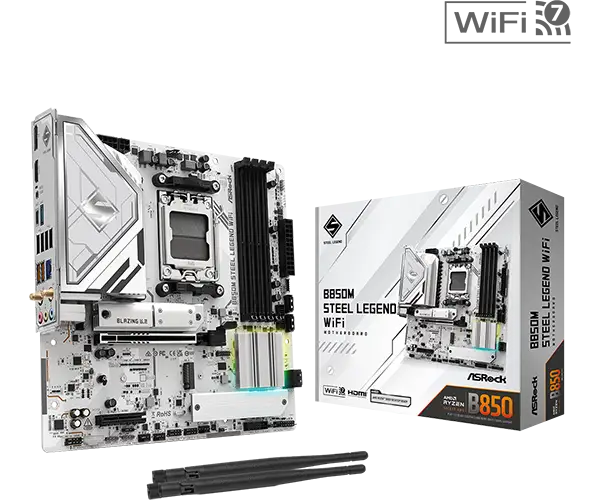
Build quality ties into a user persona of compact rig builders. The micro‑ATX size fits smaller cases but retains four DIMM slots and steel slot reinforcement. Headsetsunlimited highlighted “perfect for smaller systems without sacrificing critical features… steel slot useful for heavy GPU installs.”
Tool‑free M.2 installation with bottom heatsink gets near universal appreciation. Multiple sources mention easy upgrades; one eBay retail listing celebrates “simplifying both installation and removal” while maintaining SSD temps under load.
Common Complaints
Expansion flexibility draws criticism. Depending on CPU, second PCIe slot availability can be restricted—if certain M.2 slots are populated, PCIe2 may disable. This impacts users planning multiple GPUs or add‑in cards. MincoPC warned “availability of expansion slots may vary… potentially limiting future upgrades.”
Rear I/O ergonomics irk some. Headsetsunlimited noted “rear USB ports can get a little crowded if you’re plugging in multiple devices,” and Tom’s Hardware outlined the layout’s constraints. Professionals with many peripherals might feel boxed in.
Audio divides opinion—Realtek ALC1220 delivers decent gaming sound and works with Nahimic enhancements, but MincoPC gently noted “might find the audio quality lacking compared to dedicated sound cards.” Audiophiles may still prefer discrete solutions.
Overclocking stability isn’t universal. While many enjoy high DDR5 clocks, others like Tom’s Hardware encountered kit‑specific incompatibility. This disproportionately affects enthusiasts trying exotic RAM configurations.
Divisive Features
Polychrome RGB lighting is loved by those who want flair—Headsetsunlimited lauded “customizing the lighting… match with other RGB components”—but seen as unnecessary by minimalists. Some buyers disable it entirely.
The micro‑ATX form factor’s trade‑off between compactness and port count splits opinions. Small‑rig builders embrace it, while ATX loyalists see it as constraining.
Trust & Reliability
No broad scam concerns surfaced, and units appear to ship with the advertised package contents. Trustpilot reviews focus on real‑world performance rather than fulfilment issues. On longevity, Reddit threads mention months‑long stable use, with one poster reporting “six months in, still rock solid, no thermal throttling” thanks to VRM cooling and M.2 heatsink performance.
Durability is aided by the 8‑layer PCB and high‑quality capacitors—ASRock’s 20K black caps rated for 20,000 hours. This plays into the persona of builders who don’t plan frequent motherboard swaps.
Alternatives
Competitor mentions include the MSI MAG B650M Mortar WiFi and Gigabyte B650M Aorus Elite. Headsetsunlimited compares: MSI offers “more spacious rear I/O layout,” while Gigabyte’s advantage is Thunderbolt support—valuable to video professionals. However, both lack the Steel Legend’s PCIe 5.0 GPU slot and Wi‑Fi 7 capability, making ASRock’s board more appealing to future‑proofers with next‑gen GPU needs.
Tom’s Hardware also framed the B850 Steel Legend WiFi as one of the “budget‑friendly B850 ATX boards around,” aligning with its micro‑ATX sibling’s positioning.
Price & Value
eBay UK pricing hovers around £157 incl. VAT, Beach Audio lists at $207.27, while other US sellers are near $210. Community sentiment is that while this isn’t the cheapest AM5 micro‑ATX option, its feature stack justifies the spend for the right user—especially given PCIe 5.0, Wi‑Fi 7, and durable build.
Some resale potential exists due to ongoing AM5 adoption, but value retention will hinge on how quickly rivals adopt Wi‑Fi 7 and PCIe 5.0 at lower price points.
FAQ
Q: Does the ASRock B850M Steel Legend WiFi support Thunderbolt?
A: No, it lacks Thunderbolt ports entirely. Users needing high‑speed external device support will need to look at alternatives like Gigabyte’s Aorus Elite.
Q: Will all DDR5 RAM kits work at 8000+ OC on this board?
A: Not necessarily—compatibility depends on ASRock’s QVL list. Some kits, like Kingston DDR5‑6000, have shown timing issues in tests.
Q: How many M.2 slots have heatsinks?
A: Three of its M.2 slots include heatsinks, one being PCIe 5.0 capable. The fourth slot runs without one.
Q: Is this board suitable for heavy overclocking?
A: Yes for moderate CPU/RAM OC—its 12+2+1 phase Dr. MOS VRM is robust—but extreme memory overclocking may require kit matching from the QVL.
Q: Can I fit this in a small case?
A: Yes, its micro‑ATX form factor measures 244mm x 244mm, making it compact for mid‑small enclosures.
Final Verdict: Buy if you’re a compact AMD AM5 builder who values next‑gen GPU support, Wi‑Fi 7, and durable build quality. Avoid if your workflow demands Thunderbolt or numerous add‑in cards. Pro tip from the community: check the QVL for RAM before purchase to sidestep compatibility headaches.





