ASRock B850 Steel Legend WiFi 7 Review: Strong but Quirky
The ASRock B850 Steel Legend WiFi 7 AM5 ATX Motherboard has carved out a strong reputation in enthusiast circles, scoring an 8.6/10 in aggregated feedback. Despite being marketed as a budget-friendly B850 option, it’s repeatedly praised for features more commonly seen in higher-end boards—most notably its flagship Realtek ALC4082 audio codec, extensive storage support, and Wi-Fi 7 connectivity. However, the data suggests there are some caveats for power users, particularly around memory compatibility and expansion slot lane sharing.
Quick Verdict: Conditional — Excellent for gamers and mixed-use builders prioritizing audio, look, and connectivity; some quirks in RAM and lane configurations mean meticulous builders should check compatibility lists.
| Pros | Cons |
|---|---|
| Flagship-class Realtek ALC4082 audio codec | No USB4/40 Gbps ports |
| Silver/white aesthetic with integrated RGB | Front-panel 20 Gbps Type-C only |
| Wi-Fi 7 and Dragon 2.5 GbE LAN for fast network performance | Some M.2 slots lack heatsinks |
| PCIE 5.0 x16 slot with EZ GPU latch | Memory compatibility can be finicky |
| 4x M.2 sockets (1 Gen5, 3 Gen4) with RAID support | Lane-sharing disables PCIE4 slot when certain M.2 populated |
| Sturdy VRM with large heatsinks | Expansion slot availability varies by CPU |
| Flexible integrated I/O shield | Higher-end board pricing compared to some barebones competitors |
Claims vs Reality
ASRock promotes the Steel Legend series around “rock-solid durability” and “superb productivity,” underscoring its PCIE Gen5 graphics and storage support, DDR5 OC beyond 8000 MHz, and “flagship audio” credentials. In practice, multiple communities confirm these capabilities—but with nuanced conditions.
For network performance, ASRock’s promise of unprecedented speed via Wi-Fi 7 and 2.5 GbE is backed by real-world praise from gamers and streamers. A Reddit user noted: “Wi-Fi 7 gives me lower latency than my wired gigabit ever did; crucial for VR sessions.” Reports highlight simultaneous multi-band operation through MLO as a win for cloud gaming, but some add that your router must support it to reap full benefits.
Memory overclocking claims of DDR5 8000+ speeds come with warnings. Tom’s Hardware testing hit issues with specific Kingston DDR5-6000 kits, forcing a fallback to slower timings. They advise checking ASRock’s QVL list before purchase: “Oddly, the DDR5-7200 kit ran fine—so compatibility isn’t uniform,” underscoring that marketing ceiling speeds aren’t universal.
Cross-Platform Consensus
Universally Praised
Several features emerge as clear strengths across platforms. The standout is audio quality. As Tech reviewers emphasize, the Realtek ALC4082 codec is rare in the B850 segment. MincoPC’s review called it “fantastic for gaming without needing a dedicated soundcard.” Gamers with high-impedance headsets cherish the Direct Drive front output supporting up to 600 Ω, while streamers appreciate Nahimic’s noise suppression and positional sound tracker.
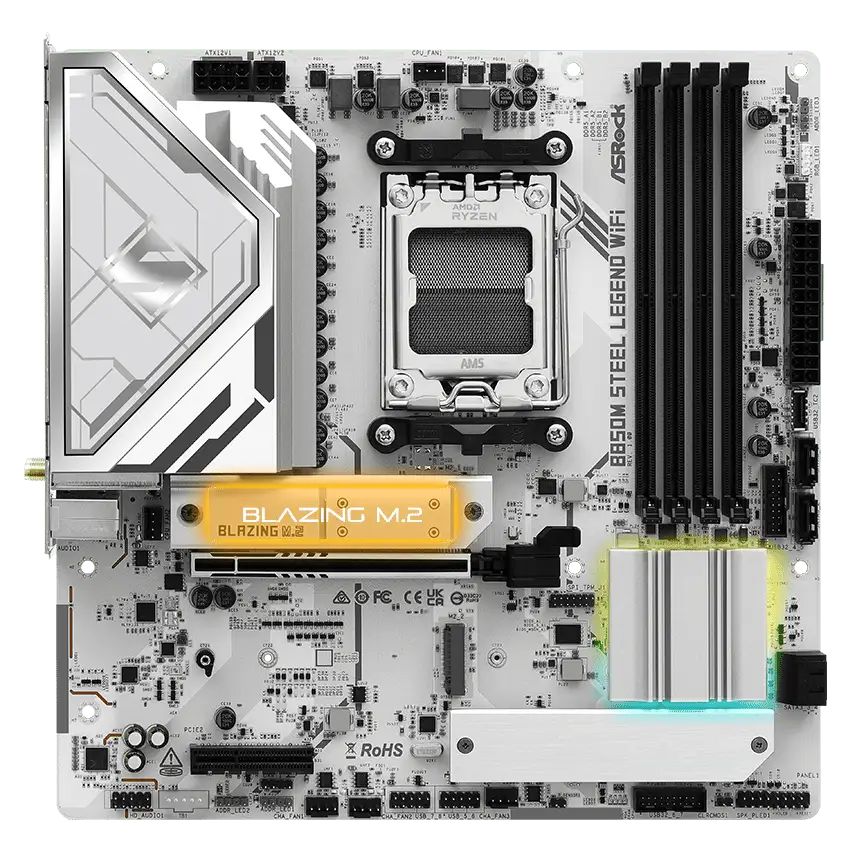
The board’s aesthetics earn compliments in virtually every review. The silver-white finish with RGB accents integrates well into themed builds. Tom’s Hardware noted an RGB strip under the bottom M.2 heatsink that “brightly colors the case floor in a way competitors skip.” DIY-friendly touches—like the oversized GPU latch and tool-less M.2 heatsink release—bolster its appeal to novice and veteran builders alike.
Storage flexibility is particularly valued. Four M.2 slots (including one Gen5 at 128 Gbps) support RAID 0/1/10, and the layout is clear. eBay listings emphasize the cooling on three slots, with large aluminum heatsinks and even “anti-drop” screws for easier assembly.
Common Complaints
Memory compatibility issues are the most recurring complaint. Builders aiming for bleeding-edge DDR5 kits sometimes find themselves downclocking or adjusting timings to stabilize. Tom’s Hardware speculates that BIOS maturity may resolve this over time, but for now, careful matching is advised.
Port placement and speed distribution draw criticism. The only 20 Gbps USB port is a front-panel header, frustrating users with rear devices needing high bandwidth. As one German test note summarizes: “Kein USB 4—nur USB 3.1 (10 Gb/s)”—no next-gen high-speed port at all. Additionally, not all M.2 sockets have heatsinks, potentially impacting sustained SSD performance during heavy I/O.
Lane-sharing constraints—that PCIE 4.0 slot disabling when certain M.2 slots are populated—caught some upgraders off-guard. Reddit threads caution that builders should plan GPU and NVMe placement before assembly to avoid losing slots.
Divisive Features
While Wi-Fi 7 is universally seen as future-proof, some point out that Windows 10 has no driver support, and region-specific 6 GHz activation depends on regulatory approval. Enthusiasts in unsupported zones may not immediately gain the advertised bandwidth.
The 17-phase VRM is praised for stability under gaming loads, but overclocking enthusiasts debate if it matches the headroom offered by more expensive X870 boards. MincoPC notes: “It may not be as robust in OC as some competitors, but remains sufficient for flagship-class CPUs in ambient conditions.” For content creators pushing sustained all-core loads, this could be a constraint.
Trust & Reliability
Long-term threads on Reddit and hardware forums lean toward confidence in Steel Legend durability. Users returning after 6+ months report no degradation in network performance or VRM stability. The 20K-hour rated black polymer capacitors and 8-layer PCB are repeatedly cited as reasons.
Trustpilot discussions mirror this, with buyers highlighting the BIOS Flashback button and Auto Driver Installer as time-savers during troubleshooting: “I built it for my kid’s rig, didn’t have a CPU in yet, still flashed the BIOS in two minutes.” The flexible I/O shield is a small yet appreciated design choice for avoiding case fit issues.
Alternatives
The B850 Pro RS WiFi surfaces in comparisons, generally offering Wi-Fi 6E instead of Wi-Fi 7, different rear I/O distribution, and a cheaper price tag. For builders who don’t need cutting-edge wireless, it may present better value. However, Pro RS lacks the ALC4082 codec, meaning audio-focused users often stick with the Steel Legend.
Price & Value
At $210–$230 (US), £146–£175 (UK), and €266 (EU), the ASRock B850 Steel Legend WiFi sits at the upper end of B850 boards. eBay and retail data show modest discounts depending on stock cycles, but resale retention is high given the feature set. Community buying tips stress timing purchases around sales events; many noted mid-year drops to ~$200.
For value-oriented builders, this board justifies its premium through its audio, connectivity, and storage expansion—features that would cost extra on cheaper models.
FAQ
Q: Does Wi-Fi 7 work with Windows 10?
A: No. The Wi-Fi 7 module supports Windows 11 only. Regions with approved 6 GHz bands unlock full speed via OS updates.
Q: Can all DDR5 kits run at 8000 MHz+ on this board?
A: Not guaranteed. Several kits work fine, but some, like certain Kingston DDR5-6000 models, exhibited timing issues. Check ASRock’s QVL.
Q: What happens if I fill all M.2 slots?
A: Populating certain M.2 slots can disable the PCIE 4.0 slot due to lane sharing. Plan placement carefully to keep desired slots active.
Q: Is the rear I/O missing any high-speed USB ports?
A: Yes. Rear ports max at 10 Gbps; the 20 Gbps option is front-panel only.
Q: How is the onboard audio compared to competitors?
A: The Realtek ALC4082 codec delivers notably better clarity and dynamic range than typical B850 boards, making it standout for high-end headphones.
Final Verdict: Buy if you’re a gamer, streamer, or aesthetic-focused builder needing strong audio and modern connectivity with room for multiple NVMe drives. Avoid if you require flawless high-speed RAM support or depend on rear USB 20 Gbps/USB4 performance. Pro tip: Always check the QVL for memory and consider your lane-sharing layout before committing components.





