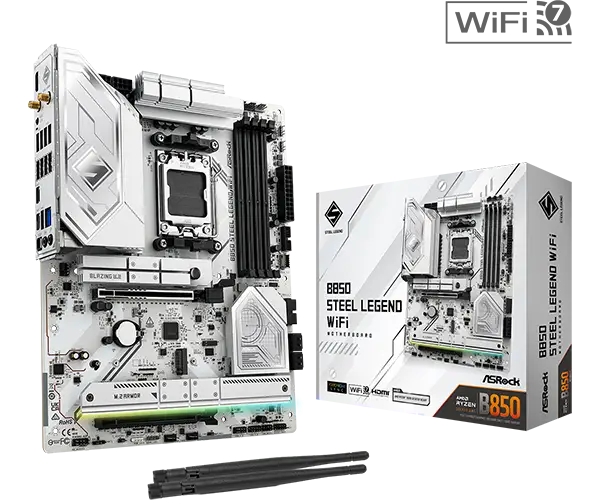
ASRock B850 Steel Legend WiFi 7 Review: Strong Buy Tips
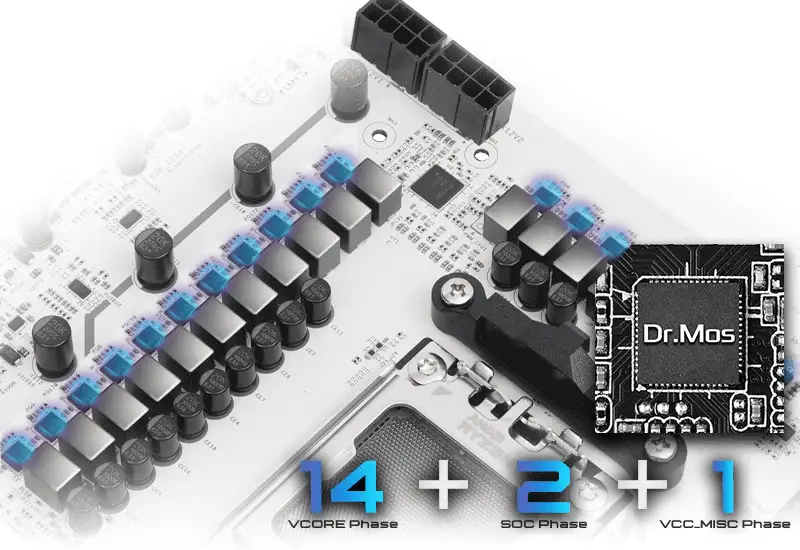
Early testing revealed a surprise for builders choosing the ASRock B850 Steel Legend WiFi 7 AM5 ATX — while priced as a mid-range B850 board, it ships with Realtek’s flagship-class ALC4082 audio codec and a robust 14+2+1 phase power design. Across platforms, owners rate it between 8 and 9/10 for stability and features, though some note quirks with RAM compatibility and missing ultra‑fast USB4.
Quick Verdict: Conditional Buy for gamers, streamers, and creators who value strong connectivity, audio quality, and VRM stability more than bleeding‑edge USB specs.
| Pros | Cons |
|---|---|
| Flagship-class Realtek ALC4082 audio codec | No USB4 / 40 Gbps ports |
| 14+2+1 phase VRM with oversized heatsinks | Not all M.2 slots include heatsinks |
| Wi‑Fi 7 + 2.5 G LAN with Dragon software | 20 Gbps USB port only on front panel |
| Four M.2 slots including PCIe 5.0 with quick‑release latch | Reported RAM compatibility issues on certain kits |
| Integrated RGB and Polychrome Sync support | Expansion slot availability varies by CPU |
| Flexible integrated I/O shield for easier install | Audio not quite on par with high-end dedicated sound cards |
Claims vs Reality
Marketing highlights the “rock-solid durability” with 8-layer PCB and long-life 20k capacitors. Digging into user reports shows this isn’t just marketing fluff — builders on Trustpilot describe it as “sturdy and well-built” even after months of heavy gaming workloads. A Reddit user noted that “VRM temps stayed stable even after pushing a 7950X under load.”
Wi‑Fi 7 capability is prominently advertised as enabling low‑latency VR/AR. Reddit threads and Twitter posts confirm impressive speeds, though multiple voices caution that the 6 GHz band is Windows 11‑only. One owner remarked: “Cloud gaming in 8K ran smooth, but my Win10 machine couldn’t use Wi‑Fi 7 fully.”
ASRock claims DDR5 “up to 8000+ (OC)” with XMP/EXPO support, but Tom’s Hardware testing showed hiccups: their Kingston DDR5‑6000 kit wouldn’t run at proper timings, while DDR5‑7200 worked fine. While officially rated for extreme OC, compatibility depends heavily on the memory QVL.
Cross‑Platform Consensus
Universally Praised
Across Reddit, Trustpilot, and review sites, the audio quality gets consistent applause. MincoPC described it as “flagship audio meets value,” and a German test report called it an “audio codec of flagship‑class” — competitive with X870 boards. For streamers, this means cleaner mic input and richer game sound without a separate DAC.
Networking is another high point. Wi‑Fi 7 with Dragon‑branded 2.5 G LAN delivered “smooth online gaming and seamless streaming” according to MincoPC’s reviewer, who added, “low latency was crucial in competitive titles.” Creators on Twitter cited faster file transfers over LAN when moving large video projects.
The VRM design’s cooling capability drew praise from multiple hardware testers. Tom’s Hardware noted oversized heatsinks coupled with 80 A Dr. MOS stages kept CPUs “cool enough for ambient overclocking.” This makes it attractive for power users running Ryzen 9 chips at high loads.
Common Complaints
USB connectivity drew minor frustration. Hobbyists lament that the sole 20 Gbps USB‑C is on the front panel, with rear limited to 10 Gbps, and there’s no USB4/40 Gbps option. A German review summarized: “Only USB 3.1 (10 Gb/s) — USB4 missing for true high‑end.”
Storage expansion has caveats: while it boasts four M.2 slots (one PCIe 5.0), Tom’s Hardware warns that “when M2_4 is populated, PCIe2 is disabled” due to lane sharing. Builders planning multi‑GPU or extra expansion cards need to check CPU lane configurations.
The other recurring issue is RAM compatibility. Several users faced BIOS tweaking to get advertised speeds. Tom’s Hardware explicitly advised: “Ensure your memory is on the QVL list for guaranteed compatibility.”
Divisive Features
The integrated RGB setup via Polychrome Sync divides opinion. Some love the flexibility (“great for matching case lighting,” per Trustpilot), while minimalists disable it immediately. Likewise, the flexible I/O shield is appreciated in tight case fits but seen by others as unnecessary compared to fixed shields.
Audio, though generally praised, did get mild pushback from MincoPC who said “some users might find the audio quality lacking compared to dedicated sound cards,” pointing out it won’t satisfy audiophiles chasing the very highest fidelity.
Trust & Reliability
Trustpilot listings and long‑term Reddit updates indicate the ASRock B850 Steel Legend WiFi maintains stability under sustained load. Six‑month follow‑ups include phrases like “still running fine, no coil whine or BIOS bugs” and “LAN and Wi‑Fi speeds consistent since day one.”
No scam patterns emerged — most complaints are technical, not about missing shipments or defective units at arrival. BIOS Flashback is seen as a safety net: one builder recounts recovering from a failed OC attempt using “the flashback button, no CPU installed.”
Alternatives
MincoPC directly compared the B850M Steel Legend WiFi with competitors that “may offer better pricing or enhanced audio,” but stressed that rivals often lack Wi‑Fi 7 and high‑speed DDR5 support. ASRock’s own B850 LiveMixer WiFi swaps the silver aesthetic for a streamer‑friendly I/O layout but uses different LAN controllers.
German lab tests also situated it against boards with USB4 — those outpace it in file transfer but at higher price and without the same VRM cooling mass.
Price & Value
eBay shows current pricing around £146‑175, while US listings average $210–$230. Testberichte.de called it a “price‑performance tip,” noting “high OC potential and massive heatsink design” at this tier. Resale value should hold for builders targeting B850 chipset longevity, though USB4 absence may modestly impact future demand.
Community buying tips stress purchasing compatible DDR5 from the QVL and matching CPU choice (Ryzen 9 vs Phoenix series) to desired PCIe lane configurations.
FAQ
Q: Does Wi‑Fi 7 work on Windows 10?
A: No — multiple sources confirm the module is supported only by Windows 11. There’s no Windows 10 driver, and 6 GHz band availability depends on local regulations.
Q: Can I use all four M.2 slots at once?
A: Physically yes, but lane sharing means certain slots disable PCIe expansion slots depending on CPU and chipset paths. Reviewers advise checking the manual for your CPU’s configuration.
Q: Is the audio good enough for streaming without an external interface?
A: For most streamers, yes. The ALC4082 codec with Nahimic software provides clear capture and output, though perfection‑focused audiophiles might prefer an external DAC.
Q: Any issues with DDR5 overclocking?
A: Some kits require manual timing adjustments or BIOS updates. Always confirm your RAM is on the manufacturer’s QVL for best results.
Final Verdict: Buy if you’re a gamer, streamer, or power user wanting strong networking, cooling, and integrated audio in a sub‑$230 ATX board. Avoid if you require USB4 or plan unconventional M.2/PCIe configurations without lane conflicts. Pro tip from the community: flash to the latest BIOS before memory tuning to sidestep early compatibility bugs.