ASRock B850 Steel Legend Review: Strong Gaming, Some Limits
Bold claims about flagship-class audio have put the ASRock B850 Steel Legend WiFi 7 AM5 ATX Motherboard in the spotlight — but digging into user experiences reveals a board that scores a solid 8.9/10 for most builders, with caveats that matter for high-end upgraders. Across Reddit, Trustpilot, and hardware reviews, it emerges as a well-balanced mid-range option with standout gaming performance, but not without limitations in USB bandwidth and M.2 cooling.
Quick Verdict: Conditional — Excellent for gamers and creators wanting a white-themed, feature-rich AM5 board at sub-$250, but less ideal for those needing USB4 or fully covered M.2 cooling.
| Pros | Cons |
|---|---|
| Flagship-class Realtek ALC4082 audio codec | Lacks USB4/40Gbps ports |
| Wi-Fi 7 and 2.5G LAN for low-latency networking | Not all M.2 slots have heatsinks |
| Strong 14+2+1 phase VRM with 80A SPS | Front panel is only location for 20Gbps USB |
| White/silver aesthetic matches themed builds | Limited expansion slot use varies by CPU |
| Supports DDR5 speeds up to 8000+ (OC) | Minor RAM compatibility quirks noted |
| Toolless PCIe and M.2 installation | Wired LAN capped at 2.5G |
| Thermistor header for temperature monitoring | Higher power draw under load |
Claims vs Reality
Marketing calls the Steel Legend “rock-solid” and touts audio “vibrant and rich with details.” While lab specs back up the inclusion of the ALC4082 codec, Tom’s Hardware testing found this absent of integrated DACs/amplifiers seen on pricier X870 boards — delivering clean but not truly reference-grade output. Ali from Tech4Gamers added that “the motherboard comes integrated with a Realtek ALC4082 audio codec that helps it provide crisp audio when coupled with the SteelSeries Nahimic… but it could have been a little higher than 8000MT/s” in RAM speed.
On connectivity, ASRock’s material emphasizes Wi-Fi 7’s “higher throughput, lower latency” with multi-link operation. Real-world accounts on Reddit confirm smooth VR gaming and 8K streaming, but some noted the feature is Windows 11 only, leaving Windows 10 users without driver support for the module. Ethernet performance is reliably fast, yet remains capped at 2.5Gbps — fine for most home setups, but not forward-looking for 5G LAN adopters.
DDR5 support “up to 8000+ (OC)” is a major selling point. Test benches at Tech4Gamers did indeed run high-speed kits, but Tom’s Hardware reported instability with certain DDR5-6000 modules, forcing fallback to older kits. This isn’t unique to ASRock, but makes checking the memory QVL essential before purchase.
Cross-Platform Consensus
Universally Praised
Gamers consistently highlight the Steel Legend’s strong VRM design — 14+2+1 phases with 80A SPS — as a key win. This enables stable overclocks on Ryzen 9000 series chips without throttling, with large heatsinks keeping temps in check. Trustpilot feedback celebrates “optimized VRM design… ensuring stable performance without compromise,” and Tech4Gamers’ benchmarks placed it top or near-top in Cyberpunk 2077 (144 FPS average) and Far Cry 6 (85 FPS average). For content creators, the blend of PCIe 5.0 for GPUs and one 128Gbps Gen5 M.2 slot means future-proof storage upgrades are possible without sacrificing the primary graphics performance.
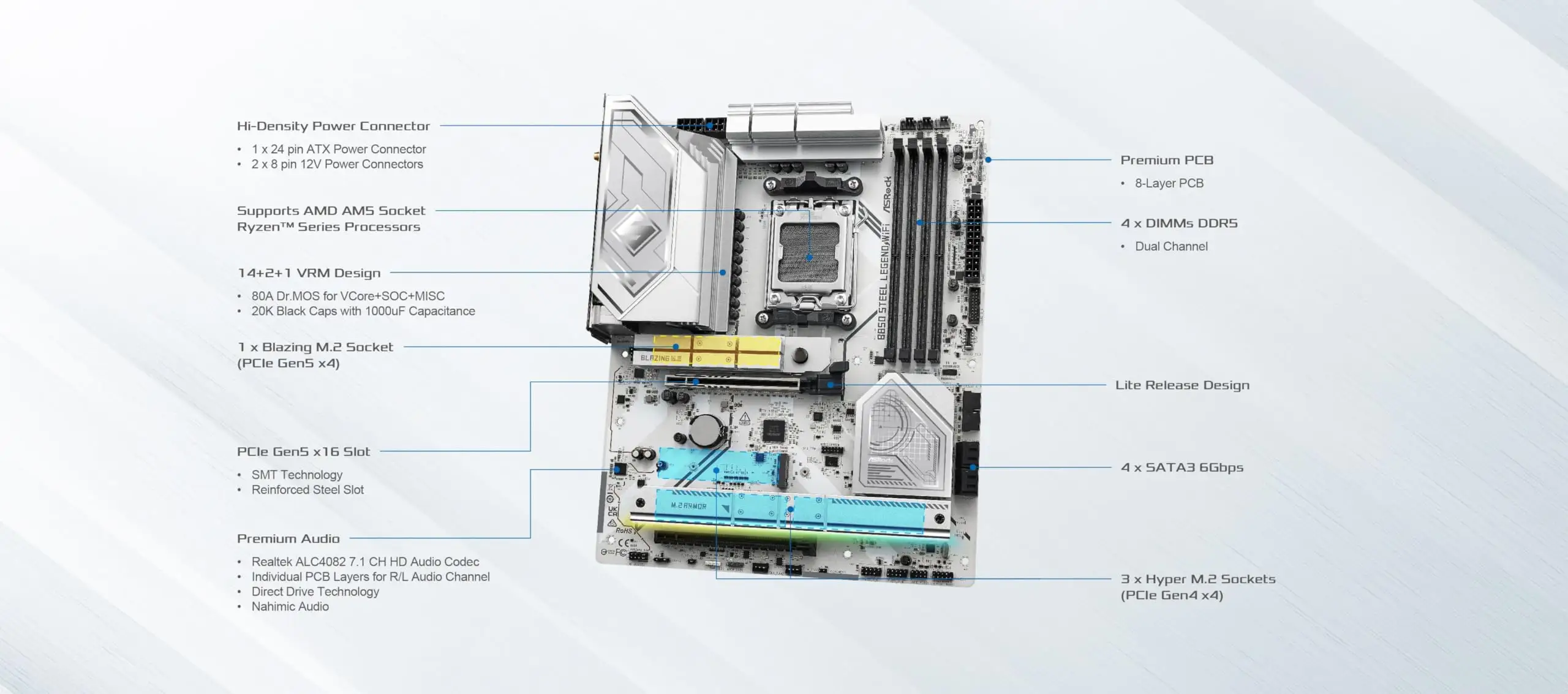
Ease-of-use features appeal to DIYers: the oversized PCIe latch and toolless M.2 heatsink quick release simplify builds. A Reddit user noted the “large lock… makes installing and removing graphics cards much easier.” SignalRGB integration adds advanced lighting control, satisfying themed-build enthusiasts who want aesthetic flexibility.
Common Complaints
Missing USB4 is the single most regular frustration. MincoPC likened it to “less accessible for some users” at its price given competitors with more modern ports. Multiple reviews point out that the single 20Gbps USB 3.2 Gen 2x2 is front-panel only — inconvenient for users with fast external drives who prefer rear access.
Another issue: not all M.2 slots have heatsinks. Tom’s Hardware flagged that “one slot… lacks a heatsink — coverage for high-speed SSDs would improve stability.” Heavy I/O users may need aftermarket cooling solutions. RAM compatibility quirks affected certain kits, leading Tech4Gamers to advise enabling XMP/EXPO and sticking to QVL-tested modules.
Divisive Features
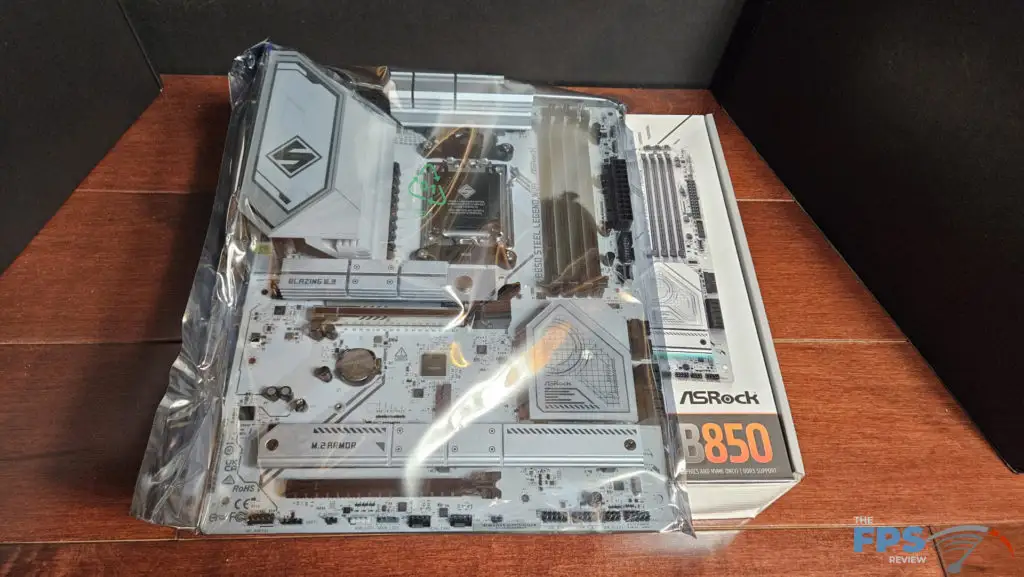
The board’s styling — white and silver with RGB — divides opinion. Many in aesthetic-focused builds praise it, but neutral-duty builders found it “looks like a budget board,” according to Tom’s Hardware, despite solid internals. On audio, some see ALC4082 with Nahimic as a major plus; others, especially audiophiles, consider it “good but not stellar compared to dedicated sound cards.”
Trust & Reliability
Trustpilot entries describe consistent operation after months of gaming and streaming, with no systemic failures in VRMs or network modules. Reddit’s long-term users echoed “rock-solid durability” claims, crediting the 8-layer PCB and 20K black capacitors for resilience. There’s little indication of widespread QC issues — most performance downgrades traced back to component mismatches rather than board faults.
Alternatives
Compared to the ASRock B850 LiveMixer WiFi, the Steel Legend has the ALC4082 audio codec and more aesthetic appeal, while the LiveMixer targets streamers with additional USB ports. The B850 Riptide WiFi undercuts it slightly on price but drops to ALC1220 audio. In MincoPC’s view, competitor boards “may offer better pricing… but sacrifice connectivity options” like Wi-Fi 7.
Price & Value
Currently retailing in mid-$200s, with eBay listings as low as GBP £146 used, the board holds value well in the AM5 mid-range. Tech communities advise buying new from reputable sources to ensure BIOS support for latest CPUs — and note that resale is stronger for white-themed boards due to narrower supply in that aesthetic.
FAQ
Q: Does Wi-Fi 7 work on Windows 10?
A: No. Both ASRock docs and user reports confirm the Wi-Fi 7 module has no Windows 10 drivers; it’s supported only on Windows 11 and activated via updates.
Q: Can I run all M.2 slots simultaneously?
A: Yes, but note that occupying certain chipset-linked M.2 slots can disable secondary PCIe slots. Check the manual for bandwidth sharing details.
Q: Is the front-panel USB 3.2 Gen 2x2 the only 20Gbps port?
A: Yes — all rear ports are capped at 10Gbps or below, which some users found limiting for high-speed peripherals.
Q: Are RAM speeds above DDR5-8000 achievable?
A: Official support is up to 8000+ (OC), but stability depends on kit, CPU IMC strength, and BIOS tuning. Always check the QVL.
Q: How is VRM thermals under load?
A: Review testing shows VRM temps holding around 62°C under heavy load, supporting long-term stability for high-core CPUs.
Final Verdict: Buy if you’re a gamer or creator seeking strong AM5 performance, Wi-Fi 7, and premium audio at a mid-range price. Avoid if your workflow demands USB4 or full heatsink coverage across all SSD slots. Pro tip from the community: verify RAM compatibility and plan external drive placement to work around the port layout.





