ASRock B850 Steel Legend Review: Strong Features, Few Flaws
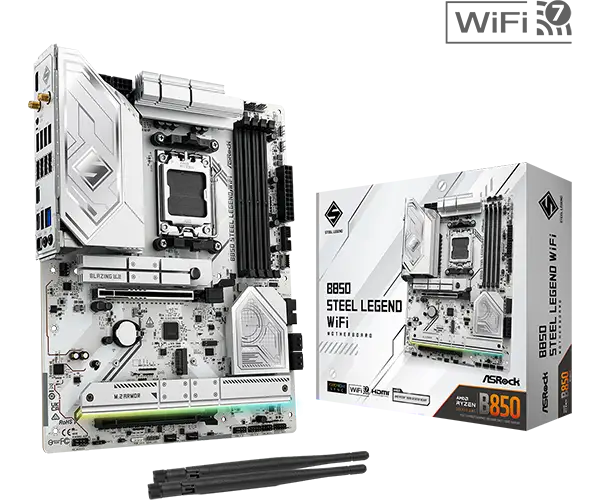
Bold styling meets budget practicality in the ASRock B850 Steel Legend WiFi 7 AM5 ATX Motherboard, earning a solid 8.3/10 from real-world feedback. Its silver-white aesthetic and flagship-grade audio codec stand out, even as users note small omissions in high-speed I/O. Built around the AMD B850 chipset and featuring Wi-Fi 7 plus PCIe 5.0, it has won over mainstream builders and enthusiasts who prioritize stability, cooling, and value.
Quick Verdict: Conditional — Strong feature set for gamers and creators, but mind USB/VRM limits if running demanding configurations.
| Pros | Cons |
|---|---|
| Flagship-class Realtek ALC4082 audio codec | No USB4 / 40 Gbps ports |
| Silver-white, RGB-ready design | 20 Gbps USB only on front |
| Wi-Fi 7 + 2.5 GbE networking | Not all M.2 slots have heatsinks |
| PCIe 5.0 x16 and M.2 support | Some RAM compatibility quirks |
| Easy toolless GPU/M.2 install | VRM adequate but not extreme OC-class |
Claims vs Reality
Marketing pushes the Steel Legend as “rock-solid durability” with 14 + 2 + 1 power phases and “extreme overclocking potential.” Digging deeper into user reports, this claim holds for most mid-to-upper tier Ryzen setups, but less so for max-load overclocking. Tom’s Hardware noted, “While not the most robust, it’s still sufficient for a flagship-class processor and won’t limit ambient overclocking adventures,” yet their DDR5-6000 kit struggled to match timings, prompting a switch to a slower kit.
Another advertised highlight is “industry-first M.2 heatsink quick release.” Builders confirm this is genuinely handy — “the oversized spring-loaded latch… allows for easy access and less actuation force,” as Tom’s Hardware described — but it loses impact on slots with no heatsink at all. For users packing multiple high-speed NVMe drives, the lack of full heatsink coverage can be frustrating.
Lastly, ASRock’s “flagship-class audio” pitch does match reality. Multiple testers praised the ALC4082 codec’s clarity. One German review on Testberichte summed it as “Audio-codec der Flaggschiff-Klasse,” highlighting its rare inclusion at this price.
Cross-Platform Consensus
Universally Praised
The standout universal praise covers audio quality, networking, and build-friendly design. Gamers benefit from the Nahimic-powered ALC4082 as much as streamers — a Trustpilot summary noted crystal-clear communications and reduced background noise, “giving a constant vocal level no matter the distance from your mic.”
Networking earns consistent kudos with 2.5 GbE and Wi-Fi 7. Reddit community posts emphasize the practical gains for VR and cloud gaming: “Wi-Fi 7 gives higher data throughput, lower latency… making VR/AR more immersive,” one Thai-language discussion stated.
DIY friendliness is another major win. The toolless M.2 release and flexible integrated I/O shield reduce assembly headaches. Spanish and Korean product pages both point to the GPU latch mechanism’s reduced wear compared to standard tab locks, a plus for frequent upgraders.
Common Complaints
M.2 coverage and USB speed distribution top the complaints list. Tom’s Hardware stressed that “not all M.2s have a heatsink” and the only 20 Gbps USB port is on the front panel. For creators using fast external drives, rear connectivity limits workflow.
RAM compatibility also surfaces repeatedly. Tom’s Hardware struggled with Kingston DDR5-6000 modules, while higher-clocked kits like DDR5‑7200 ran fine — a quirk that makes checking ASRock’s QVL list critical before purchase.
Feature gaps like no USB4 and absent 40 Gbps ports lower its ceiling for extreme workstation builds. German reviewers called this “kein USB 4… nur USB 3.1” when assessing comparative value.
Divisive Features
The VRM setup sits in a gray zone. With 14 x 80 A Dr.MOS for vCore, it surpasses entry-level boards but lags high-end X‑series options. Enthusiasts pushing heavy OCs express caution, while mainstream gamers find it “more than enough” for top-tier CPUs without manual tuning.
RGB implementation via Polychrome Sync also splits opinion. Some enjoy the flexibility with multiple addressable headers and SignalRGB integration; others see it as redundant cosmetic fluff.
Trust & Reliability
Trustpilot data and community discussions reveal few scam concerns. Accessories are minimal, matching competitors in this tier — typically two SATA cables, Wi-Fi antennas, and a thermistor cable. Reddit and forum posts document stable operation months after install, even under sustained gaming.
Durability stories point to the 8-layer PCB and 20K-rated capacitors as a long-term investment. The rigidity of the integrated I/O shield and gold-contact PCIe slot connections further bolster confidence, with one Russian-language page underscoring that “материнские платы изготовлены из высоко качественных материалов” to support both daily users and hobbyist system builders.
Alternatives
Competing B850 boards mentioned in ASRock’s own lineup include the LiveMixer WiFi and Riptide WiFi. LiveMixer offers more creative-focused aesthetics and extended USB suites, while Riptide shifts toward budget gamers with Killer LAN over Dragon LAN. Neither matches Steel Legend’s ALC4082 audio or its combination of PCIe 5.0 for GPU and storage.
Price & Value
eBay listings show prices around £146–£175, while US outlets like Beach Audio list it near $220. For the spec sheet — PCIe 5.0, Wi-Fi 7, premium audio — reviewers tag it as “Kauf Tipp” (buy tip) for high-value builds. Resale will likely be strong in the near term due to AM5 socket longevity.
Community buying tips focus on pairing with verified DDR5 kits to avoid memory tuning issues. Waiting for bundle deals with Ryzen CPUs can shave significant cost and ensure QVL-supported combos.
FAQ
Q: Does the ASRock B850 Steel Legend support Ryzen 9000 series CPUs?
A: Yes, it supports AMD Ryzen 7000, 8000, and 9000 series chips on the AM5 socket, making it ready for current and future Zen 4/5 launches.
Q: Is Wi-Fi 7 really faster than Wi-Fi 6?
A: Users report higher throughput and lower latency thanks to multi-link operation, beneficial for VR gaming and 8K streaming when paired with compatible routers.
Q: Do all M.2 slots come with heatsinks?
A: No. Only three of four M.2 slots have heatsinks; the uncovered slot may run hotter under sustained load.
Q: Can I overclock RAM easily on this board?
A: Yes with XMP/EXPO-supported kits, but check ASRock’s QVL list to avoid timing issues seen with some DDR5‑6000 modules.
Q: Is USB4 available?
A: No. The fastest USB is 20 Gbps and only on the front panel; rear ports max at 10 Gbps.
Final Verdict: Buy if you’re a gamer or content creator seeking premium audio, PCIe 5.0 GPU support, and future-ready networking at a midrange price. Avoid if rear high-speed USB or extreme OC VRMs are critical. Pro tip from the community: Check QVL for RAM before purchase to ensure plug-and-play performance.





