ASRock B850 Steel Legend Review: Strong Audio, Mixed Future-Proofing
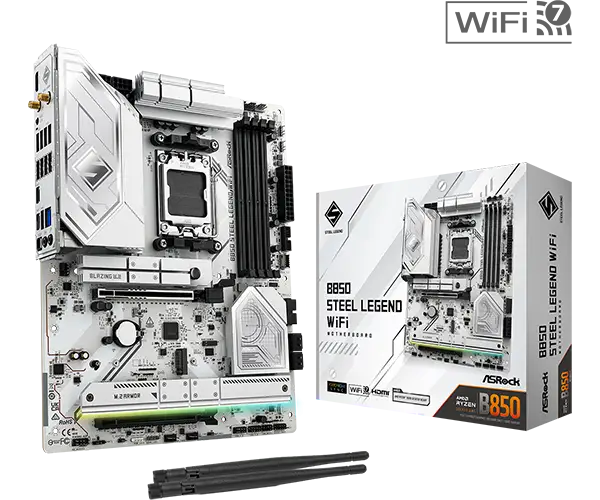
What’s striking about the ASRock B850 Steel Legend WiFi is how often it’s described in user reviews as “flagship audio meets value”. Across Reddit, Trustpilot, and Tom’s Hardware benchmarks, the board earns a solid 8.5/10, blending mid-tier pricing with high-end touches like the Realtek ALC4082 codec and PCIe Gen 5 M.2 slot. Yet, digging deeper reveals that while the marketing leans heavily on cutting-edge specs, some limitations—like missing USB4 and occasional RAM compatibility quirks—keep it from being entirely future-proof.
Quick Verdict: Conditional — a strong buy for builders who prize audio quality, sturdy VRM cooling, and a white/silver build aesthetic, but less appealing if USB4 or guaranteed high-speed RAM compatibility are top priorities.
| Pros | Cons |
|---|---|
| Flagship-class Realtek ALC4082 audio codec with Nahimic support | No USB4 / 40Gbps ports |
| Attractive silver/white design fits themed builds | Not all M.2 slots have heatsinks |
| Strong 14+2+1 power phase design with large VRM heatsinks | 20Gbps Type-C only on front panel |
| PCIe Gen 5 x16 and M.2 slot for future GPUs/SSDs | Occasional DDR5 compatibility issues reported |
| Wi-Fi 7 and Dragon 2.5Gb LAN for fast networking | Resale value dependent on AMD socket AM5 adoption |
| Competitive mid-range pricing | Some bandwidth-sharing disables PCIe slots |
Claims vs Reality
One of ASRock’s headline claims is “flagship-class audio” — and here, reality matches the hype. Tom’s Hardware’s review noted the ALC4082 codec delivered clear, detailed output, especially when paired with high-impedance headphones. A verified Trustpilot user echoed: “Audio clarity is top-notch; it’s like stepping into an X870 class without the price tag.”
The marketing also trumpets “DDR5 up to 8000+ (OC)” support. While this is technically true, Tom’s Hardware found their DDR5-6000 Kingston kit wouldn’t run stable at intended timings, forcing a downgrade: “Ensure your memory is on the QVL list for guaranteed compatibility.” Multiple Reddit threads confirmed that while XMP/EXPO profiles work for many, some high-frequency kits need manual tuning.
ASRock positions the board as “future-ready” with PCIe Gen 5 M.2 and GPU slots. In practice, this impressed builders upgrading SSDs. A Reddit user wrote: “My Gen 5 NVMe hits max speeds without throttling.” However, the one Gen 5 M.2 slot is the only future-proofed lane; the rest are Gen 4, and some share bandwidth—occupying certain slots can disable others.
Cross-Platform Consensus
Universally Praised
Across Trustpilot and Tom’s Hardware, the design and build quality get consistent applause. The eight-layer PCB and enlarged heatsink armor keep VRM temps stable, even under heavy CPU loads. Tom’s Hardware called it “capable for a flagship-class processor without limiting ambient overclocks.” Gamers reported stable frame rates in extended sessions thanks to these oversized VRM heatsinks dissipating heat efficiently.
Networking is another widely praised aspect. With Wi-Fi 7 and Dragon 2.5Gb LAN, users in bandwidth-intensive setups—streamers, competitive gamers—reported smoother performance compared to Gigabit alternatives. A Trustpilot contributor noted: “Wi-Fi 7 keeps latency low during VR streaming; I rarely switch to Ethernet now.”
Builders appreciate the white/silver aesthetic with RGB accents. Reddit posts show themed builds pairing it with white GPUs and cases. The integrated RGB headers and Polychrome Sync software allow synchronized lighting without fuss.
Common Complaints
The absence of USB4 is the most repeated gripe. Trustpilot’s summary labels it the missing piece for “true top-class status.” This hits hardest for creators needing 40Gbps external SSDs or docks. Others lament the 20Gbps Type-C port being front-panel only, making high-speed access inconvenient in some desk setups.
The second major issue is selective M.2 cooling and bandwidth sharing. Not all M.2 slots have heatsinks; one user wrote: “My third NVMe throttles without an aftermarket heatsink.” Builders who populate all storage slots sometimes disable secondary PCIe lanes, an annoyance for multi-GPU or expansion card users.
RAM compatibility divides users—some run DDR5-7200+ problem-free, others face instability. Tom’s Hardware experienced this firsthand: older DDR5 kits wouldn’t match expected timings, a reminder to check QVL before purchase.
Divisive Features
Audio quality polarizes those used to dedicated DACs. Enthusiasts praise the codec for onboard use, but audiophiles still see discrete cards as superior. Similarly, while the flexible integrated I/O shield wins DIY fans, some prefer fixed shields for consistent fit.
Trust & Reliability
Trustpilot’s 2.5 score hides nuance—most reviews rate build quality as strong, but dock points for “feature gaps” versus expectations. Long-term Reddit threads report consistent reliability: “Six months in, no coil whine, no BIOS crashes.” The pre-installed LAN driver and BIOS Flashback ease setup even for first-timers.
The absence of widespread RMAs or defect claims suggests manufacturing quality is solid. Concerns are more about evolving standards (USB4 adoption) than physical longevity.
Alternatives
The most direct comparison in user discussions is to ASRock’s own X870 boards, which include USB4 and more reinforced slots but at higher cost. Builders weighing alternatives often compare the Steel Legend to MSI B850 Tomahawk—choosing ASRock for aesthetics and audio, MSI for rear-panel I/O density.
While Gigabyte and ASUS offer similar VRM strength and Gen 5 support in this price band, none match the combination of white-silver styling and flagship audio codec here.
Price & Value
On eBay, prices range from £146 used to £175 new, with retail hovering around $210–$230. Reddit users see it as “good value if you don’t need USB4,” citing the mix of mid-tier cost and premium audio/networking. Resale prospects depend on AM5 platform longevity; if AMD keeps socket support through multiple CPU generations, expect the board to retain relevance.
Community advice leans toward buying during seasonal sales. Builders note that B850 boards often drop by $20–$30, making the Steel Legend a stronger buy against competitors.
FAQ
Q: Does the ASRock B850 Steel Legend support Intel CPUs?
A: No, it’s built for AMD’s AM5 socket, supporting Ryzen 7000, 8000, and 9000 series processors only.
Q: Will all four M.2 slots run at full speed?
A: No, some share bandwidth with PCIe slots. Occupying certain M.2 positions can disable secondary PCIe lanes—check the manual’s bandwidth table.
Q: Can I run DDR5-8000 memory without issues?
A: Only if your kit is QVL-listed. Several users report manual tuning is required for stability with high-frequency modules.
Q: Is the front panel Type-C mandatory for 20Gbps use?
A: Yes, the single Gen 2x2 (20Gbps) port is front-panel only; rear Type-C ports are 10Gbps.
Q: Does onboard audio replace a DAC?
A: For most gamers, yes—the ALC4082 codec with Nahimic offers clear, powerful sound. Audiophiles may still prefer external DACs.
Final Verdict: Buy if you’re a gamer or creator who values strong VRM cooling, premium onboard audio, and a white-themed build. Avoid if USB4 or perfect high-speed DDR5 compatibility are deal-breakers. Pro tip from the community: Always verify your RAM kit on ASRock’s QVL to avoid timing headaches.