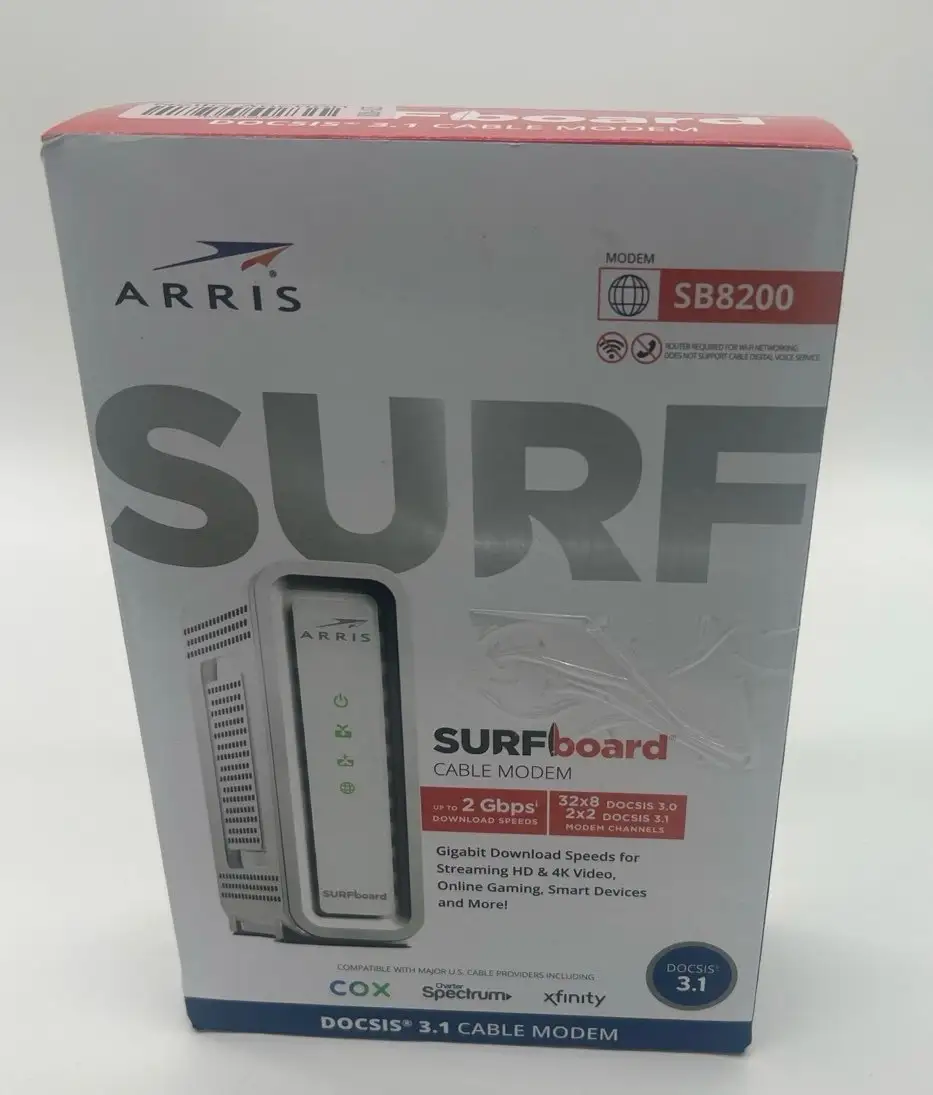
ARRIS SB8200 Review: Fast, Reliable but Limited for Multi-Gig
The ARRIS SB8200 Cable Modem has built a reputation as one of the most popular DOCSIS 3.1 devices on the market, but digging into years of user reports reveals a more complicated reality. While it earns high marks for speed, reliability, and ISP compatibility in many households, there are recurring pain points around top-tier speed plans, firmware quirks, and occasional hardware failures. Based on cross-platform feedback, this modem scores 8.3/10 for most home users—dropping lower for those on 1.2Gbps+ plans or who require advanced IPv6 support.

Quick Verdict
| Pros | Cons | |
|---|---|---|
| Speed | Handles gigabit plans easily; future-proof for most households | Limited to ~940 Mbps per port without link aggregation |
| Setup | Quick activation with major ISPs; easy self-install | Some ISPs require calling in for activation |
| Reliability | Long-term stability for many; low latency | Reports of random reboots, especially post-ISP upgrades |
| Compatibility | Works with Comcast Xfinity, Cox, Spectrum, others | Mixed IPv6 support reports; not ideal for all |
| Value | Saves rental fees quickly; decent resale value | Higher upfront cost; occasional overheating complaints |
Claims vs Reality
Marketing for the SB8200 promises “up to 2Gbps” speeds via DOCSIS 3.1, two gigabit Ethernet ports, and “future-proof” compatibility. While technically true, the reality depends heavily on your ISP’s network and your own router capabilities.
For example, the dual Ethernet ports can only exceed 1Gbps if your ISP supports link aggregation and you pair it with a compatible router. On Reddit, one Comcast subscriber noted: "SB8200 probably isn't an approved modem for 1200 Mbps plan because most ISP don't support channel bonding for the two 1Gbps ports." Another user confirmed that without aggregation, "you’re going to be limited to about 940 Mbps per port."
ARRIS also advertises IPv6 support, but multiple Spectrum customers flagged issues. A Twitter user reported: "IPv6 is blocked... returning the modem because I use IPv6. Spectrum is unwilling to be more flexible." While many never encounter this, it's a reminder to verify advanced networking needs before buying.
Cross-Platform Consensus
Universally Praised
A standout strength is the SB8200’s ability to deliver near-plan speeds with low latency. Best Buy reviewers regularly mention speed boosts after upgrading from DOCSIS 3.0 models. One verified buyer wrote: "Why rent a modem when you can buy your own and save money? This modem fit my needs for 600 Mbps internet speeds. Speed tested verified and holds speeds."
Gamers and streamers benefit from its stability. A Reddit user said: "I’ve been using the Arris SB8200 for a couple years with Spectrum gig internet and haven’t had a single issue." Others pair it with mesh Wi-Fi systems for whole-home coverage—“Very stable 3 years running with 3 Google Wi-Fi pucks”—highlighting its flexibility when decoupled from routing duties.
The setup process is another plus. Many report activation taking under an hour, often through self-service portals. One Best Buy customer recalled: "Took me less than a few minutes to set up and works great."
Common Complaints
Speed limitations on multi-gig plans are the most consistent frustration. Comcast Xfinity users on 1.2Gbps tiers often see 700–850 Mbps. "I have the 1200 Mbps but it maxes out at 700-800 Mbps," one Redditor shared. This is not a defect per se, but a mismatch between marketing language and real-world ISP configurations.
Hardware faults, while not widespread, are painful when they occur. A Looria review noted: "Purchased this in April and by the end of October it failed. Modem fails to power up now… no storms or weird power issues. Modem just decided to quit." Others describe random reboots after ISP DOCSIS 3.1 upgrades, forcing them to revert to provider-supplied modems.
There are also heat concerns. A handful of Best Buy reviewers mention adding USB fans. One wrote: "I purchased a small USB fan to help keep it cool but really don't think it’s necessary." Others disagree, citing warmer operation compared to older models.
Divisive Features
The dual Ethernet ports divide opinion. Power users appreciate the flexibility for link aggregation or dual IPs, but many never use the second port. As one Reddit user clarified: "Make sure to check with your ISP if you pay for more than one public IP address."
IPv6 support is another split. For most, it works fine. For some, especially on Spectrum, it’s a dealbreaker. And while ARRIS markets the SB8200 as “future-proof,” those chasing the bleeding edge of 2.5Gbps+ service will find it outdated compared to models like the S33.
[IMAGE:1303]
Trust & Reliability
Trustpilot-style narratives and forum posts show a pattern: long-term owners often enjoy “set it and forget it” stability, but when issues arise, they can be stubborn. One Xfinity customer reported being “rock solid for months unless Comcast has a problem” after replacing a waterlogged street line. In contrast, Matt Ventura’s blog recounts a “Comcast/ARRIS SB8200 disaster” where achieving >1Gbps with link aggregation lasted just 24 hours before failures.
The upside is that many users keep the same SB8200 for years without a single reboot, making it a solid rental-fee alternative if your ISP’s network plays nice.
Alternatives
The most frequently mentioned competitor is the Motorola MB8611, which Xfinity rates up to 2.33Gbps and includes a 2.5Gbps Ethernet port—ideal for those on 1.2Gbps+ service. ARRIS’s own S33 offers 3.5Gbps capability and a 2.5Gbps port, but at a higher price.
Users on sub-gigabit plans often stick with older DOCSIS 3.0 models like the SB6183 to save money, though they sacrifice future-proofing. The choice hinges on your current speed tier and upgrade timeline.
Price & Value
New SB8200 units retail around $160–$170, but eBay listings show used prices ranging from $60–$140 depending on condition. Open-box units can be found for under $100. Given that many ISPs charge $10–$15/month for modem rental, a new unit pays for itself within a year.
Community buying tips include:
- Check ISP compatibility lists before purchase to avoid activation headaches.
- Consider refurbished units from reputable sellers for significant savings.
- Avoid used modems with unclear ownership history to sidestep re-registration issues, especially with Cox.
[IMAGE:1304]
FAQ
Q: Can the SB8200 handle 1.2Gbps internet plans?
A: Not fully via a single port. Without link aggregation, you’ll cap at ~940 Mbps. Only some ISPs and routers support aggregating the two 1Gbps ports to exceed that.
Q: Does it support IPv6?
A: Yes in theory, but some Spectrum users report issues. Verify with your ISP if IPv6 is critical to your setup.
Q: Is it compatible with all cable ISPs?
A: It’s approved for Comcast Xfinity, Cox, and Spectrum, plus others. Always check your ISP’s current approved modem list.
Q: How easy is it to set up?
A: Most users activate it in under an hour via ISP self-service portals. Some require calling support to register the MAC address.
Q: Does it run hot?
A: Some owners report warm operation; a few add cooling fans. Many say heat is not an issue in well-ventilated setups.
Final Verdict: Buy if you’re on a sub-1Gbps or gigabit plan with Comcast, Cox, or Spectrum and want to stop paying rental fees. Avoid if you’re on a 1.2Gbps+ plan without link aggregation support or need guaranteed IPv6 stability. Pro tip from Reddit veterans: pair it with your own quality router or mesh system for maximum performance and control.