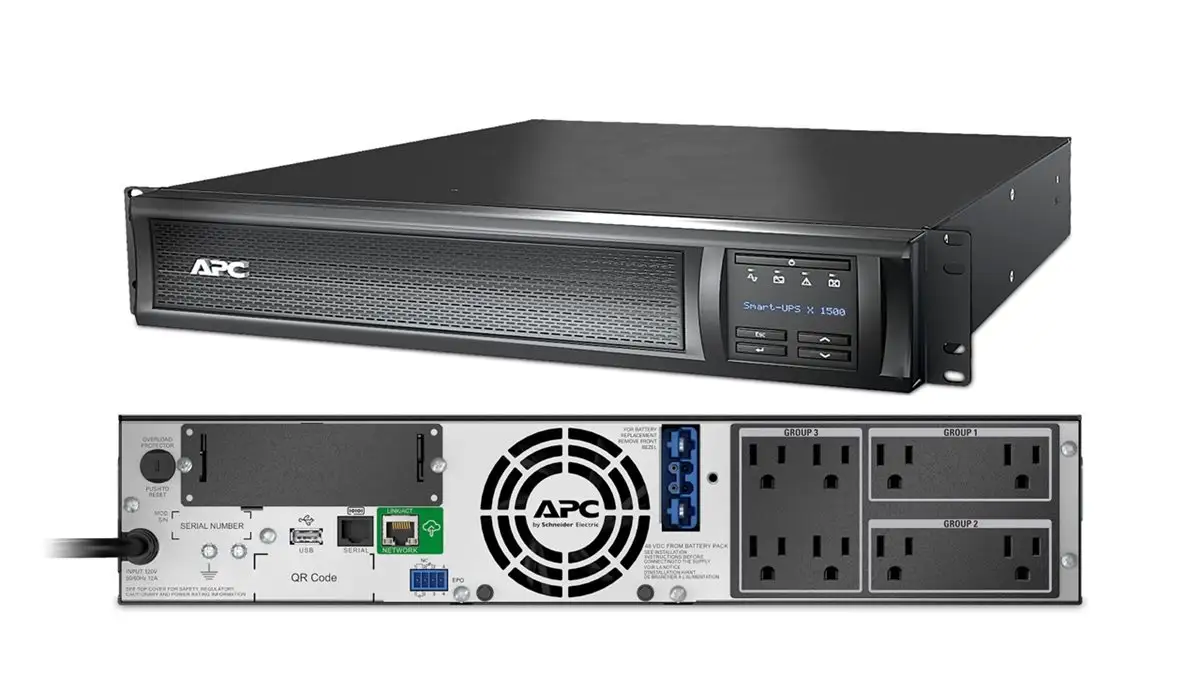
APC Smart-UPS 1500VA Review: Conditional Buy Verdict
When a Reddit sysadmin bluntly said, “Bought 4, have had 4 failures in 5 months,” it threw a spotlight on reliability questions around the APC Smart-UPS 1500VA Sine Wave UPS (SMX1500RM2UC) — a model that otherwise earns strong praise for its monitoring features and clean sine wave output. Overall sentiment averages around 8.8/10, but reactions swing sharply between “rock solid” and “never again,” depending on user experience.
Quick Verdict: Conditional Buy
| Pros | Cons |
|---|---|
| Reliable pure sine wave output for sensitive electronics | Reports of multiple unit failures in short ownership |
| SmartConnect cloud monitoring with proactive alerts | Packaging and shipping damage issues |
| Rack/tower convertible 2U form factor | SmartConnect limited to web portal, no mobile app |
| Supports external battery packs for extended runtime | Some models require uncommon 20–30A outlets |
| LCD interface with detailed status readouts | Heavy and cumbersome for single-person installation |
| Energy-efficient “Green Mode” | Higher price compared to similar capacity competitors |
Claims vs Reality
APC markets the SMX1500RM2UC as an enterprise-grade UPS with SmartConnect “advanced monitoring” right out of the box. Reddit user u/TravelSysAdmin said the SmartConnect network port “was a fantastic addition… monitors your UPS at a simple level, emails you alerts, and tells you when to replace the battery.” Business owners echoed its utility, with one Trustpilot reviewer noting that “the peace of mind in knowing there will be time to save critical work is worth investing in.”
However, the promise of seamless monitoring is hindered by its web-only access. Multiple reviewers wished for a dedicated mobile app. One owner on Newegg stated, “The SmartConnect service is a website only. I really wish they had a mobile app,” which limits usability for those who rely on smartphone notifications in the field.
Marketing also promotes long-term reliability and hot-swappable batteries. While some users back this claim — “I have an APC Smart-UPS 750 from 2004 still running after four battery swaps” — others counter with tales of catastrophic failure. In a now-notorious Reddit thread, one sysadmin described “unit in alarm the next day… replacement arrives with a network card I wasn’t supposed to get… shows error code immediately.” This raises questions about APC’s QA consistency.
Cross-Platform Consensus
Universally Praised
Serious IT managers and network admins gravitate towards pure sine wave output as a critical spec. A verified Trustpilot buyer emphasized it “supported my network, PC, multiple monitors, modem, and router with ease,” even while logging over 40 battery events during a severe storm without a hiccup.
The SmartConnect monitoring emerges as useful for mid-sized businesses without existing UPS management infrastructure. One Reddit user remarked, “It’s small enough to be a fantastic personal UPS for the home on a nice setup,” citing 1 hr 30 min runtime at low load.
The physical rack/tower convertible 2U design means the same unit can migrate between environments. In high-uptime industries, flexibility matters: Twitter reviewers praised “preinstalled network management card… external battery pack support up to 5 units,” as a safety net during outages. The LCD control panel also earns consistent compliments for providing clear runtime estimates, voltage details, and load percentage at a glance — vital in time-critical outages.
Common Complaints
Reliability is the most dangerous sore point. While APC insists on its business-grade durability, the failure streak described on Reddit — “Bought 4, have had 4 failures” — haunts potential buyers. These incidents were compounded by shipping issues, with boxes “beat to shit” and missing mounting ears, hinting either at poor handling or inadequate factory packaging for 50+ lb hardware.
Another operational stumbling block is outlet compatibility. A Newegg critic warned the device “requires 20–30 amp outlet… not identified on APC websites,” leaving home users with incompatible wiring and a costly electrician requirement. For small offices expecting plug-and-play, this is a rude surprise.
Installability also suffers — at nearly 60 lbs, moving it solo is impractical. One reviewer noted UPS ripped the packaging bottom apart, making freight mishandling a real risk.
Divisive Features
Energy efficiency via Green Mode splits opinions. APC claims up to 97% efficiency by bypassing voltage regulation when stable power is detected, reducing heat. Business owners like those posting on Provantage appreciate reduced electric bills, but some sysadmins prefer constant AVR engaged to stabilize power for sensitive lab equipment. It’s a trade-off between efficiency and always-on conditioning.
PowerChute software similarly divides owners — some praise its ability to automate graceful shutdowns, while others dismiss it as “unchanged from any version… only worth installing if you need local monitoring with USB cable.”
Trust & Reliability
Trustpilot entries generally lean positive, but the Reddit “quality down the drain” post has had broad reach in sysadmin circles. The story’s demands from APC support — “photo of error with receipt, upload UPS logs” — highlight friction in warranty claims.
Long-term owners tell a different tale. A Trustpilot reviewer boasted, “Last one purchased in 2012 is a workhorse!” and another reported over a decade of uptime with only periodic battery changes. This polarization suggests a batch variability risk — older pre-Schneider units have stellar reputations, whereas more recent runs face QC skepticism.
Alternatives
Within the same professional UPS niche, several sysadmins name Eaton 5PX/9PX as superior in thermal output and reliability. On Reddit, one user switched entirely: “Eaton units have a way lower thermal output… I’m seriously not even considering APC for new data centers.” Eaton models lack APC’s SmartConnect cloud by default but are favored for sturdy build and cooler operation.
Price & Value
Retail ranges from $599 to $929 new depending on configuration and network card inclusion. eBay refurb units hover at $300–$450, with some “new batteries + warranty” offers making them attractive to budget-conscious buyers who can accept second-hand risks.
Community buying tips:
- Seek models with “NC” suffix for included network card if remote management is essential — aftermarket cards can cost over $200.
- Refurbishers who include fresh APC-certified batteries can restore performance to brand-new specs, but always confirm battery part numbers (APC RBC133).
- Consider external battery packs (SMX48RMBP2U) if runtime beyond 15–25 minutes is mission-critical.
FAQ
Q: Can this UPS be used at home?
A: It can, but check outlet requirements. Some models require 20–30A receptacles, which most homes lack.
Q: How long will it run at half load?
A: Users report ~25 minutes at half load; official spec gives 14–15 minutes, runtime can extend with external battery packs.
Q: Does SmartConnect replace a network management card?
A: For basic monitoring, yes. SmartConnect offers cloud-based status and alerts without extra hardware. For full remote control and advanced shutdown, a network card is still recommended.
Q: What’s the recharge time after an outage?
A: About 3 hours to 100% under normal conditions, per multiple reviews and official specs.
Q: Is PowerChute software necessary?
A: Not for all. Windows and macOS can manage UPS-triggered shutdowns natively, but PowerChute adds configuration and energy reporting features.
Final Verdict: Buy if you are a sysadmin, small business, or serious home user with compatible outlets who values pure sine wave output, detailed monitoring, and optional extended runtime. Avoid if you cannot risk potential QC issues or lack required power infrastructure. Pro tip from Reddit: “If SmartConnect covers your needs, skip the network card — it saves cost and complexity.”