Antennas Direct DB8e Review: Rural HDTV Reception Verdict
A verified buyer on Amazon summed up their experience in one sentence: "This antenna is a beast." That sentiment captures much of the reaction to the Antennas Direct 8-Element Bowtie UHF Outdoor HDTV Antenna (DB8e), a multi-directional high-gain antenna marketed as having a 70+ mile range. On aggregated performance and value, it earns an 8.8/10 from compiled user feedback.
Quick Verdict: Conditional — Exceptional reception for rural/suburban users within 60 miles of towers, but overkill for short-range city setups.
| Pros | Cons |
|---|---|
| Outstanding multi-directional reception | Large and cumbersome for tight spaces |
| Pulls clear HD in foliage-heavy areas | Setup requires patience and precise aiming |
| Durable, all-weather build | Limited VHF without add-on kit |
| Saves substantial cable costs | Long-range claims can be hit-or-miss beyond 60 miles |
| Flexible orientation for multiple tower clusters | Challenging to tune in areas with multipath interference |
| Lifetime warranty | Too much antenna for <25-mile proximity to towers |
Claims vs Reality
Marketing materials trumpet “70+ mile range” and “unsurpassed gain of 17.4 dBi,” positioning the DB8e as the most powerful bow tie antenna available. Digging deeper into buyer reports, this claim holds for strong UHF stations up to around 60 miles for most users, but terrain and obstructions temper expectations at further distances. Reddit user feedback notes, “extreme long-range reception … can be hit-or-miss depending on terrain.”
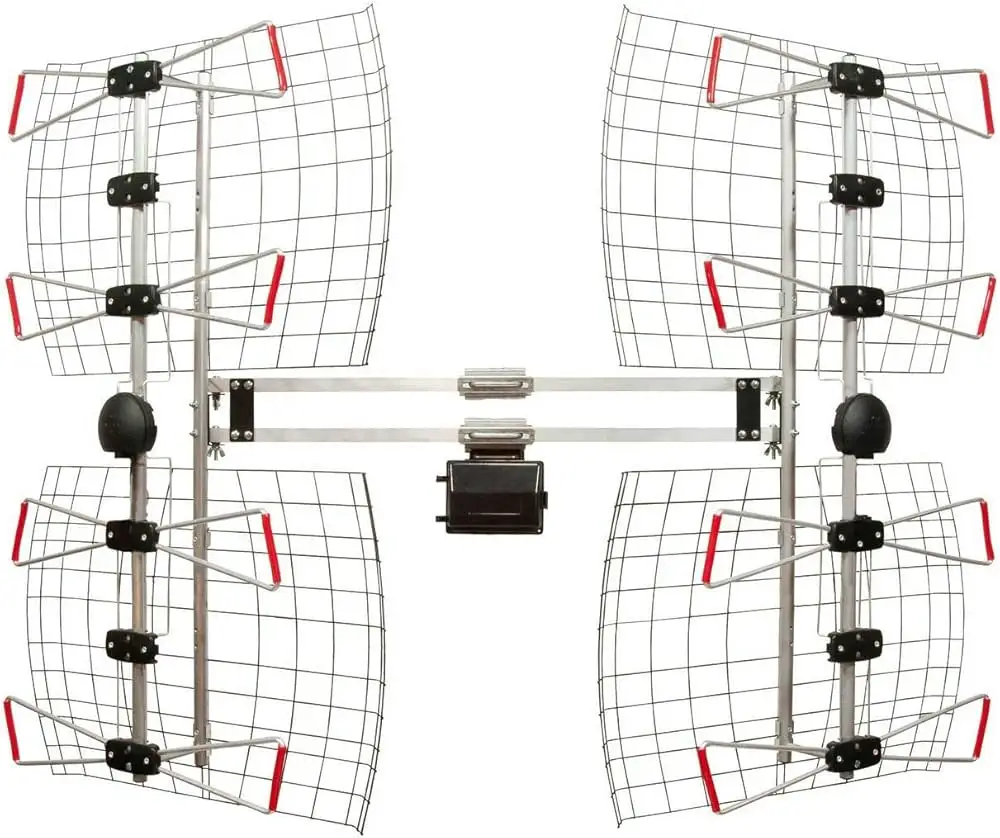
Another selling point is the multi-directional bracket system that allows independent panel rotation to cover different clusters of broadcast towers. Trustpilot reviewers repeatedly confirm this, with one writing, “With a 50 degree spread between TV towers in my area, I fully tested this feature … meticulous adjustments really worked to pull stations from two directions.”
Durability claims — “industrial-grade build” and “all-weather mounting hardware” — appeared consistent across sources. A verified buyer on Amazon mentioned, “Since it’s protected from the elements inside our attic, this antenna should easily last without the need for the lifetime parts guarantee.” Outdoor installers described it as “sturdy and weather-resistant” with little degradation in harsh climates.
Cross-Platform Consensus
Universally Praised
For rural and suburban households, the DB8e’s ability to pull clear HD channels from multiple tower clusters is a recurring highlight. Reddit user comments describe it as “like going from dial-up to fiber optic internet” when replacing less capable indoor antennas. This is especially beneficial for cord-cutters balancing free OTA content with streaming services — one Trustpilot user calculated their $250 investment paid for itself in three months by eliminating an $80/month cable bill.
Users living between tower clusters praised the ability to angle the two panels independently. “I can angle each set of elements differently to maximize reception,” noted a Reddit poster. This configuration lets rural homes pick up more channels without losing strength, and several reports mention improved performance with careful orientation.
Weather resistance earned applause from installers and long-time owners. The DB8e’s reflectors and industrial-grade frame stand up well against wind and storms. One Trustpilot reviewer noted, “Once mounted, the antenna feels secure, even during strong winds and rain.”
Common Complaints
Oversized dimensions made attic installations tricky, with multiple users describing tuning difficulties in confined spaces. A Trustpilot customer noted, “Its large size works against it to make ‘tuning’ extremely difficult in such signal challenged areas.” For those living within 25 miles of broadcast towers, some consider it overkill: “Too much antenna if you live less than 25 miles from your TV towers,” cautioned an Amazon reviewer, adding it performed no better than a $30 compact GE attic model in short-range conditions.
While advertised as 70+ mile range, several users report reception quality drops past 60 miles, especially without amplification. Terrain obstructions like hills and dense trees were frequently cited as limiting factors. One rural resident found “channels in the 50+ mile range required some tweaking — rotating those bow tie elements to find the sweet spot took patience.”
Another consistent complaint involves multipath interference in heavily wooded areas. Signals reflecting off obstacles caused pixelation, and some wished for a “twin yagi style offering … better at rejecting multi-path signals” than the DB8e in certain environments.
Divisive Features
The tuning process divided users into two camps: those who enjoy the precision and flexibility, and those frustrated by the trial-and-error nature. Positive accounts call it “straightforward” and manageable with two people; others found fine adjustments cumbersome.
Build size also split opinion — some appreciate the substantial feel and interpret it as a sign of quality, while others found it unwieldy for attic mounting. One Reddit installer commented, “Very large… compact size would have been a perfect fit for the attic” when comparing with smaller models.
Trust & Reliability
Concerns about misleading range expectations pop up in isolated accounts, but no reports of fraudulent sales or warranty disputes emerged from Trustpilot data. On longevity, users report consistent performance even after extended outdoor exposure. One Amazon buyer noted their attic-mounted DB8e showed no performance drop after several seasons.
The lifetime parts warranty adds a layer of consumer trust, especially given the higher upfront cost. Reports suggest minimal need to claim it due to the antenna’s robust design and weather resistance.
Alternatives
User comparisons frequently cite the Channel Master CM-4228HD and Winegard Elite 7550. The Channel Master boasts an advertised 80-mile range, but some owners call that “a joke,” noting performance dips past 50 miles. It lacks the DB8e’s multi-directional panel adjustment, a feature rural users see as essential. Winegard Elite owners appreciate its compact design and built-in amplifier, but DB8e fans point out the shorter range as a drawback for rural locations.
For urban setups within 30 miles of towers, the consensus is to opt for smaller, cheaper antennas — the DB8e’s size and gain offer no advantage at short distances and may complicate aiming due to multipath effects.
Price & Value
Current retail prices vary from about $124 on Amazon to nearly $196 on niche electronics sites, with eBay listings around $192 before the model became unavailable. Community tips suggest watching seasonal sales or open-box deals to offset the premium pricing.
Resale value isn’t strongly documented, but the product’s durable build and lifetime warranty keep second-hand demand steady. Buyers emphasize calculating cost savings versus cable bills — those in strong reception areas can break even in under six months.
FAQ
Q: Can the DB8e receive VHF channels?
A: Not by default — it’s UHF-only. For VHF (channels 7-13), add the manufacturer’s ClearStream 5 Hi-VHF antenna and combiner kit.
Q: Is it suitable for indoor attic installation?
A: Yes, but space can be tight. Users recommend measuring beforehand and noting that attic placement may reduce extreme range performance.
Q: Do I need a preamplifier?
A: If you’re running long coaxial cables or splitting to multiple TVs, a powered splitter or preamp helps maintain signal strength.
Q: How difficult is installation?
A: Most find it manageable with two people. Expect to spend time aiming panels for optimal reception, especially in multi-tower areas.
Q: Will it work in heavy foliage areas?
A: Many rural users report good performance through trees, but multipath interference can occur — careful orientation minimizes this.
Final Verdict: Buy if you’re a rural/suburban cord-cutter within 60 miles of broadcast towers and want multi-tower reception flexibility. Avoid if you’re under 25 miles from towers — cheaper, smaller antennas may suffice. Pro tip from the community: invest in quality coax and a powered splitter to fully realize the DB8e’s potential.





