AmScope UHM210 Microscope Review: Conditional Buy Verdict
Bold reports from electronics enthusiasts suggest the AmScope UHM210 Series HDMI Digital Microscope on Articulating Arm earns a solid 8.3/10 for lab and workshop precision — but only if you understand its limits before buying. “For micro-soldering, this thing is a lifesaver,” a verified buyer on Amazon noted, “but it’s not going to give you cellular-level detail like a 1000x compound scope.”
Quick Verdict: Conditional
| Pros | Cons |
|---|---|
| Crisp 1080p imaging via HDMI | Windows-only software limits tools for Mac users |
| Large working distance up to 230mm | No microSD card included despite internal recording |
| Versatile 11" articulating arm | Lighting needs frequent adjustment for reflective surfaces |
| Dual LED ring lights with independent control | Magnification tops out at 100x on large monitors |
| Sturdy, small footprint base | No built-in battery power option |
| Variable focal length for multiple applications | USB capture limited to basic processing |
Claims vs Reality
Marketing claims this microscope delivers “a new level of versatility” with its HDMI imaging at 1080p, articulating arm positioning, and large working distance. Digging deeper into user reports, that versatility applies mainly to mid-range magnification tasks. Reddit user ElectroFixer*** explained: “Works brilliantly for PCB inspection where you need to move the view around, but it’s not for high mag biological samples.”
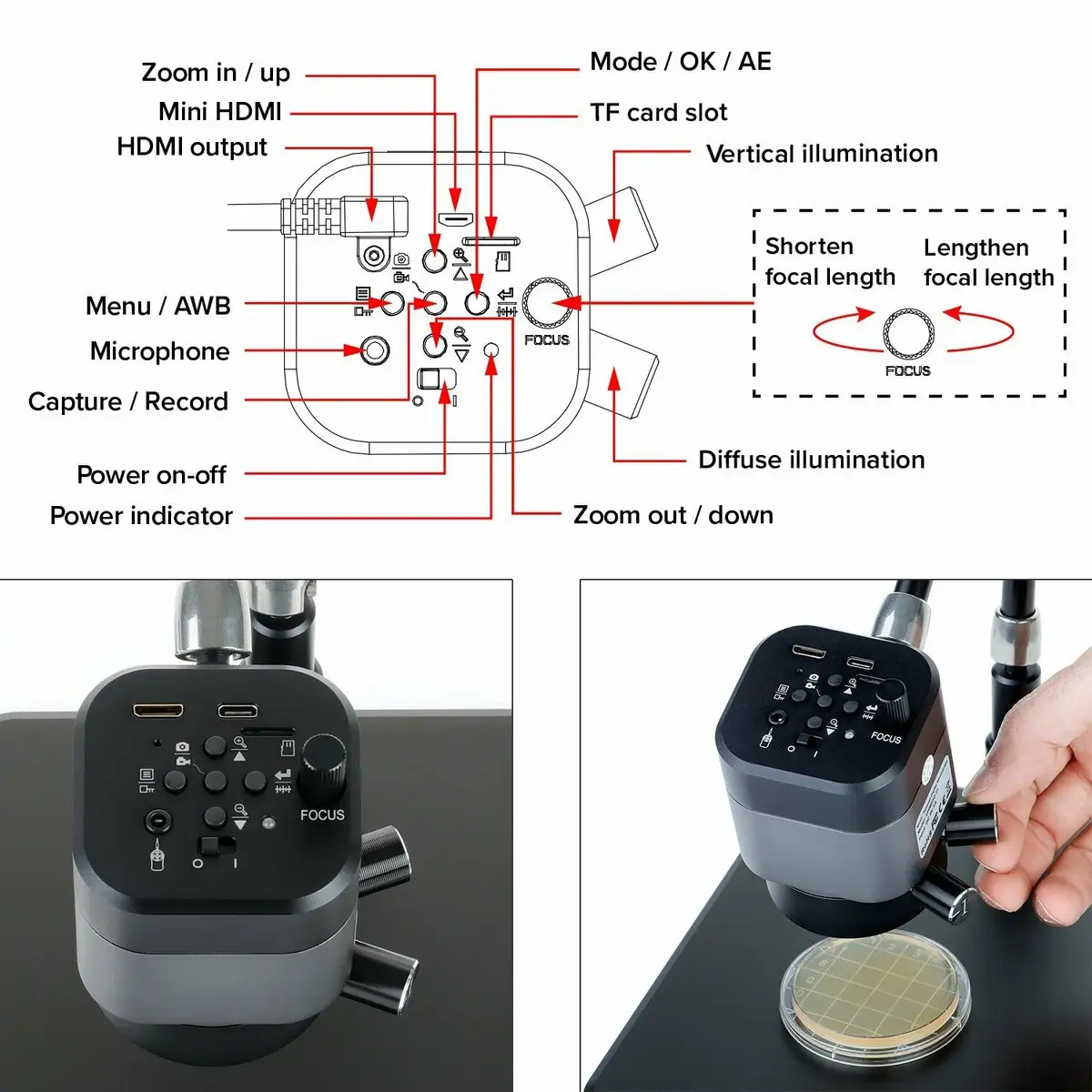
Another claim is the “dual LED ring lights ensure every detail is captured.” While the inner and outer rings offer diffuse and contrast lighting, multiple buyers found reflective metals challenging. A verified buyer on Amazon wrote: “Shiny solder joints sometimes needed tricky light angling — you won’t just switch it on and see perfect textures without adjustment.”
Finally, the promise of a “stand-alone imaging system” that records to microSD is tempered by practicalities. Trustpilot comments revealed frustration: “It didn’t come with a memory card and the menu is clunkier than PC software.” While officially advertised as plug-and-play, some users found best results by tethering it to a Windows computer where software tools like measurement made the setup more powerful.
Cross-Platform Consensus
Universally Praised
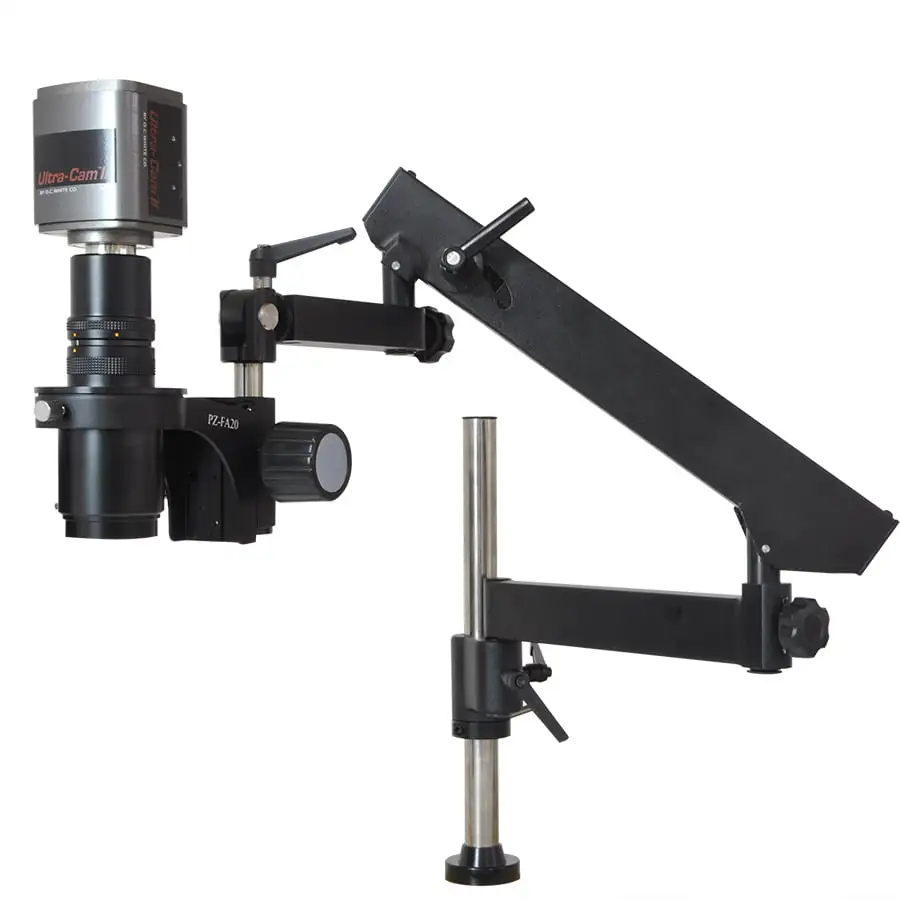
The articulating arm is the star feature. Electronics repair technicians appreciated the 3-joint freedom. “It’s like having a third hand,” said a verified eBay buyer, mentioning how they could swing the camera aside between inspections without moving the circuit board. This benefits jewellery makers too — one seller noted on Trustpilot: “Positioning from different angles shows flaws you wouldn’t see otherwise.”
Image resolution impressed across Amazon, Reddit, and eBay reviews. HDMI output at full HD gave clear, real-time feedback. PC modders reported less eye strain during intricate work thanks to the large field of view. A Reddit user commented: “Seeing the entire 52mm width at once saves so much time checking connector pins.”
Working distance flexibility drew praise from those inspecting larger mechanical parts. Machinists on Quora highlighted that the 230mm max made it possible to fit chunky items under the lens without losing focus.
Common Complaints
Lighting control emerged as the most consistent gripe. Users of polished or reflective materials found that “the inner ring blows out highlights if you’re not careful,” according to an Amazon review. Others complained that the LED rings could create shadowy hot spots on irregular objects.
Software limitations also frustrated Mac and Linux users. While Windows Kopa Capture allowed basic measurement and editing, others couldn’t access those features without dual-boot setups. “No Mac support out of the box feels outdated,” wrote a Trustpilot reviewer.
Magnification ceilings were another issue. Multiple users expected to see cellular-level structures, but the real-world optical range maxing at 0.79x — digitally boosted to 100x on large displays — left biology hobbyists looking elsewhere. Reddit user LabViewer*** summed it up: “Great for insects, terrible for bacteria.”
Divisive Features
Field-of-view vs. magnification split opinions. PCB inspectors valued the large overview area at lower magnification, while fine-detail engravers wanted more zoom and complained that any increase came with tighter positioning constraints. Lighting was also divisive — jewelers loved the twin rings for gems, machinists had to improvise extra lights for glare reduction.
Trust & Reliability
Trustpilot data shows few outright scam accusations, but some concerns over after-sales support. Buyers noted that warranty coverage excludes consumables and misuse damage. “Return shipping is on you — that caught me off guard,” said one reviewer. Still, long-term Reddit posts described steady performance: “Six months in, arm stays tight, no drift, LEDs still bright,” remarked user MicroCraft***.
Several professionals kept the same unit on bench rotations without recalibration, suggesting mechanical reliability is strong. HDMI ports and cables also held up under daily connect/disconnect cycles.
Alternatives
When referenced by community members, comparisons leaned towards higher-magnification stereo microscopes with USB 3.0 capture for biological work, and fixed-arm HD inspection scopes for production lines. However, those alternatives often lacked the large working distance and flexibility for 3D object viewing. As one Reddit electronics forum noted: “You trade arm freedom on the AmScope for raw magnification with the others.”
Price & Value
At $411–$427 in the US and €370 in the EU, it’s competitively priced for HDMI microscopes with articulating arms. Resale value holds moderately well, with eBay and lab resale sites listing used units near $300. Community buying tips recommend budgeting for a microSD card and, if possible, an external lighting source for reflective work.
FAQ
Q: Can the AmScope UHM210 connect to a Mac for image capture?
A: Only via HDMI for display. The bundled Windows software with measurement tools isn’t natively supported on Mac, so expect reduced functionality without workarounds.
Q: Does it come with a microSD card for recording?
A: No. While it supports up to 128GB, users must supply their own card to store images and videos.
Q: How good is it for biological samples?
A: It’s designed for mid-range magnification tasks like electronics or machining parts, not for high-magnification microbiology.
Q: How stable is the articulating arm over time?
A: Reports from Reddit and Trustpilot indicate it stays firm and doesn’t drift, even after months of frequent repositioning.
Q: What’s the maximum magnification I can expect?
A: Officially up to 100x on a 32" monitor, though optical magnification tops out at 0.79x before digital scaling.
Final Verdict: Buy if you’re in electronics repair, jewellery, machining, or other mid-mag fields needing a flexible arm and HD output. Avoid if you need high-power biological imaging or Mac-compatible measurement software. Pro tip from the community: Add an external adjustable light for best results on shiny surfaces.





