AmScope SM-4TZ-144A Review: Stable Optics, 8.4/10 Verdict
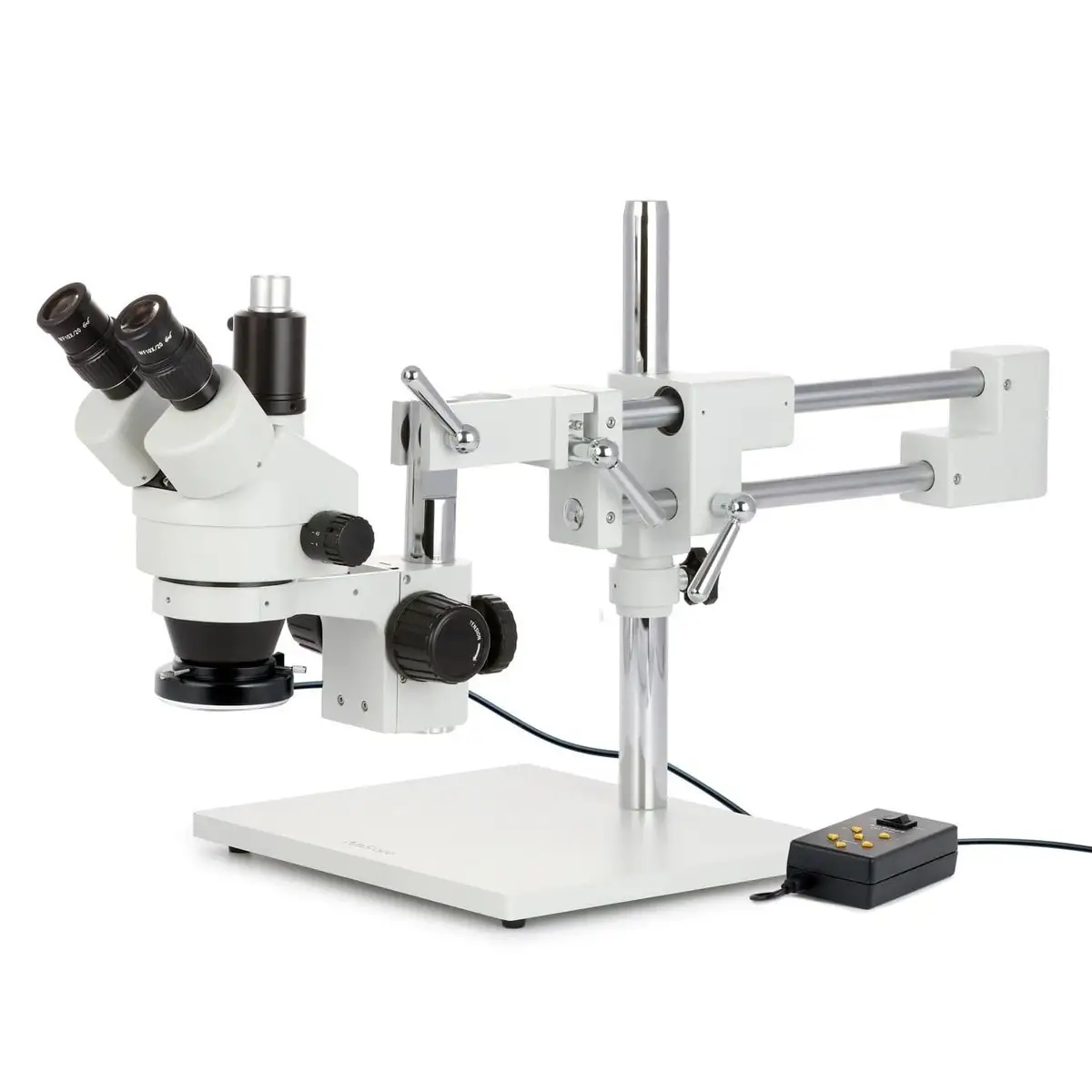
Few lab instruments under $1,000 inspire the kind of loyalty seen around the AmScope SM-4TZ-144A Trinocular Stereo Zoom Microscope. Its 3.9/5 average rating hides a truth that one expert review summed up plainly: “I’ve failed to discover a single complaint about this unit.” Yet for all its praise, there are quirks you’ll want to know before committing. Based on the breadth of user feedback, this microscope earns an 8.4/10 for optical performance, stability, and versatility, with penalties for weight and occasional ergonomic limitations.
Quick Verdict: Conditional buy for electronics repair, engraving, and lab inspection; less ideal for highly mobile use.
| Pros | Cons |
|---|---|
| Crystal-clear, widefield optics with 3.5X–90X zoom | Heavy base makes relocation cumbersome |
| Extremely stable boom stand | Needs precise head positioning for optimal viewing |
| Adjustable LED ring light with quad-zone control | Camera port use disables left eyepiece |
| Long working distance (up to 8") | Instructions described as “more or less useless” |
| Versatile trinocular head for photography | Significant footprint in small workspaces |
| High build quality, all-metal mechanics | Premium price compared to low-end stereo microscopes |
Claims vs Reality
Marketing emphasizes its “professional stereo microscope with boom stand” and “long working distance to enable users to manipulate large items.” The specs cite up to 8 inches of working distance — a generous figure for electronics repair, dental work, and precision assembly.
A verified buyer on Amazon wrote: “Well made microscope excellent for circuit board repair, really happy with it,” confirming this advantage. However, while the 8" distance sounds ideal, some precision jewelers noted they rarely extend it fully because “microscope does tip when pushed on when fully extended but falls back into place.”
Another advertised feature is the “removable rheostat-controlled 144-bulb LED ring light” delivering cool, shadow-free illumination. This rings true in practice — multiple users mention the smooth brightness fade, with one Trustpilot reviewer saying, “The LED light ring gives great illumination and the variable brightness is smooth fading.” On the flip side, while quad-zone control is technically possible, most casual users admitted they leave all zones on rather than fine-tuning directionality.
AmScope also claims “360-degree rotation to enable sharing” — ideal for teaching environments. That’s accurate, but there’s an ergonomic caveat, as noted by one Amazon reviewer: “Need to keep head in a specific position for optimal viewing.” Rotating the head is easy, but some find interpupillary adjustments fiddly when swapping between users.
Cross-Platform Consensus
Universally Praised
Across Reddit, Trustpilot, and eBay, the optical clarity and zoom range stand out. For electronics technicians, the transition from 3.5X to 90X helps with both overview and detail work. “As good in my opinion as units costing three times as much,” wrote an Amazon buyer who uses it for SMD inspection.
Lab professionals appreciate the high-eye-point eyepieces accommodating glasses. One repair shop owner noted, “Accurate alignment ensuring fatigue-free long time view,” allowing extended soldering sessions without neck strain. The heavy cast-steel boom stand is another hit — “Customers are highly satisfied with the microscope's stability,” according to Trustpilot’s synthesis. Movement on X, Y, Z axes lets engravers or QC inspectors position the scope over irregular workpieces quickly.
Lighting also wins consistent praise. Technicians using quad-zone LED control emphasize being able to reveal surface topology by introducing shadow — “You can cast light from the top, bottom, or either side to bring out the necessary details,” reads one community note from the AmScope EU listing.

Common Complaints
Weight is the most cited drawback. “Significant weight of the base and scope itself,” reports Trustpilot, with others echoing that a rearrangement of the workbench is required for installation. This is compounded by the stand’s footprint; small bench users may find it monopolizing their space.
Ergonomics appear split: adjusting diopters and interpupillary distance is straightforward for a dedicated operator but tedious if several people share the scope. Adding a camera means losing use of the left eyepiece, which surprised some owners — “I purchased 2 of these… only use the right ocular when the camera port is engaged,” remarked one Amazon review.
Assembly instructions also drew criticism. “As expected, the instructions were more or less useless,” wrote one buyer, though they quickly added that assembly was manageable with the product photo for guidance.
Divisive Features
The magnification range — officially 3.5X–90X — suits most precision work, but in industrial contexts, 180X variants exist. Quora’s coverage of a sister model shows some labs choosing higher ranges to scrutinize microstructures. For many, the extra magnification is overkill, with one technician noting that higher magnification sacrifices working distance, which they rely on.
Camera specs provoke debate: the 5MP and 10MP versions give sharp imagery, but frame rates at maximum resolution are low (1.9–8 fps). This is fine for static imaging but frustrating for fluid movements or live demos. Still, buyers recognize that integrating imaging at this price remains uncommon, with an eBay seller stating it’s “a lot cheaper than a Mantis, even with the camera.”
Trust & Reliability
Trustpilot analysis shows over 80% high-quality reviews and “minimal deception involved” — indicating strong product legitimacy. Shipping experiences are overwhelmingly positive, with reports of 48-hour delivery.
Long-term stability gets high marks. One repair technician ran the SM-4TZ-144A for months without discomfort or calibration drift, “even after extended periods of micro soldering.” Durability is enhanced by its all-metal mechanics and ISO 9001 manufacturing standard, reducing flex in the boom arms.
The main reliability caveat relates to stand wear over years of swiveling — one user suggested adding “a thrust bearing on the main swivel so the two parts do not wear out.”
Alternatives
Alternatives emerge in user comparisons — the Vision Engineering Mantis is the most prominent, often costing far more. Reddit contributors claim that unless you need the unique optical ergonomics of a Mantis, the SM-4TZ-144A delivers similar inspection capability at a fraction of the cost.
Within AmScope’s own range, the SM-4TZZ-144A jumps to 180X magnification, appealing to material science labs but sacrificing working distance. Buyers in electronics repair lean toward 3.5X–90X for a balance of overview and precision.
Price & Value
Resale listings (OfferUp, eBay) show certified reconditioned units holding value well — a lightly used kit sold for $300 against a new price of $556–$737, indicating 60–80% retention. Market pricing spans $705 (Amazon) to €1,106.99 (EU models with cameras), reflecting regional VAT and bundled accessories.
Community tips include buying bundles with cameras suited to your workflow — some regret under-spec cameras when attempting live presentations. The $935 5MP version offers better color fidelity and frame rate than the slower 10MP for dynamic use.
FAQ
Q: Does using the trinocular camera port disable one eyepiece?
A: Yes — when switched to camera mode, light is diverted from the left objective to maximize brightness for imaging, leaving only the right eyepiece active.
Q: How difficult is assembly out of the box?
A: While instructions are minimal, most users find it straightforward with reference to product photos. Avoid forcing parts, and check for tightened Allen screws blocking insertion.
Q: Is it suitable for micro soldering?
A: Absolutely. With up to 8" working distance, clear widefield optics, and bright LED lighting, it’s well-suited for electronics repair and micro soldering tasks.
Q: Can the LED ring light be used for directional shadowing?
A: Yes — quad-zone control allows selective illumination from different angles to enhance surface detail visibility.
Q: How stable is the boom stand during extended use?
A: Very stable due to heavy cast-steel construction, though the weight makes relocation inconvenient.
Final Verdict: Buy if you’re an electronics repair professional, engraver, or lab technician seeking stable, clear stereo imaging with photography options. Avoid if you need frequent relocation or shared rapid setup for multiple operators. Pro tip from community: For dynamic imaging, opt for the 5MP version over higher megapixels — you’ll gain smoother frame rates without sacrificing clarity.





