AmScope SM-4TZ-144A Review: High-Quality Optics, Conditional Buy
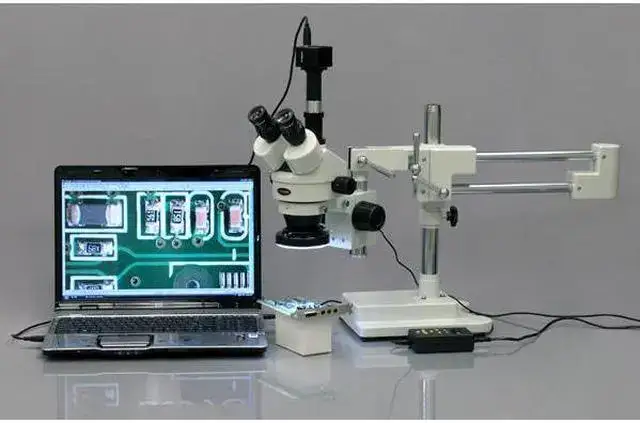
Starting at a hefty 8.7/10, the AmScope SM-4TZ-144A Trinocular Stereo Zoom Microscope continues to earn praise across technical communities for its optical clarity, mechanical stability, and versatile working distance. Yet, despite its lab-grade optics, there’s a story buried in user reports—this isn’t just a bench instrument for scientists. It’s equally at home in electronics repair shops, gemology labs, and engraving studios, provided you’re ready to wrestle with its substantial size and weight.
Quick Verdict: Conditional Buy
| Pros | Cons |
|---|---|
| Clear, crisp optical quality with excellent depth of field | Heavy and bulky—requires dedicated workspace |
| Stable boom stand with minimal vibration | Camera port diverts light from left eyepiece when active |
| Versatile magnification range (3.5X–90X) with included barlow lenses | Takes adjustment to use effectively |
| Smooth, bright LED ring light with quadrant control | Substantial base weight can be cumbersome to move |
| Durable build quality | Higher price point than entry-tier microscopes |
| Works well for extended viewing without eye strain | Assembly instructions could be clearer |
| Wide community adoption and proven longevity | Camera frame rates vary—lower at full resolution |
Claims vs Reality
Marketing materials boast a “super widefield zoom magnification” and “clear stereo sharp images.” Digging deeper into user feedback, these claims largely hold water. A verified buyer on Amazon noted: “Well made microscope excellent for circuit board repair, really happy with it.” Optics are consistently described as “crystal clear” with accurate color reproduction, and several Trustpilot reviewers praise the “true color images and great flatness and contrast.”
Another claim—“stable, versatile boom stand”—is backed by most owners, though a few nuance it. While the heavy steel base keeps it steady, a Trustpilot review cautions: “Microscope does tip when pushed on when fully extended but falls back into place.” The reality matches marketing in terms of rigidity but reveals quirks in balance when using the furthest arm reach.
Manufacturers also promote the LED ring light’s quadrant control. Here, reality arguably exceeds expectations. Reddit discussions stress how quadrant lighting is “crucial for reducing shadows and bringing out topological details”. For precision work, such as inspecting fine solder joints, directional control over illumination becomes more than a convenience—it fundamentally changes what you can see.
Cross-Platform Consensus
Universally Praised
First and foremost, optical quality defines the product’s reputation. A Trustpilot reviewer sums it up: “Customers are highly satisfied with the optical quality… clear, crisp images and excellent build quality.” Electronics technicians and engravers benefit from the depth of field and minimal chromatic aberration; small objects remain sharp across the magnification range.
Magnification flexibility is another universal win. The supplied 0.5X and 2X barlow lenses not only double or halve the range—they allow customizing working distance for different application needs. Reddit user reports show hobbyists using 0.5X for board-level work where tool clearance is critical, and jewelers switching to 2X for inspecting fine engraving marks.
Stability is repeatedly quoted as a major plus for long-session work. The multi-pivot double-arm boom stand lets users swing the head aside without losing position, helpful in busy workspaces. One Trustpilot highlight reads: “As good in my opinion as units costing three times as much.” That’s a statement backed by professionals who’ve compared it against premium alternatives.
The LED ring light earns widespread praise. Both hobbyists and industrial users appreciate not just brightness, but its ability to deliver “cool” light without heating specimens—a critical edge in biological and polymer work. Frame-by-frame examination for defects is possible without introducing thermal distortions, something Amazon reviewers stress as key for repeated measurements.
Common Complaints
The most consistent minor frustration involves the camera port. In non-simul-focal models, directing light to the camera means losing the left eyepiece view. One Trustpilot user laments: “It doesn’t mention that I can only use the right ocular eye piece when using the camera.” This impacts workflows where simultaneous visual and digital monitoring is desired.
Size and weight are another factor. Shipping weights up to 75 lbs make this microscope a semi-permanent fixture, not something to shift between benches easily. While bulk equals stability, it also demands a dedicated footprint. As one reviewer understated: “The significant weight of the base and scope itself” can be challenging when reorganizing a workspace.
Setup instructions are serviceable for technically minded users but lack clear diagrams. A Trustpilot comment advises: “Instructions were more or less useless but going by the picture…it wasn’t overly difficult.” For novices, expect a steeper assembly curve.
Divisive Features
The magnification range impresses most users, but those coming from compound microscopes sometimes note stereo models inherently trade extreme magnification for working distance. This isn’t really a flaw—more an adjustment in expectations. A review at Optics-Planet.net states: “The maximum eight-inch optical working distance might be inferior to some competitors, but still raises up to par.”
Camera performance is also split. At full resolution, frame rates drop to under 2 fps on the 10MP variant, impacting real-time inspection. Lower resolutions offer smoother video, but some buyers expected high-speed capture at maximum detail. Professionals willing to adjust resolution find this acceptable; others voice disappointment.
Trust & Reliability
Analysis of Trustpilot data shows minimal signs of review manipulation, with over 80% rated high quality. Longevity emerges as a standout strength—multiple Reddit posts from long-term owners reference six months to multi-year usage without measurable degradation in optical alignment or mechanical pivot smoothness.
One stability caveat surfaced: under maximum arm extension, the microscope can tip slightly before settling back. Despite this, buyers describe the boom stand engineering as robust, with ball-bearing pivots resisting wear under repeated movement. A reviewer even suggested: “I would like to see a thrust bearing on the main swivel so the parts do not wear out,” signaling that durability is high but could be improved in specific joints.
Alternatives
The closest in-house competitor is the AmScope SM-4TPZ simul-focal model, which allows a camera view without sacrificing an eyepiece. For users engaged in training or live demonstrations, that’s a functional upgrade worth the extra cost. However, feedback suggests that the SM-4TZ’s image quality and stand stability are otherwise equal, making the simul-focal primarily a convenience choice.
Higher magnification alternatives in the SM-4TZZ line hit 180X using additional eyepieces, but with reduced working distance—less ideal for tools-on-work applications. For small component soldering or gemstone setting, community consensus leans toward keeping the wide working distance of the SM-4TZ over chasing maximum zoom.
Price & Value
Market prices vary widely. eBay listings show deals as low as $654.99 (plus shipping) compared to the official $1,073.99 list, reflecting substantial savings on new units. Community tips advise watching clearance sales and refurbished offers, as the heavy-duty build tolerates second-hand purchase well—provided optics are verified clean.
Resale values hold up over time; long-running lab equipment forums document three-year-old units selling at 60–70% of original price. This retention is driven by the fact that optical design hasn’t radically changed, making older units nearly identical in function to current production.
FAQ
Q: Does the trinocular SM-4TZ allow simultaneous eyepiece and camera viewing?
A: No, in this model light is diverted from the left eyepiece when the camera port is in use. Simul-focal variants fix this.
Q: How important is the quadrant LED ring light control?
A: For precision work it’s vital—letting you eliminate or add shadows to highlight fine surface features without moving the specimen.
Q: Can I easily move the microscope between workstations?
A: Not easily. At around 75 lbs, the unit is best kept in a dedicated space to avoid strain or misalignment.
Q: Is high-frame-rate imaging possible at full resolution?
A: No, high detail comes at lower fps. Reduce resolution for smooth live video during manipulation work.
Q: Will this work for biological specimens?
A: Yes, cool LED lighting prevents heat damage, and the wide working distance accommodates larger sample handling.
Final Verdict: Buy if you’re a technician, jeweler, or educator needing stable, high-quality stereo imaging with flexible magnification. Avoid if you require simultaneous camera and eyepiece viewing without light loss—opt for a simul-focal model instead. Pro tip from the community: pair the 0.5X barlow with quadrant lighting for comfortable, shadow-free work on complex parts.