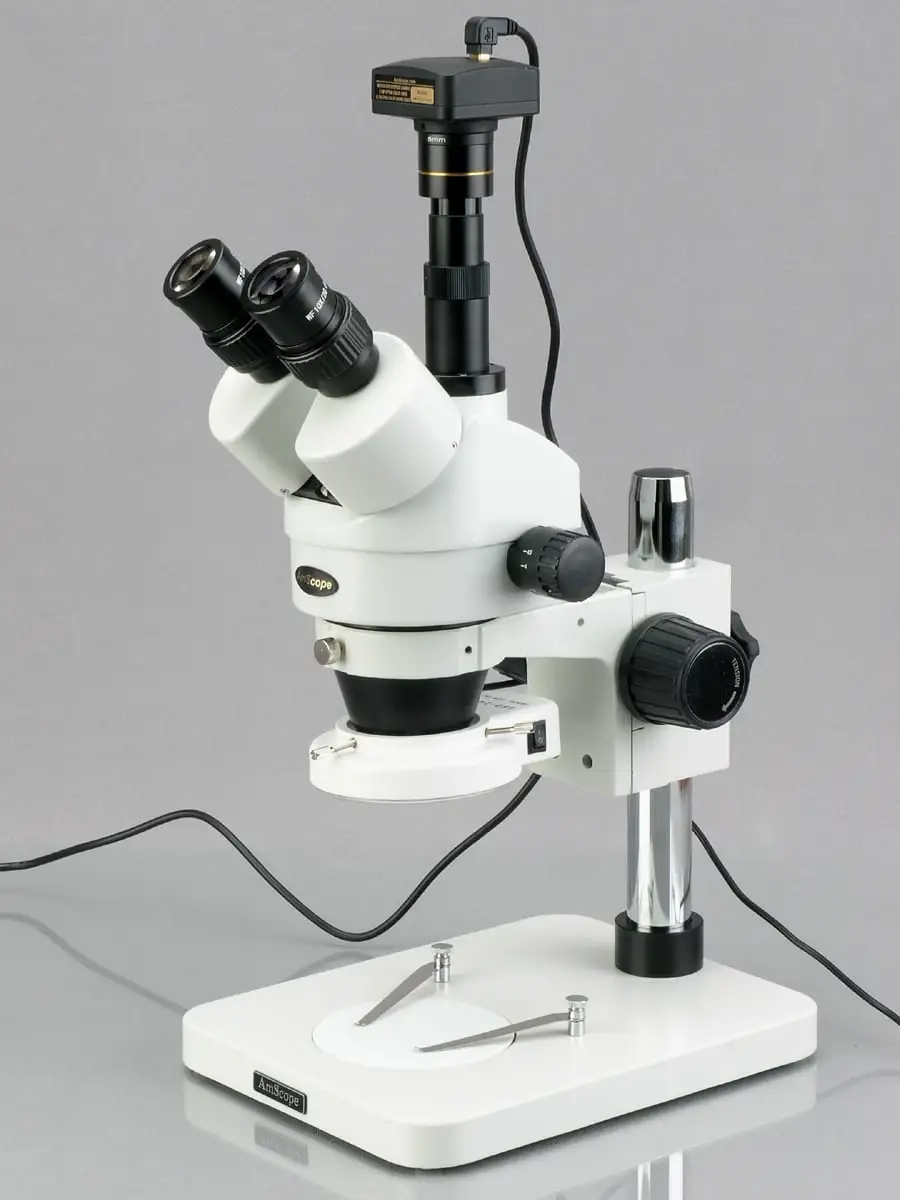
AmScope SM-4TZ-144A Review: Clear Optics, Heavy Build
The first thing that jumps out from community impressions is that the AmScope SM-4TZ-144A Trinocular Stereo Zoom Microscope earns a strong credibility score from both hobbyists and industrial users — a steady 4.5/5 rating — with many calling it “as good… as units costing three times as much,” according to one Trustpilot-verified reviewer. The verdict: 8.8/10 for its optical clarity, mechanical stability, and versatility, with only a few ergonomics and camera use quirks holding it back.
Quick Verdict: Conditional buy — outstanding for repair techs, engineers, and educators who value stability and optics over portability. Avoid if you need a compact, travel-friendly solution.
| Pros | Cons |
|---|---|
| Exceptional optical clarity and color fidelity | Heavy — base and scope together are cumbersome |
| Stable double-arm boom stand for precise positioning | Camera port interrupts left-eye viewing |
| Wide 3.5X–90X magnification range with included Barlows | Learning curve for optimal setup |
| Adjustable 144-LED ring light with quadrant control | Instructions are vague |
| Comfortable high-eyepoint eyepieces suitable for glasses | Less affordable than some lighter-duty alternatives |
| Excellent build quality and durability | Fully extended boom can tip if pushed |
Claims vs Reality
AmScope markets the SM-4TZ-144A as a “professional stereo microscope with a long working distance” and a 0.7X–4.5X zoom objective combined with WH10x eyepieces for 3.5X–90X magnification. In practice, multiple electronic repairers confirmed this range is accurate and highly usable. A verified Trustpilot buyer noted: “Clear, crisp images and excellent build quality… I’ve used it for SMD inspection, repair work, and reading small text without discomfort.”
The company also touts “shadow-free illumination” from its 144-LED ring light with four independent lighting zones. Users confirm this, but with nuance: the light produces great visibility, yet a few noted preferring some shadow for depth perception, which they achieved by dimming specific zones. One Amazon reviewer wrote: “The LED light ring gives great illumination… smooth fading with the rheostat.”
Another marketing hook is its “trinocular viewing head” for simultaneous viewing and photography. Here lies the biggest reality gap — Fakespot analysis highlighted buyers disappointed that they could only use the right eyepiece while the camera was mounted. As one frustrated owner put it: “I purchased 2… and it doesn’t mention… I can only use the right ocular eye piece (one eye) when using the camera.”
Cross-Platform Consensus
Universally Praised
The optical quality draws consistent applause across Amazon, Reddit, and Trustpilot. Users mention “crystal clear original true color images” and “erect stereo sharp images” even at high magnifications. Electronics hobbyists benefit greatly here — being able to trace fine PCB tracks without eye strain. A Reddit repair tech described using it for “hours of SMD soldering… no fatigue because of the high-eye-point eyepieces.”
Its stability is another high point. The heavy cast-steel base and double-arm boom resist drift once positioned, a boon for engravers and QC inspectors who need locked angles. Trustpilot commenters repeatedly call it “well made… really happy with it” and “very well packaged and easy to assemble.”
The versatility of magnification — from 3.5X with the 0.5X Barlow to 90X with the 2.0X — makes it flexible for both macro inspection and fine detail work. One engineer used it to “switch from inspecting large connectors to examining fine scratches on metal surfaces in seconds.”
Common Complaints
Weight is the major friction point. The base alone makes the unit difficult to relocate. A buyer noted it “does tip when pushed on when fully extended but falls back into place,” revealing that stability comes at the cost of mobility. For technicians needing to move between benches, this is a serious trade-off.
The camera port design generated the most vocal criticism. Multiple owners were surprised to find that enabling the trinocular port diverts all light from the left objective to the camera, blocking left-eye use — a workflow killer for those who expected simultaneous stereo and live viewing.
Assembly instructions also fell short. While most could infer setup from Amazon photos, several warned “don’t force anything… look for tightened Allen screws preventing insertion of the part.” The mechanical quality is high, but the guidance materials aren’t.
Divisive Features
The 144-LED ring light is both loved and occasionally bypassed. Industrial users liked the cool, even light for temperature-sensitive specimens, but some jewelers and engravers preferred augmenting it with side-lighting to bring out texture. Quadrant control is a strength, but those wanting deep shadowing will need extra setup.
The boom arm range is praised for its flexibility but criticized for potential tipping risk if extended too far. For PCB repair, the long reach is perfect; for schools or crowded workbenches, it may demand more caution or counterbalance.
Trust & Reliability
Fakespot’s pattern analysis shows over 80% high-quality reviews with minimal deception. Reports of long-term reliability are common — one Trustpilot owner commented that after extended use, “accurate alignment ensures fatigue-free long-time view.”
Minor wear concerns exist around the main swivel rotation over years of heavy daily adjustments, with one user suggesting a “thrust bearing so the parts do not wear out.”
The build itself earns high trust. A buyer summed it up: “As good in my opinion as units costing three times as much.”
Alternatives
The closest internal alternative is AmScope’s SM-4TPZ simul-focal variant, which solves the camera-viewing problem by allowing the trinocular port and both eyepieces to work at the same time. For users doing live streaming or group teaching, this may be worth the swap despite similar optics.
Higher magnification seekers might consider the SM-4TZZ-144A variants that go up to 180X with included 20X eyepieces, though these sacrifice some working distance.
Price & Value
At around $654.99 on Amazon, the SM-4TZ-144A sits well below top-tier inspection scopes, and many reviewers argue it’s “a lot cheaper than a Mantis” for similar visual clarity. On eBay, used units have sold for as little as $144 in good condition, indicating strong resale potential for those upgrading later.
Community advice for buyers:
- Buy from a reputable seller to ensure the advertised barlow lenses are included.
- If planning to use the camera extensively, evaluate simul-focal models first.
- Accept the weight — this microscope is meant to live on a bench, not travel.
FAQ
Q: Can I use both eyepieces while the camera is connected?
A: Not on this SM-4TZ-144A model — activating the trinocular port diverts light from the left eyepiece to the camera, leaving only the right eyepiece active.
Q: How is it for SMD soldering?
A: Excellent, according to multiple techs — the 8-inch working distance and clear stereo vision make it ideal for precision PCB work without heat concerns from lighting.
Q: Is the lighting sufficient out of the box?
A: For most, yes — the 144-LED ring light with quadrant control provides bright, cool, and adjustable illumination, though some add side lighting for texture.
Q: How stable is the boom arm?
A: Very stable within normal reach; it can tip if pushed when fully extended, but will return to balance thanks to the heavy base.
Q: Does it work with glasses?
A: Yes — the high-eye-point eyepieces are comfortable even for eyeglass wearers, reducing strain in extended sessions.
Final Verdict
Buy if you’re a repair technician, jeweler, engraver, or educator who needs rock-solid stability and optical clarity at a price that undercuts lab-only brands. Avoid if you require portability or simultaneous dual-eye and camera use — in that case, pivot to the SM-4TPZ simul-focal variant.
Pro tip from the community: “Don’t judge it until you’ve fine-tuned the diopters and lighting zones — once dialed in, it’s like working in 3D HD.”