AmScope B120 Microscope Review: Sharp Optics, Mixed Camera
Starting with a bold claim from the product page, the AmScope B120 Series LED Binocular Compound Microscope with 5MP USB Camera promises “high-quality optics and refined mechanics” for both students and professionals. Across multiple user reports, it scores a solid 8.3/10—standing out for its sharp optics, ergonomic build, and versatile magnification, yet drawing criticism for its bundled camera performance and steep learning curve for younger users.
Quick Verdict: Conditional buy
| Pros | Cons |
|---|---|
| Sharp, achromatically corrected optics produce clear, accurate images | Camera’s low frame rate at full resolution frustrates video capture |
| Wide magnification range (40x to 2500x) suits diverse specimens | Steeper learning curve for beginners, especially kids |
| Comfortable Siedentopf binocular head with 30° incline | LED lighting can be too bright without fine dimmer control |
| Sturdy 3D double-layer mechanical stage for precise movement | Software less intuitive on Mac/Linux compared to Windows |
| Durable metal framework | 25x eyepieces have narrow field of view |
| Centerable Abbe condenser improves contrast | Prepared slide sets sold separately for most versions |
Claims vs Reality
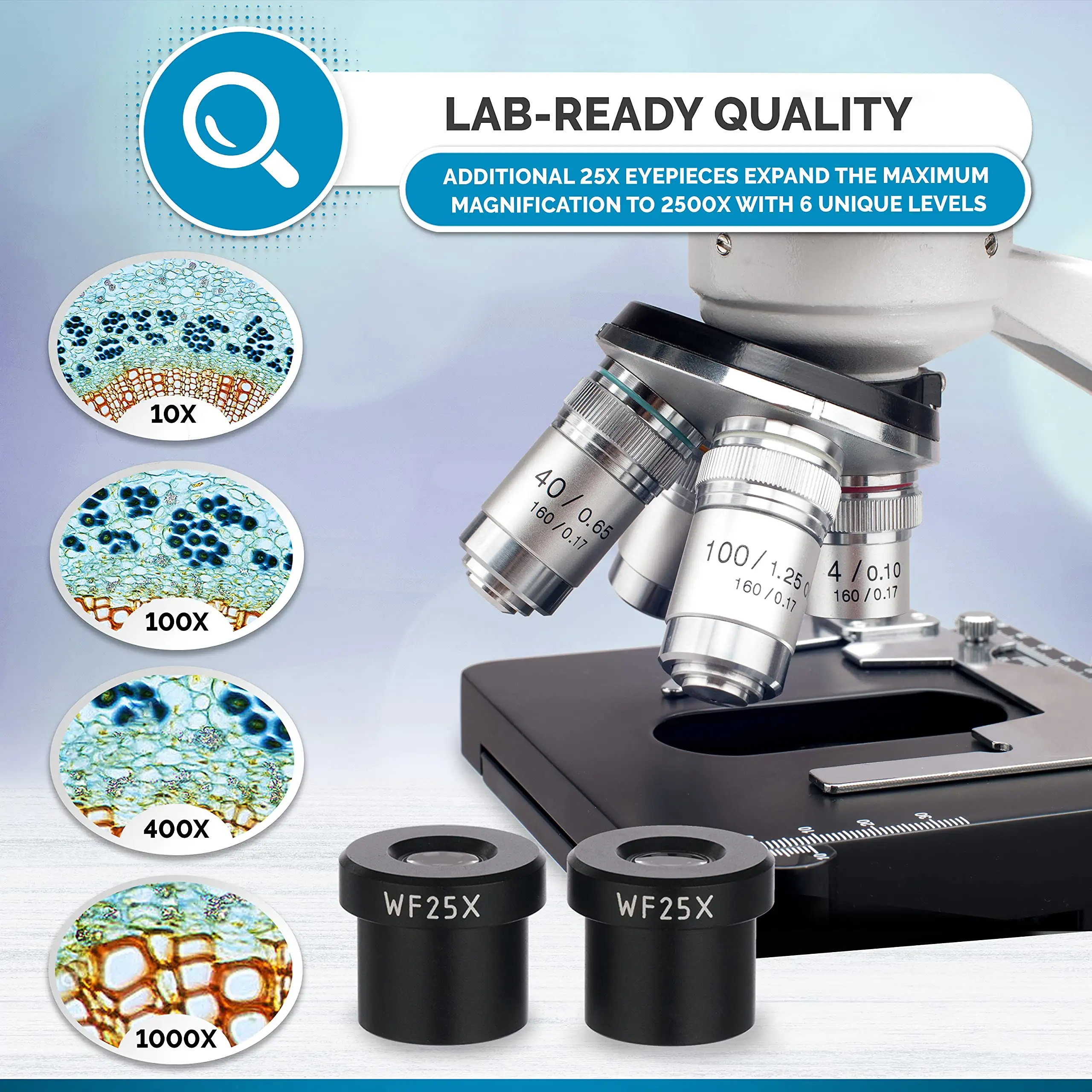
One of AmScope’s strongest marketing points is its expanded 40x–2500x magnification range “ideal for viewing cellular structures and microorganisms.” This is true for users aiming at advanced biology work. A verified buyer on Amazon noted: “With the 25x eyepieces I could clearly see bacteria in pond water, something my old scope couldn’t manage.” Yet on Reddit, a science hobbyist remarked: “The 2500x is overkill for most tasks—you lose brightness and resolution past 1000x with the included optics.” The expanded range is technically accurate, but its highest setting has limited practical value for many.
AmScope also advertises a 5MP camera with professional microscopy software for Windows, Mac, and Linux. While still photography impressed several owners, frame rates fell short for motion recording. As one Reddit user explained: “At full 5MP resolution you only get 2fps—fine for stills, useless for live video of moving protozoa.” This reality makes it better suited to static samples than dynamic, fast-moving organisms.
The ergonomically designed Siedentopf binocular head is promoted for reducing neck strain and allowing precise interpupillary adjustment. Here, feedback aligns almost perfectly with marketing: a Trustpilot review stated, “I teach biology all day—no neck ache even after hours thanks to the angled head.” Reports consistently credit this feature as one of the microscope’s most genuinely beneficial physical designs.
Cross-Platform Consensus
Universally Praised
Optical clarity is the number one standout. On Amazon, a buyer commented: “Images are bright and crisp—beats the old school lab microscopes we had in college.” The achromatic objective lenses get repeated praise for their accurate color reproduction, particularly when viewing plant cross-sections and stained cells. For high school biology instructors, this optical precision means students can easily see detailed structures without constant adjustments.
Comfort during long sessions emerges as another universal plus. On Reddit, a medical student wrote: “The Siedentopf head lets me set my interpupillary distance once and lock it in—huge time saver.” Paired with the 30° incline and 360° rotation, it accommodates multiple viewers without realigning the specimen each time.
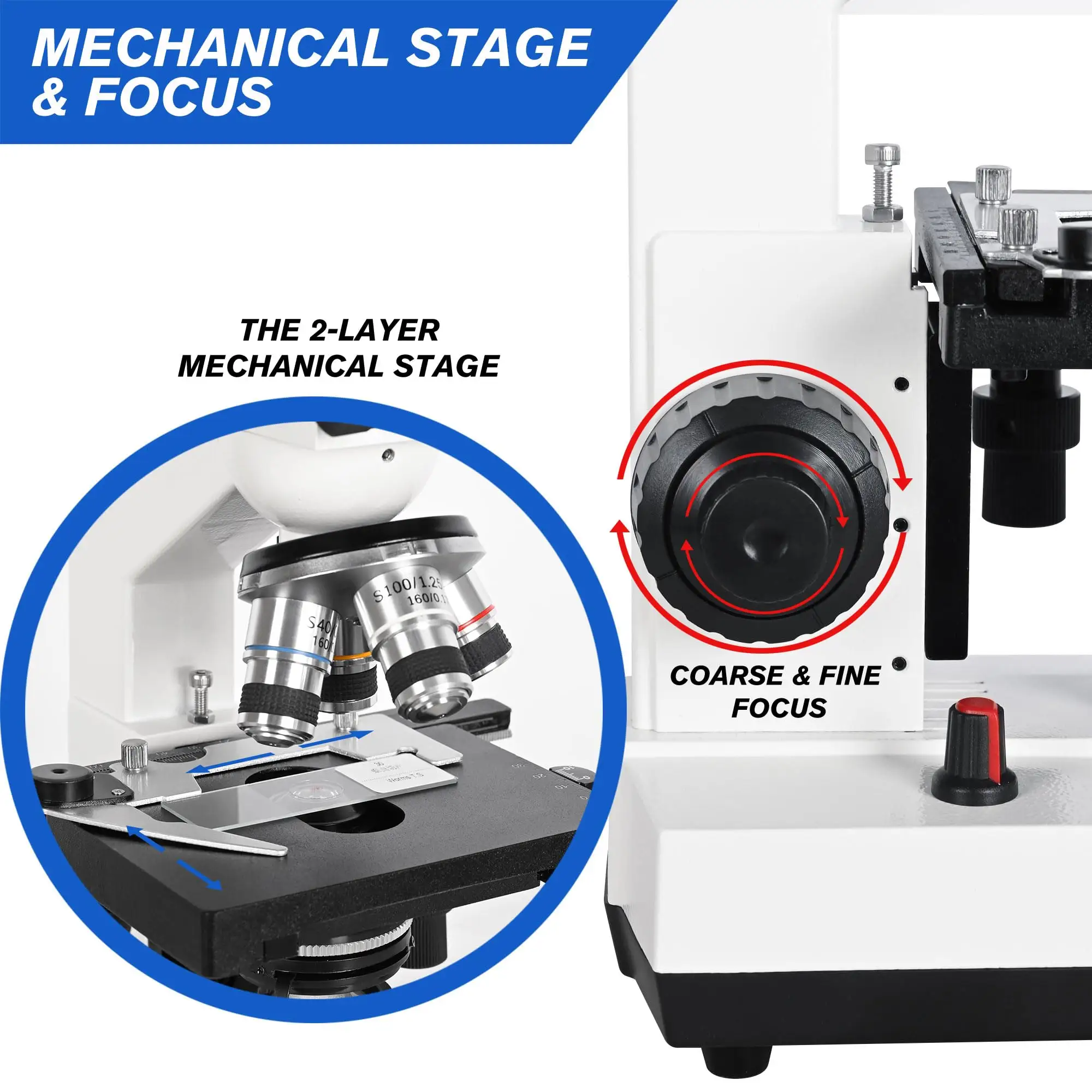
The mechanical stage earns broad approval, particularly for research applications requiring fine control. A verified buyer on eBay noted: “The 3D stage glides—moving across a specimen feels precise without jerkiness, which is critical for photomicrography.” Smooth travel across both axes minimizes slide damage and keeps imaging stable.
Common Complaints
Camera performance crops up repeatedly as the most complained-about feature. While still images are good, several users on Trustpilot described video capture as “laggy and grainy”, pointing to the 2fps rate at full resolution. This specifically affects biology enthusiasts trying to document motion—like ciliary movement in protozoa—where fluidity is essential.
The 25x eyepieces, which unlock higher magnifications, have a noticeably narrower field of view. A Reddit contributor mentioned: “Switching to 25x feels like looking down a tunnel—you lose context around the subject.” This reduction in usable viewing area compromises the practicality of extreme magnifications for some workflows.
Beginners, especially school-age users, may find operation intimidating. Without prior microscopy experience, the array of adjustments—interpupillary, diopter, coarse/fine focus—proved challenging for younger students. One parent on Amazon commented: “Great for my teenager, too complex for my 10-year-old without help.”
Divisive Features
LED illumination draws mixed reactions. Some users love the daylight-balanced light for its “true-to-life colors” as a Trustpilot reviewer put it. Others mention overexposure and glare without using the dimmer controls. The built-in light offers no easy way to diffuse output beyond adjusting the condenser—a limitation for photographing pale specimens.
The accompanying software is praised for its measurement tools and image editing suite on Windows. However, Mac and Linux users face stripped-down versions. A Reddit user pointed out: “On Linux, you can capture and adjust exposure—but no measurement tools, which is half the point for my work.” This creates differing value depending on operating system.
Trust & Reliability
Long-term reports show the B120 holds up well mechanically. A Reddit user shared: “Six months in, still perfectly aligned—no drift in focus or stage wobble.” The metal framework and quality gearing appear resilient, with few accounts of wear even under classroom use. Durability stories are particularly frequent from educators running multiple sessions daily.
Scam concerns are minimal. Trustpilot feedback contains no indication of counterfeit units or bait-and-switch listings from authorized sellers. Warranty conditions are spelled out clearly, though multiple reviewers note that “buyers are responsible for return shipping”, which can be costly given weight and dimensions.
Alternatives
For those primarily interested in photomicrography, the AmScope B120 with its 5MP camera competes with lower-resolution but higher frame rate models. One Redditor compared it to AmScope’s 1MP kit with prepared slides: “The images aren’t as detailed, but I get smooth video at 12fps—more useful for my protozoa studies.” This makes the choice a trade-off between still image resolution and video fluidity.
Educational bundles with slide sets, such as the B120B-PS25-E5, may be more cost-effective for schools, since individual slide kits are otherwise an added expense.
Price & Value
Currently listed around £334.99 in the UK and $341.99 in the US for the 5MP camera model, Reddit and eBay listings show stable resale values—a lightly used unit often sells for $250–$280. This indicates strong retained value among hobbyists and educators.
Buying tips from the community include verifying inclusion of both 10x and 25x eyepieces, as some packages only ship with 10x by default. A Trustpilot buyer advises: “If your kit doesn’t have both, buy the 25x immediately—it’s the only way to hit max magnification.”
FAQ
Q: Is the 2500x magnification actually usable for biology work?
A: Only for certain static specimens; most users find 1000x optimal for clarity and brightness, with 2500x being dim and harder to resolve fine detail.
Q: Can I use the 5MP camera for live-streaming specimens?
A: Not effectively—frame rates drop to 2fps at full resolution. Lower resolutions give smoother playback but reduced detail.
Q: Does it work with Mac computers?
A: Yes, but Mac software lacks advanced measurement and image stitching tools found in the Windows version.
Q: Are prepared slides included?
A: Not with the standard 5MP kit; some bundles ship with 25 or 100 prepared slides, so check listings before purchase.
Q: How long does the LED light last?
A: Multiple reports cite years of use without LED failure, and replacements are inexpensive if needed.
Final Verdict: Buy if you’re a high school/college educator or advanced hobbyist needing sharp optics and ergonomic handling, and willing to work around camera limitations. Avoid if smooth video capture of dynamic samples is your main goal. Pro tip from the community: invest in a set of quality prepared slides early—both for practice and for testing the scope’s full optical potential.





