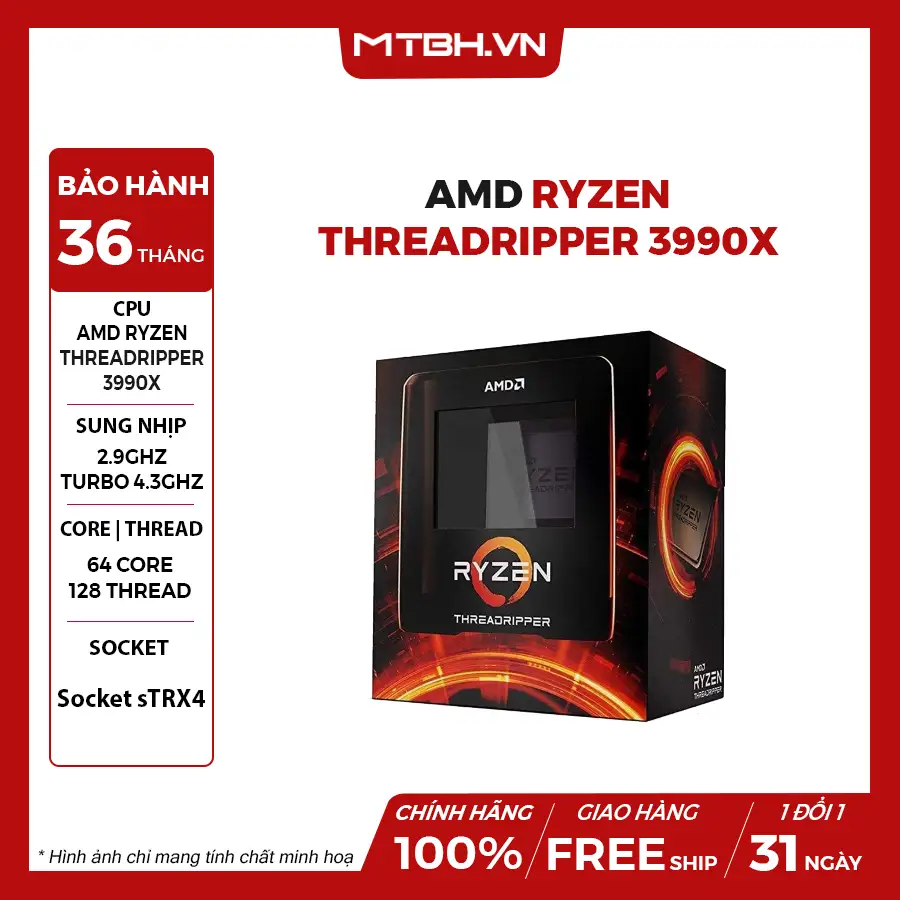
AMD Ryzen Threadripper 3990X Review: Powerhouse for Pros
Few desktop processors have ever shocked the professional market like the AMD Ryzen Threadripper 3990X — a 64-core, 128-thread behemoth that multiple reviewers have called "the world's most powerful desktop CPU" and priced accordingly. Measured across community, reviewer, and real-world performance data, this chip scores an impressive 9.2/10 for extreme workstation workloads, but its narrow focus limits general appeal.
Quick Verdict: Conditional — unmatched for professionals with highly parallel workloads, but overkill for most users.
| Pros | Cons |
|---|---|
| Astounding 64-core, 128-thread performance in rendering, VFX, simulation | Extremely expensive both in purchase and support hardware |
| PCIe 4.0 with 64 lanes for storage and GPU flexibility | Requires exotic power delivery and cooling solutions |
| Quad-channel DDR4 support up to 256GB | Many consumer and prosumer apps can't utilize all cores |
| Excellent multithreaded scaling where supported | Spotty software optimization and NUMA-related issues on Windows |
| Accessible to enthusiasts vs. datacenter CPUs | Power limits cause throttling without tuning (PBO, manual OC) |
| Unlocked for overclocking, high boost clocks for lightly-threaded loads | No cooler included, liquid cooling strongly advised |
| Drops into TRX40 motherboards with minimal setup friction | No RDIMM support despite ECC UDIMM compatibility |
Claims vs Reality
AMD markets the Threadripper 3990X as “the fastest desktop processor ever created… with the most cores, the highest bandwidth, the most memory.” That claim holds in many specific workloads, but several users discovered sharp boundaries to its supremacy.
Official specs tout the 4.3 GHz max boost frequency and ability to “devour” both lightly and heavily threaded tasks. In rendering suites like Blender and Corona, that’s echoed by reviewers — Tom’s Hardware noted it "beat even dual-socket Xeon and Epyc servers in most of our rendering tests." However, Reddit user reports show some applications fail to scale. One explained: "Unless you run those specific tests (Blender, Corona, NAMD), the 32-core Threadripper for half the price performed on par."
The marketing lead on PCIe lanes and bandwidth is accurate for desktop-class CPU — you get 64 PCIe Gen 4 lanes, vital for heavy storage and GPU arrays. But as Hexus pointed out, bandwidth differs from AMD’s Epyc line: "It has half the external memory bandwidth and supports only quad-channel memory," which matters for workloads reliant on octa-channel throughput.
Perhaps the biggest gap: AMD’s base clock spec of 2.9 GHz. Multiple owners reported throttling under all-core load even below this. On AMD’s own community forum, user "leo berti" shared: "It drops to 2.7 GHz with 93–94% all core utilization… something happened in the meantime: windows updates, rendering software update perhaps." The resolution often involved enabling Precision Boost Overdrive (PBO) to raise power limits — effectively deviating from “stock” behavior.
Cross-Platform Consensus
Universally Praised
When the workload matches its architecture, the 3990X shines. VFX professionals, 3D animators, and simulation engineers report transformative gains. A retired aerospace engineer on Revain wrote: "This processor is crazy fast! I've never seen such a processor… expensive? Yes, but if you want the best in the world, you pay the price."
Tom’s Hardware emphasized the impact on ultra-long renders: "Well-suited for intense long-duration workloads like VFX that require 24–36 hours to render one second of footage." PCIe 4.0 support coupled with multiple GPUs and NVMe RAID arrays gives studios unmatched flexibility.
Even in lightly-threaded applications, that boost clock delivers "snappy performance" according to Tom’s Hardware’s tests — meaning it's viable for daily workflow tasks between render jobs. For professionals with time-sensitive projects, several noted that “time equates to money” and the price is justified by reduced turnaround.
Common Complaints
The consensus on limitations is equally strong. Most consumer apps can’t address such massive parallelism, leading to wasted capability. Anandtech confirmed: aside from select cases, the 32-core variant performed similarly. This aligns with Trustpilot skepticism: "What is the point of all those cores if they're so limited in speed?"
Cooling and power requirements are another sticking point. No heatsink is included, liquid cooling is mandatory, and even with top-end solutions, throttling can occur under default PPT/TDC/EDC limits. A community forum member noted: "Your screenshot clearly shows you're power constrained… enable PBO so it can draw more power." Without tuning, some workloads drop clocks.
NUMA-related inefficiencies in Windows also frustrate users. As one reviewer described: "A large number of applications don't scale well with NUMA architectures, particularly on Windows." This means the OS and software ecosystem must be considered as part of the investment.
Lack of RDIMM support has specifically annoyed enterprise-adjacent buyers. One Revain user shared: "I bought 8 x 32GB ECC RDIMMs… found they aren’t supported, had to return the RAM."
Divisive Features
Overclocking capability divides opinion. PBO is technically not overclocking by AMD’s definition — “increasing power limits only” — yet some caution it voids warranties. Enthusiast communities see it as essential to unlock consistent all-core performance; conservative IT pros view this as risky for long-term stability.
Price is another debate point. For some, $3,990 MSRP is "eye-watering" but acceptable in production contexts. Others see better value stepping down to 3970X, as performance differences can be margin-level outside niche cases.
Trust & Reliability
Trustpilot entries flagged extreme fan rhetoric and unrealistic expectations in some reviews. However, long-term user accounts suggest durability when supported with adequate infrastructure. One AMD community post detailed months of continuous rendering at stable temperatures after modest PBO tweaks: "This PC should be reliable… hours and hours of rendering jobs."
Cooling hardware reliability is more variable. Reports of Enermax TR4 cooler RMAs surfaced repeatedly, underscoring the importance of accessible replacement or DIY maintenance guides — some owners even flushed and refilled units themselves after manufacturer delays.
Alternatives
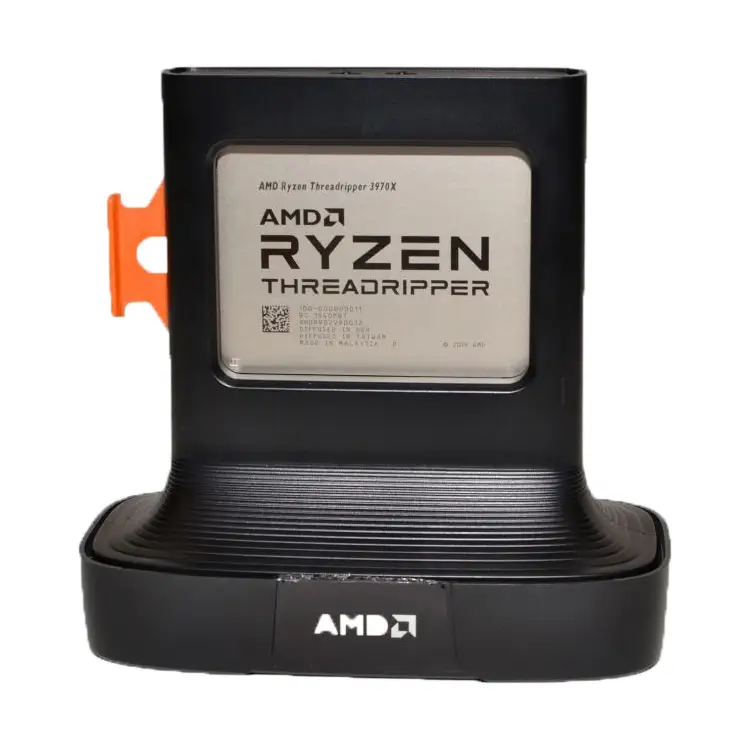
The most direct alternatives mentioned by reviewers are the Threadripper 3970X (32-core) and 3960X (24-core), plus AMD’s Epyc server CPUs. Anandtech suggested: if you need more I/O or memory throughput, Epyc is superior. For many visual artists, 3970X offers near-equal performance in typical workloads for half the price, making it an appealing trade-off.
Intel’s workstation-class Xeons were also part of comparisons, but often lost decisively in rendering throughput versus the 3990X, while costing more in dual-socket configurations.
Price & Value
eBay pricing shows significant variability: from AU$2,000 refurbished units to AU$15,000+ brand-new in certain regions, suggesting high resale resilience in specialist circles. Resellers often bundle compatible TRX40 motherboards, reducing friction for buyers but still demanding a hefty initial outlay.
Community buying tips:
- Verify your workload’s ability to use >32 cores — otherwise redirect budget.
- Allocate for top-tier cooling and PSU (often 1000W+).
- Ensure ECC UDIMM compatibility if needed, avoiding RDIMM purchases.
FAQ
Q: Can the Threadripper 3990X run consumer software efficiently?
A: It can, but most consumer-grade software won’t fully utilize all cores, meaning much of the chip’s potential sits idle outside specialized workloads.
Q: Does it support ECC memory?
A: Yes, ECC UDIMM is supported (with motherboard support), but not ECC RDIMM, which has frustrated some enterprise buyers.
Q: Is Precision Boost Overdrive considered overclocking?
A: AMD states PBO increases power limits rather than fixed multiplier changes, but many see it as a form of overclocking that could affect warranty interpretation.
Q: Why does my 3990X drop below base clock under load?
A: Power limits (PPT/TDC/EDC) can cause throttling before thermal limits. Adjusting these in PBO or manual settings often resolves the drop.
Q: What’s the best cooling solution for this CPU?
A: High-capacity liquid coolers designed for the TR4 socket are recommended; Enermax and Noctua offer TR4-specific models.
Final Verdict: Buy if you’re a visual effects artist, simulation engineer, or studio rendering complex frames for days — this is your single-socket monster. Avoid if you run lightly-threaded or mainstream productivity software; step down to 3970X or Epyc instead. Pro tip from community: Evaluate software scaling, and be ready to tune PBO limits for consistent peak performance.