Amazon Basics 12-Inch Thermal Laminator Review: 7.9/10
“I jammed, crumbled, and permanently creased my card.” That one-line horror story sits right next to a sea of praise—and it captures the real gamble with the Amazon Basics 12 inch Thermal Laminator Machine with 20 Pouches: when it’s dialed in, it can look “absolutely flawless,” but a bad feed or a finicky unit can ruin something important. Verdict: a strong budget pick for careful, small-batch laminating, with enough quirks that it isn’t a blind buy. Score: 7.9/10.
Quick Verdict
Yes—conditionally. It’s a value-first laminator that many owners describe as quiet, compact, and capable of bubble-free results, but several warn to test-run it and feed carefully to avoid jams and wrinkling.
| Decision | Evidence from user feedback |
|---|---|
| Buy if you want budget laminating | A verified buyer on Amazon noted: “works well and very good price.” |
| Buy if you laminate small batches | A verified buyer on Amazon wrote: “I would recommend this to someone who desires to laminate small jobs at a time or infrequently.” |
| Buy if portability matters | A verified buyer on Amazon described it as “very petite… lightweight… fit in a carry on, backpack, or even a big purse.” |
| Think twice if you need foolproof feeding | A verified buyer on Amazon warned it “does not have ‘guides’… sheets can enter in at an angle and cause crumpling.” |
| Avoid if you can’t risk a jam on originals | A verified buyer on Amazon said: “it jammed, crumbled, and permanently creased my card.” |
| Expect slower throughput | A verified buyer on Amazon summarized: “it is slow but works great for small projects.” |
Claims vs Reality
Amazon listings position the machine as a quick, easy home laminator—yet the fine print and user experiences suggest “quick” and “easy” depend heavily on warm-up patience and careful feeding. Digging deeper into user reports, the most consistent gap isn’t about whether it can laminate—it’s about how forgiving it is when you rush or misalign.
Claim: “Rapid warm-up (1 minute)” / “ready in minutes.”
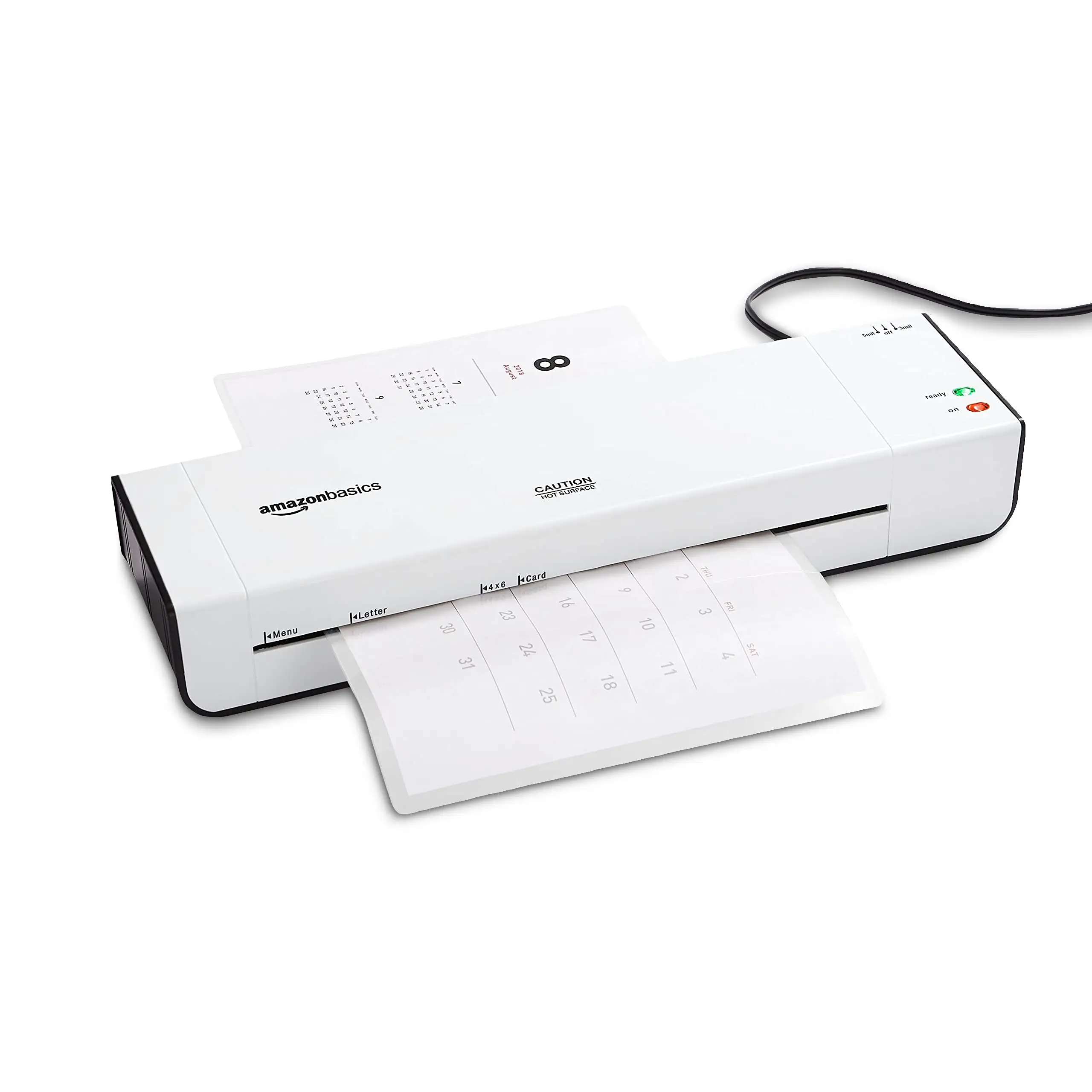
Official specs vary across Amazon listings, including a “rapid warm-up (1 min)” claim on one listing and “quick 3–5 minute warm up” on another. In practice, at least one verified buyer described a longer real-world ramp: “heats up and ready to use in about 5 - 7 minutes,” and noted that ignoring reheating cues can degrade results. That matters for teachers, Etsy sellers, and crafters who want to turn out multiple sheets back-to-back—because the machine may need recovery time to maintain clarity and seal.
A recurring pattern emerged: when users push throughput, they see quality drift. One verified buyer said the laminator “tries to reheat itself… the red light will come on,” and warned that skipping that wait can create “foggy looking lamination” or “bubble and peel open.” While marketing implies a quick start, the lived reality for many is more about managing heat cycles than racing a stopwatch.
Claim: “Jam-free operation” / jam-release lever makes clearing easy.
The product is marketed with a jam-release mechanism, but user stories show jams can still happen—especially when feeding small items or when a unit has manufacturing defects. One verified buyer on Amazon relayed a worst-case scenario: “it jammed, crumbled, and permanently creased my card,” after attempting a business-card-size laminate. They later discovered “pieces of plastic from the manufacturing process sticking up” and reported that trimming them allowed the next attempt to come out “perfect.”
That story highlights the gap between “jam-free” messaging and the reality that alignment and hardware variation can make or break a pass. For buyers laminating irreplaceable documents—licenses, certificates, ID cards—this isn’t a minor inconvenience; it’s a risk.
Claim: “Easy to use.”
Plenty of owners agree it’s simple—once you learn its feeding behavior. A verified buyer on Amazon called it “very simple to operate,” but in the same review stressed it “does not have ‘guides’,” making it easier for sheets to drift. Another verified buyer, using it for garden labels, said it “worked great… held up against the weather,” but also admitted: “the most difficult thing was loading the machine… frustrating.”
So the “easy” claim is partly true: the controls are straightforward, but the mechanics demand attention at the feed point.
Cross-Platform Consensus
Universally Praised
The loudest praise lands on value and “good enough to great” results for everyday laminating at home, school, or small businesses. Across Amazon reviews, people repeatedly frame the purchase as a money-saver compared with paying per sheet at office stores. One verified buyer wrote: “for the price of the unit and the laminating sheets, it just made more sense to purchase my own machine,” explicitly comparing it to “pretty pricey per sheet” retail lamination. For parents preserving kids’ projects or homeowners making quick labels, that’s the core appeal: a low-cost machine that pays for itself fast.
Noise level is another standout benefit, especially for workspaces where a loud roller whine becomes a constant irritation. A verified buyer on Amazon called it “absolutely silent,” noting they “wouldn’t even know this thing was on” except for the indicator lights. For convention sellers laminating badges on-site, quiet operation becomes more than comfort—it’s about communicating with customers in a noisy environment. The same user emphasized that reduced noise made a tangible difference compared with an older machine.
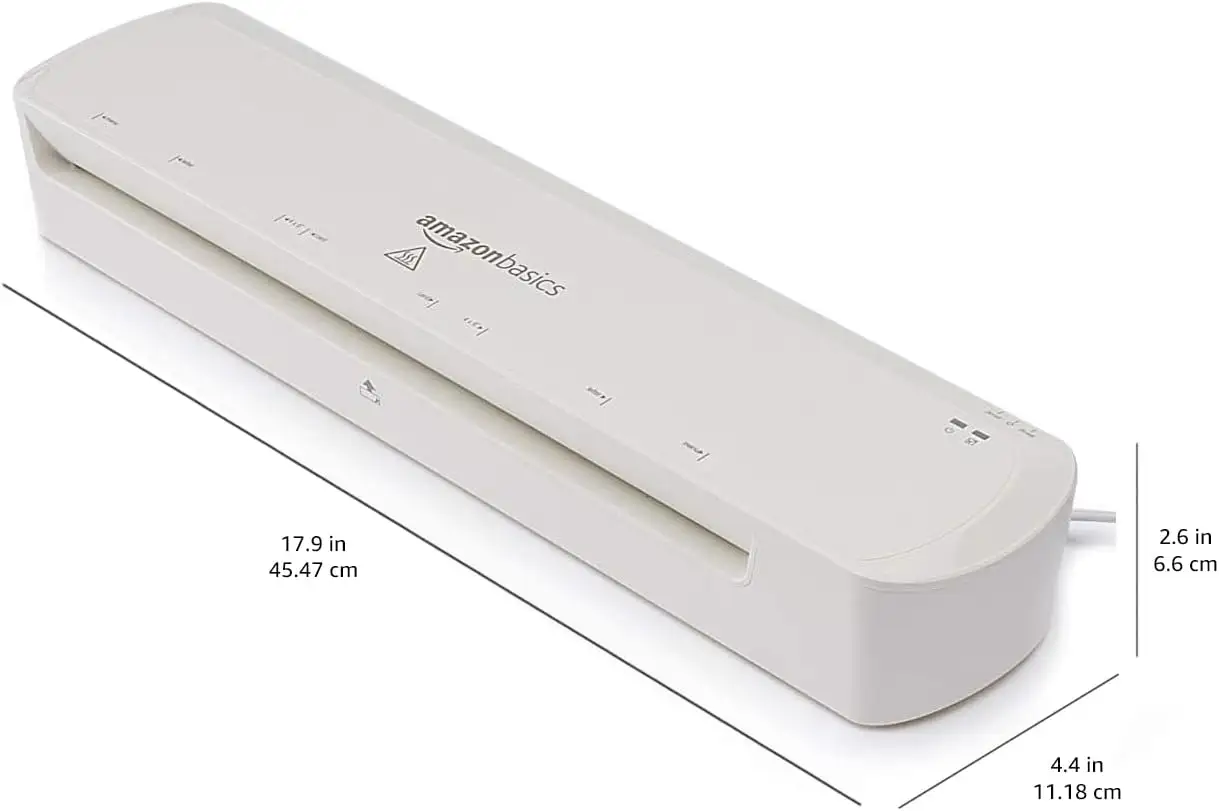
Portability and footprint also come up as practical wins. One verified buyer described it as “small and sturdy,” “lightweight,” and easy to pack—“fit in a carry on, backpack, or even a big purse.” That’s a meaningful edge for users who laminate outside a permanent office: convention vendors, traveling educators, or organizers who set up pop-up stations. Another verified buyer praised the “compact size—easy to put away or store in small spaces,” which matters for apartments or classroom storage.
When it’s working well, lamination quality can exceed expectations at this price. A verified buyer who needed bubble-free convention badges said: “the lamination quality is absolutely flawless… not a single air bubble.” For makers who cut close to the edge, they also appreciated how tightly the laminate sealed: it “laminates like a mm away from the cut image,” reducing the chance of corners lifting later.
Summary of common praise
- Value: “works well and very good price.”
- Quiet running: “absolutely silent.”
- Compact/portable: “very petite… lightweight.”
- Strong results: “absolutely flawless… not a single air bubble.”
Common Complaints
The most recurring operational complaint is feeding and alignment. Without physical guides, some users report the pouch or paper drifting sideways, which can wrinkle or crumple the laminate mid-pass. A verified buyer warned that because it “does not have ‘guides’… sheets can enter in at an angle and cause crumpling and folding,” potentially “permanently damage your document.” Another verified buyer echoed the struggle in plain terms: “the paper tended to pull up to one side… frustrating.”
For users laminating one-offs—like a single certificate or an important card—this issue can feel high-stakes. One verified buyer’s story reads like a cautionary tale: they fed a business-card-size item and it “jammed, crumbled, and permanently creased my card.” Their takeaway was blunt: “test it out first on something you care less about.” That advice is especially relevant for people laminating government IDs, professional credentials, or anything not easily replaceable.
Warm-up and reheating behavior also frustrates some buyers, especially those comparing it to competitors advertising faster readiness. One verified buyer said it “takes about 5 - 7 minutes to initially heat up,” adding that other brands “are competing with a 1-minute heat-up.” They also described a workflow constraint: after each sheet, the unit “tries to reheat itself,” and pushing ahead can cause “foggy” results or bubbling. For classrooms laminating dozens of name tags or busy craft rooms doing batch runs, that pause-and-go rhythm can slow productivity.
Finally, a few complaints relate to packaging/condition on arrival and minor manufacturing quirks. One verified buyer received a unit “extremely damaged in the corner,” with parts “unhooked,” though it still worked after testing. Another user found stray plastic interfering with output until they removed it—an example of quality variation that can create early frustration.
Summary of common complaints
- Misfeeds: “sheets can enter in at an angle.”
- Jams risking originals: “permanently creased my card.”
- Heat-cycle patience required: “foggy looking lamination.”
- Occasional build/ship issues: “extremely damaged in the corner.”
Divisive Features
Speed is where opinions split based on expectations and use case. Some users accept slower feed as a fair trade for quality and price. A verified buyer called it “slow but works great for small projects,” treating speed as a non-issue. But others see the same behavior as a limitation for volume work, describing the throughput as “very s.l.o.w.” and noting it’s “much more slowly than the other one” they owned.
Interestingly, for certain niche uses like toner-reactive foiling, slow feed can be a benefit rather than a flaw. One verified buyer buying it for an Etsy shop wrote: “because the print feeds so slowly… the foil spends more time under the heat, and seems to adhere better,” and celebrated getting “perfect” results after adjusting technique. For crafters doing gold foil prints, the same trait that annoys batch laminators may improve outcomes.
Trust & Reliability
Digging deeper into user reports, the reliability story hinges on two themes: unit-to-unit consistency and user technique. The most alarming reliability narrative comes from the jam-and-damage incident: a verified buyer described manufacturing debris—“pieces of plastic… sticking up”—that blocked output until they manually removed it. Their experience turned from disaster to success (“the second time it came out perfect”), but it underscores a trust concern: a small defect can cause a catastrophic first run if you laminate an original immediately.
At the same time, long-running satisfaction appears in owners who use it frequently without incident. A verified buyer on Amazon stated: “I use this laminator all the time… it is wonderful and saves me so much time and money.” Another said: “I have used it so much and have not had any issues!” These accounts suggest that once a unit is functioning properly and the user learns feeding discipline, it can become a dependable household tool.
From aggregated review analysis, BestViewsReviews reported that “around 67% reviews were positive” and “around 33%… negative sentiment” based on 63 reviews, reflecting that while many succeed with it, a substantial minority hit friction—often tied to jams, feeding, or expectations around speed and warm-up.
Alternatives
Only one “alternative” appears directly in user feedback: an unspecified “professional” laminator a verified buyer previously used for foiling. They described that older machine as noisy and problematic—“squeaking… occasional ‘grinding’ noise… rollers got stuck”—and said it took up “so much precious real estate.” In contrast, they praised the Amazon Basics unit for being “so quiet,” having a “tiny footprint,” and delivering better foiling results with fewer retries.
Because no competing brands or specific models are named in the provided data, comparisons beyond that firsthand contrast would be speculative. The clearest takeaway is situational: if your current laminator is loud, bulky, or temperamental, at least one small-business user found this budget machine to be a practical replacement for narrower-format work.
Price & Value
On Amazon, the Amazon Basics 12 inch Thermal Laminator Machine with 20 Pouches appears at different price points depending on listing and style, including a “rapid warm-up” version around $33.49 and another listing shown at $54.97. Regardless of exact price, user feedback repeatedly frames it as a cost-saver versus office-store lamination. One verified buyer justified purchasing it because per-sheet fees “add up in cost very quickly,” making ownership the economical move even for a single project.
Resale and secondary-market signals suggest it can show up cheaply at auction but also command meaningful resale when available. An eBay listing showed a used unit priced at $40 plus substantial shipping, while auction outcomes ranged from a low single-digit sale ($2.10) to a $5 win on another auction platform. For budget shoppers, this implies two strategies reflected by market behavior: buy new for convenience and bundled pouches, or hunt secondary listings where prices can drop dramatically if local pickup is possible.
Community buying tips lean toward protecting yourself from the main risk: first-run failure. A verified buyer’s hard-earned advice—“test it out first on something you care less about”—reads like the most valuable “insurance policy” before laminating important originals.
FAQ
Q: Does it actually laminate well, or is it just cheap?
A: Many verified Amazon buyers describe strong results for the price. One wrote: “the lamination quality is absolutely flawless… not a single air bubble,” while another said it “works well and very good price.” A few report occasional wrinkles or feeding issues, so results depend on careful alignment and warm-up patience.
Q: Is the warm-up really 1 minute?
A: Amazon specs vary by listing, showing claims like “rapid warm-up (1 min)” and “quick 3–5 minute warm up.” In user feedback, one verified buyer reported “ready to use in about 5–7 minutes,” and noted the machine may need reheating between sheets. Real-world timing appears closer to “minutes,” not always 60 seconds.
Q: Will it jam and ruin documents?
A: It can, especially if fed misaligned or if a unit has defects. A verified buyer warned: “it jammed, crumbled, and permanently creased my card,” then advised: “test it out first on something you care less about.” Others report smooth operation, but originals are safest after a test pass.
Q: Is it good for crafting and foiling, not just laminating?
A: At least one verified Amazon buyer using it for gold foil prints was enthusiastic, saying the slow feed helped: “the foil spends more time under the heat… and seems to adhere better.” They described getting “perfect” results after adjusting technique. That’s a specific craft use where slower speed may be beneficial.
Q: Is it portable and quiet enough for events or classrooms?
A: Multiple buyers highlight both. One described it as “very petite… lightweight” and able to “fit in a carry on,” while another called it “absolutely silent.” For convention sellers laminating badges or teachers storing equipment, those traits can matter as much as the lamination itself.
Final Verdict
Buy the Amazon Basics 12 inch Thermal Laminator Machine with 20 Pouches if you’re a home user, teacher, or small seller who wants affordable laminating, can feed carefully, and doesn’t mind a slower pace. Avoid it if you need high-volume, fast lamination with foolproof guides—or if you can’t risk a first-run jam on an irreplaceable original. Pro tip from the community: a verified buyer on Amazon stressed, “test it out first on something you care less about.”